Search
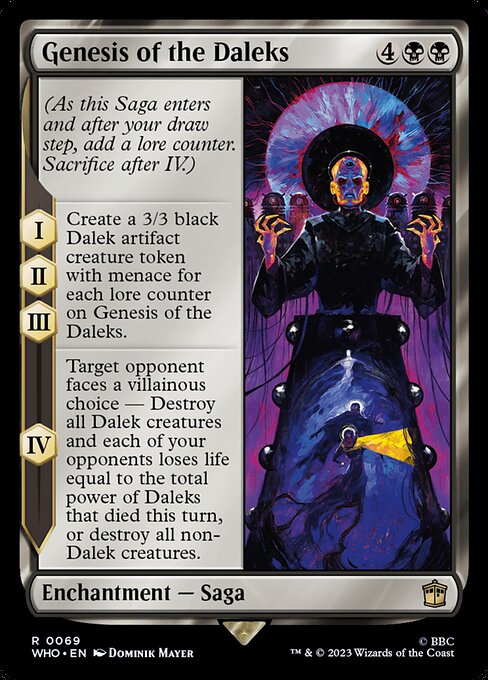
Genesis of the Daleks
Enchantment — Saga
rare
(As this Saga enters and after your draw step, add a lore counter. Sacrifice after IV.) I, II, III — Create a 3/3 black Dalek artifact creature token with menace for each lore counter on Genesis of the Daleks. IV — Target opponent faces a villainous choice — Destroy all Dalek creatures and each of your opponents loses life equal to the total power of Daleks that died this turn, or destroy all non-Dalek creatures.
 Card Kingdom
 Cardmarket
Semantic Tags
A card or token on the battlefield. See rule 110, “Permanents.”
Cares about power of creatures — Fling effects, power-based draw, Xenagos strategies.
Broadly benefits from sacrificing permanents — overlaps aristocrats but includes non-creature sacrifice.
Creates creature tokens, Treasure tokens, Food tokens, Clue tokens, or other token types.
Format Legality
Price history
Loading price history…
Printings (2)
| Set | Rarity | TCGplayer | Card Kingdom | Cardmarket |
|---|---|---|---|---|
| Doctor Who#69 | rare | · | · | · |
| Doctor Who#674 | rare | · | · | · |
Related Rules
If an ability would produce one or more mana of an undefined type, it produces no mana instead.
Some abilities produce mana based on the type of mana another permanent or permanents “could produce.” The type of mana a permanent could produce at any time includes any type of mana that an ability of that permanent would produce if the ability were to resolve at that time, taking into account any applicable replacement effects in any possible order. Ignore whether any costs of the ability could or could not be paid. If that permanent wouldn’t produce any mana under these conditions, or no type of mana can be defined this way, there’s no type of mana it could produce.
To “tap [a permanent] for mana” is to activate a mana ability of that permanent that includes the {T} symbol in its activation cost. See rule 605, “Mana Abilities.”
An ability that triggers whenever a permanent “is tapped for mana” or is tapped for mana of a specified type triggers whenever such a mana ability resolves and produces mana or the specified type of mana.
A replacement effect that applies if a permanent “is tapped for mana” or tapped for mana of a specific type and/or amount modifies the mana production event while such an ability is resolving and producing mana or the specified type and/or amount of mana.
If an object’s enters-the-battlefield triggered ability or replacement effect refers to X, and the spell that became that object as it resolved had a value of X chosen for any of its costs, the value of X for that ability is the same as the value of X for that spell, although the value of X for that permanent is 0. This is an exception to rule 107.3i.
The tap symbol is {T}. The tap symbol in an activation cost means “Tap this permanent.” A permanent that’s already tapped can’t be tapped again to pay the cost. A creature’s activated ability with the tap symbol in its activation cost can’t be activated unless the creature has been under its controller’s control continuously since their most recent turn began. See rule 302.6.
The untap symbol is {Q}. The untap symbol in an activation cost means “Untap this permanent.” A permanent that’s already untapped can’t be untapped again to pay the cost. A creature’s activated ability with the untap symbol in its activation cost can’t be activated unless the creature has been under its controller’s control continuously since their most recent turn began. See rule 302.6.
Rulings
A player facing a villainous choice can always choose either option, even if one or both of the options are impossible. For example, if one of the options is to sacrifice a creature, a player who controls no creatures can still choose that option.
If a spell or ability requires multiple players to face a villainous choice, the result is a little different from other effects in Magic. In that case, the first player in turn order makes their choice and the action for that choice is performed before the next player makes their choice. Then each of the remaining players repeat this process in turn order.
When a player faces a villainous choice, they first choose one of the two options, then all actions in the chosen option are performed.