Search
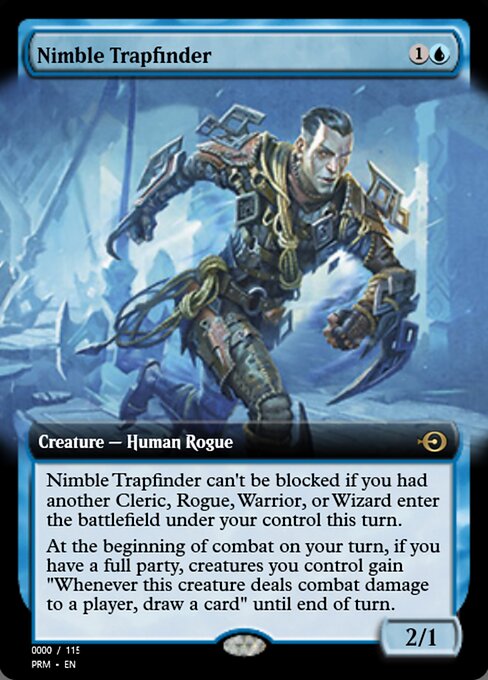
Nimble Trapfinder
Creature — Human Rogue
rare
This creature can't be blocked if you had another Cleric, Rogue, Warrior, or Wizard enter the battlefield under your control this turn. At the beginning of combat on your turn, if you have a full party, creatures you control gain "Whenever this creature deals combat damage to a player, draw a card" until end of turn.
2/1
Semantic Tags
A spell that replaces itself by drawing a card as part of its resolution.
Puts additional cards into your hand. Includes direct draw, 'look/reveal and put into hand' effects, and conditional draw triggers.
Suited for blocking and defense. Includes defender, reach, vigilance, and cards that incentivize blocking.
Difficult to block or grants evasion. Includes flying, menace, fear, intimidate, shadow, skulk, horsemanship, unblockable effects, and cards that grant these abilities.
A card or token on the battlefield. See rule 110, “Permanents.”
Cannot be blocked or has an ability that makes it very hard to block.
Cannot be blocked or has an ability that makes it very hard to block.
Format Legality
Price history
Loading price history…
Printings (5)
| Set | Rarity | TCGplayer | Card Kingdom | Cardmarket |
|---|---|---|---|---|
| Magic Online Promos#83744 | rare | · | · | · |
| Zendikar Rising Promos#72p | rare | · | · | · |
| Zendikar Rising#72 | rare | · | · | · |
| Zendikar Rising#332 | rare | · | · | · |
| Zendikar Rising Promos#72s | rare | · | · | · |
Related Rules
If an ability would produce one or more mana of an undefined type, it produces no mana instead.
Some abilities produce mana based on the type of mana another permanent or permanents “could produce.” The type of mana a permanent could produce at any time includes any type of mana that an ability of that permanent would produce if the ability were to resolve at that time, taking into account any applicable replacement effects in any possible order. Ignore whether any costs of the ability could or could not be paid. If that permanent wouldn’t produce any mana under these conditions, or no type of mana can be defined this way, there’s no type of mana it could produce.
To “tap [a permanent] for mana” is to activate a mana ability of that permanent that includes the {T} symbol in its activation cost. See rule 605, “Mana Abilities.”
An ability that triggers whenever a permanent “is tapped for mana” or is tapped for mana of a specified type triggers whenever such a mana ability resolves and produces mana or the specified type of mana.
A replacement effect that applies if a permanent “is tapped for mana” or tapped for mana of a specific type and/or amount modifies the mana production event while such an ability is resolving and producing mana or the specified type and/or amount of mana.
If an object’s enters-the-battlefield triggered ability or replacement effect refers to X, and the spell that became that object as it resolved had a value of X chosen for any of its costs, the value of X for that ability is the same as the value of X for that spell, although the value of X for that permanent is 0. This is an exception to rule 107.3i.
The tap symbol is {T}. The tap symbol in an activation cost means “Tap this permanent.” A permanent that’s already tapped can’t be tapped again to pay the cost. A creature’s activated ability with the tap symbol in its activation cost can’t be activated unless the creature has been under its controller’s control continuously since their most recent turn began. See rule 302.6.
The untap symbol is {Q}. The untap symbol in an activation cost means “Untap this permanent.” A permanent that’s already untapped can’t be untapped again to pay the cost. A creature’s activated ability with the untap symbol in its activation cost can’t be activated unless the creature has been under its controller’s control continuously since their most recent turn began. See rule 302.6.
Rulings
Nimble Trapfinder’s second ability affects only creatures you control at the time it resolves. Creatures you begin to control later in the turn won’t get the triggered ability.
If a creature has more than one party creature type, and there are multiple ways to count that creature that could result in a different number of creatures in your party, the highest such number is used. For example, if you control a Cleric and a Cleric Wizard, the number of creatures in your party is two. You can’t choose to have it be just one by counting the Cleric Wizard first as a Cleric.
Some cards refer to you having a “full party.” This is true if the number of creatures in your party is four.
To determine “the number of creatures in your party,” check whether you control a Cleric, whether you control a Rogue, whether you control a Warrior, and whether you control a Wizard. The number is the total number of those checks to which you answered yes. Each creature you control can be counted for only one of those checks.
Nimble Trapfinder’s first ability checks only whether a permanent entered the battlefield under your control earlier in the turn and had one of the party creature types as it entered. It doesn’t apply if an entering object gained the type later in the turn. It does apply if the entering object left your control since. It doesn’t matter whether Nimble Trapfinder was under your control as that object entered.
An ability referring to the number of creatures in your party gets a number from zero to four. Such abilities never ask which creatures are in your party, and you never have to designate specific creatures as being in your party. You can’t choose to exclude creatures from this count to lower the number.
After Nimble Trapfinder’s second ability has resolved, creatures you control keep the triggered ability for the turn even if you no longer have a full party later in the turn.