Search
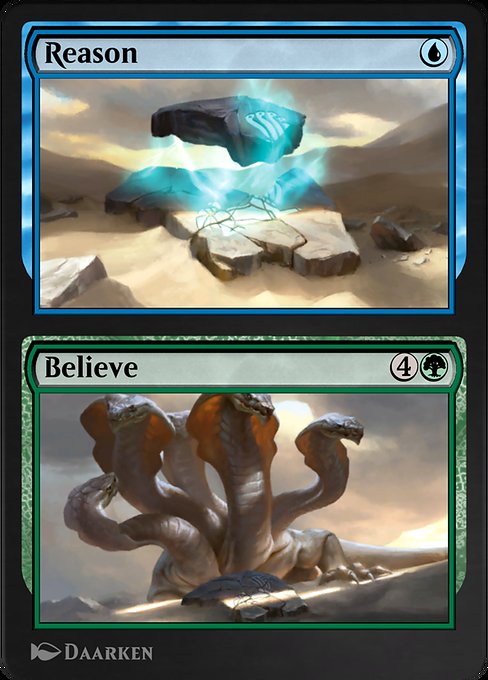
Reason // Believe
Sorcery // Sorcery
rare
Reason
Sorcery
Scry 3.
Believe
Sorcery
Aftermath (Cast this spell only from your graveyard. Then exile it.) Look at the top card of your library. You may put it onto the battlefield if it's a creature card. If you don't, put it into your hand.
Semantic Tags
Cares about or manipulates the top card(s) of your library. Includes scry, surveil, and top-deck payoffs.
Cares about or manipulates the top card(s) of your library. Includes scry, surveil, and top-deck payoffs.
Cares about or manipulates the top of library — Sensei's Top, miracles, Future Sight.
Format Legality
Price history
Loading price history…
Printings (3)
| Set | Rarity | TCGplayer | Card Kingdom | Cardmarket |
|---|---|---|---|---|
| Amonkhet Remastered#253 | rare | · | · | · |
| Hour of Devastation#154 | rare | · | · | · |
| Hour of Devastation Promos#154s | rare | · | · | · |
Related Concepts
Related Rules
A Shard token is a colorless Shard enchantment token with “{2}, Sacrifice this token: Scry 1, then draw a card.”
A Sorcerer Role token is a colorless Aura Role enchantment token named Sorcerer with enchant creature and “Enchanted creature gets +1/+1 and has ‘Whenever this creature attacks, scry 1.’”
Scry
To “scry N” means to look at the top N cards of your library, then put any number of them on the bottom of your library in any order and the rest on top of your library in any order.
If a player is instructed to scry 0, no scry event occurs. Abilities that trigger whenever a player scries won’t trigger.
If multiple players scry at once, each of those players looks at the top cards of their library at the same time. Those players decide in APNAP order (see rule 101.4) where to put those cards, then those cards move at the same time.
Aftermath
Aftermath is an ability found on some split cards (see rule 709, “Split Cards”). It represents three static abilities. “Aftermath” means “You may cast this half of this split card from your graveyard,” “This half of this split card can’t be cast from any zone other than a graveyard,” and “If this spell was cast from a graveyard, exile it instead of putting it anywhere else any time it would leave the stack.”
Rulings
While not on the stack, the characteristics of a split card are the combination of its two halves. For example, Destined // Lead is a green and black card, it is both an instant card and a sorcery card, and its mana value is 6. This means that if an effect allows you to cast a card with mana value 2 from your hand, you can't cast Destined. This is a change from the previous rules for split cards.
All split cards have two card faces on a single card, and you put a split card onto the stack with only the half you're casting. The characteristics of the half of the card you didn't cast are ignored while the spell is on the stack. For example, if an effect prevents you from casting green spells, you can cast Destined of Destined // Lead, but not Lead.
Each split card is a single card. For example, if you discard one, you've discarded one card, not two. If an effect counts the number of instant and sorcery cards in your graveyard, Destined // Lead counts once, not twice.
If another effect allows you to cast a split card with aftermath from any zone other than a graveyard, you can't cast the half with aftermath.
Split cards with aftermath have a new frame treatment—the half you can cast from your hand is oriented the same as other cards you'd cast from your hand, while the half you can cast from your graveyard is a traditional split card half. This frame treatment is for your convenience and has no rules significance.
If you cast the first half of a split card with aftermath during your turn, you'll have priority immediately after it resolves. You can cast the half with aftermath from your graveyard before any player can take any other action if it's legal for you to do so.
If another effect allows you to cast a split card with aftermath from a graveyard, you may cast either half. If you cast the half that has aftermath, you'll exile the card if it would leave the stack.
A spell with aftermath cast from a graveyard will always be exiled afterward, whether it resolves, it's countered, or it leaves the stack in some other way.
Each split card has two names. If an effect instructs you to choose a card name, you may choose one, but not both.
If you don't put the top card of your library onto the battlefield, you don't reveal it before putting it into your hand.
Once you've started to cast a spell with aftermath from your graveyard, the card is immediately moved to the stack. Opponents can't try to stop the ability by exiling the card with an effect such as that of Crook of Condemnation.
For Believe, you put the top card of your library into your hand if you don't put it onto the battlefield for any reason, whether it's not a creature card or whether you just didn't want to put it onto the battlefield.