Search
Send to Sleep
Instant
common
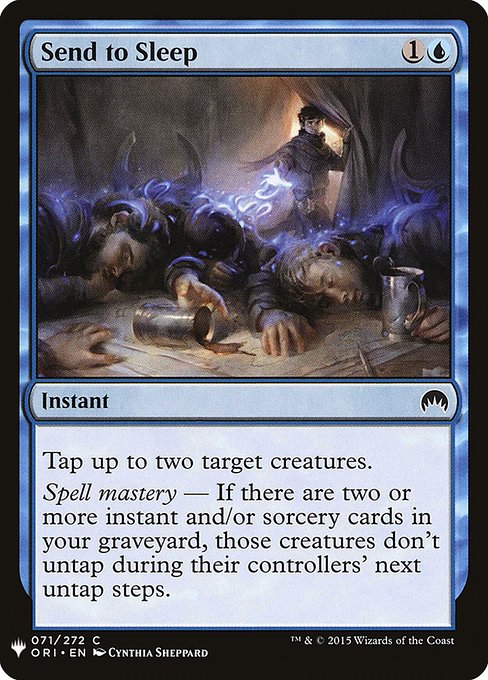
Tap up to two target creatures. Spell mastery — If there are two or more instant and/or sorcery cards in your graveyard, those creatures don't untap during their controllers' next untap steps.
 Card Kingdom
 Cardmarket
Semantic Tags
A keyword ability that lets you tap creatures rather than pay mana to cast a spell. See rule 702.51, “Convoke.”
Cares about cards in the graveyard, puts cards into the graveyard, or benefits from things dying.
A keyword ability that allows a spell to affect either a single target or many objects. See rule 702.96, “Overload.”
Rewards casting instants and sorceries. Includes magecraft, prowess triggers, and spell-count payoffs.
Format Legality
Price history
Loading price history…
Printings (2)
| Set | Rarity | TCGplayer | Card Kingdom | Cardmarket |
|---|---|---|---|---|
| The List#ORI-71 | common | · | · | · |
| Magic Origins#71 | common | · | · | · |
Related Rules
Convoke
Convoke is a static ability that functions while the spell with convoke is on the stack. “Convoke” means “For each colored mana in this spell’s total cost, you may tap an untapped creature of that color you control rather than pay that mana. For each generic mana in this spell’s total cost, you may tap an untapped creature you control rather than pay that mana.”
The convoke ability isn’t an additional or alternative cost and applies only after the total cost of the spell with convoke is determined.
Multiple instances of convoke on the same spell are redundant.
Overload
Overload is a keyword that represents two static abilities that function while the spell with overload is on the stack. Overload [cost] means “You may choose to pay [cost] rather than pay this spell’s mana cost” and “If you chose to pay this spell’s overload cost, change its text by replacing all instances of the word ‘target’ with the word ‘each.’” Casting a spell using its overload ability follows the rules for paying alternative costs in rules 601.2b and 601.2f–h.
If a player chooses to pay the overload cost of a spell, that spell won’t require any targets. It may affect objects that couldn’t be chosen as legal targets if the spell were cast without its overload cost being paid.
Overload’s second ability creates a text-changing effect. See rule 612, “Text-Changing Effects.”
Rulings
Check to see if there are two or more instant and/or sorcery cards in your graveyard as the spell resolves to determine whether the spell mastery ability applies. The spell itself won’t count because it’s still on the stack as you make this check.
If you chose two targets and one is an illegal target when Send to Sleep resolves, that creature won’t become tapped and it won’t be stopped from untapping during its controller’s next untap step (if the spell mastery ability applies). It won’t be affected by Send to Sleep in any way.
If the spell mastery ability applies and a creature affected by Send to Sleep changes controllers before its old controller’s next untap step, Send to Sleep will prevent it from becoming untapped during its new controller’s next untap step.
Send to Sleep can target tapped creatures. If a targeted creature is already tapped when the spell resolves (and the spell mastery ability applies), that creature remains tapped and doesn’t untap during its controller’s next untap step.