Search
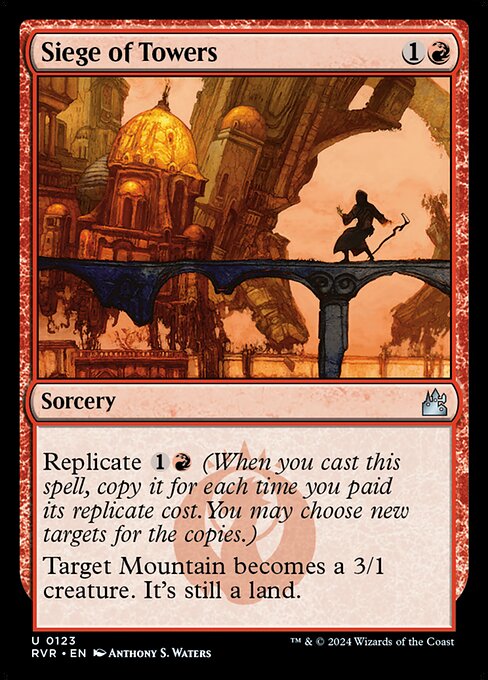
Siege of Towers
Sorcery
uncommon
Replicate (When you cast this spell, copy it for each time you paid its replicate cost. You may choose new targets for the copies.) Target Mountain becomes a 3/1 creature. It's still a land.
 Card Kingdom
 Cardmarket
Format Legality
Price history
Loading price history…
Printings (3)
| Set | Rarity | TCGplayer | Card Kingdom | Cardmarket |
|---|---|---|---|---|
| Ravnica Remastered#123 | uncommon | · | · | · |
| The List#GPT-76 | rare | · | · | · |
| Guildpact#76 | rare | · | · | · |
Related Concepts
Related Rules
Replicate
Replicate is a keyword that represents two abilities. The first is a static ability that functions while the spell with replicate is on the stack. The second is a triggered ability that functions while the spell with replicate is on the stack. “Replicate [cost]” means “As an additional cost to cast this spell, you may pay [cost] any number of times” and “When you cast this spell, if a replicate cost was paid for it, copy it for each time its replicate cost was paid. If the spell has any targets, you may choose new targets for any of the copies.” Paying a spell’s replicate cost follows the rules for paying additional costs in rules 601.2b and 601.2f–h.
If a spell has multiple instances of replicate, each is paid separately and triggers based on the payments made for it, not any other instance of replicate.
Rulings
The Mountain will remain a creature for the rest of the game. It doesn't have a creature type.
A noncreature permanent that turns into a creature can attack, and its {T} abilities can be activated, only if its controller has continuously controlled that permanent since the beginning of their most recent turn. It doesn't matter how long the permanent has been a creature.
As the replicate triggered ability resolves, you'll copy Shattering Spree for each time you paid its replicate cost, even if the original spell is no longer on the stack at that time (perhaps because it was countered).
The copies that replicate creates are created on the stack, so they're not "cast." Abilities that trigger when a player casts a spell won't trigger.