Search
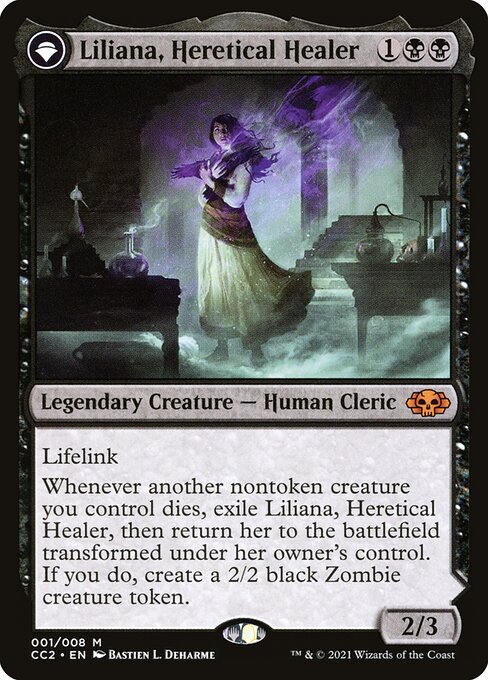
Liliana, Heretical Healer
Legendary Creature — Human Cleric
mythic
Lifelink Whenever another nontoken creature you control dies, exile Liliana, Heretical Healer, then return her to the battlefield transformed under her owner's control. If you do, create a 2/2 black Zombie creature token.
2/3
Semantic Tags
Gains you life. Relevant for lifegain-matters strategies and general survivability.
A keyword ability that causes a player to gain life. See rule 702.15, “Lifelink.”
A card or token on the battlefield. See rule 110, “Permanents.”
Planeswalker-heavy strategy — proliferate, Doubling Season, planeswalker synergies.
Format Legality
Price history
Loading price history…
Printings (7)
| Set | Rarity | TCGplayer | Card Kingdom | Cardmarket |
|---|---|---|---|---|
| Pioneer Masters#96 | mythic | · | · | · |
| The List#ORI-106 | mythic | · | · | · |
| Commander Collection: Black#1 | mythic | · | · | · |
| From the Vault: Transform#14 | mythic | · | · | · |
| Magic Origins#106 | mythic | · | · | · |
| Magic Origins Promos#106s | mythic | · | · | · |
| San Diego Comic-Con 2015#106 | mythic | · | · | · |
Related Concepts
Related Rules
If an ability would produce one or more mana of an undefined type, it produces no mana instead.
Some abilities produce mana based on the type of mana another permanent or permanents “could produce.” The type of mana a permanent could produce at any time includes any type of mana that an ability of that permanent would produce if the ability were to resolve at that time, taking into account any applicable replacement effects in any possible order. Ignore whether any costs of the ability could or could not be paid. If that permanent wouldn’t produce any mana under these conditions, or no type of mana can be defined this way, there’s no type of mana it could produce.
To “tap [a permanent] for mana” is to activate a mana ability of that permanent that includes the {T} symbol in its activation cost. See rule 605, “Mana Abilities.”
An ability that triggers whenever a permanent “is tapped for mana” or is tapped for mana of a specified type triggers whenever such a mana ability resolves and produces mana or the specified type of mana.
A replacement effect that applies if a permanent “is tapped for mana” or tapped for mana of a specific type and/or amount modifies the mana production event while such an ability is resolving and producing mana or the specified type and/or amount of mana.
If an object’s enters-the-battlefield triggered ability or replacement effect refers to X, and the spell that became that object as it resolved had a value of X chosen for any of its costs, the value of X for that ability is the same as the value of X for that spell, although the value of X for that permanent is 0. This is an exception to rule 107.3i.
The tap symbol is {T}. The tap symbol in an activation cost means “Tap this permanent.” A permanent that’s already tapped can’t be tapped again to pay the cost. A creature’s activated ability with the tap symbol in its activation cost can’t be activated unless the creature has been under its controller’s control continuously since their most recent turn began. See rule 302.6.
The untap symbol is {Q}. The untap symbol in an activation cost means “Untap this permanent.” A permanent that’s already untapped can’t be untapped again to pay the cost. A creature’s activated ability with the untap symbol in its activation cost can’t be activated unless the creature has been under its controller’s control continuously since their most recent turn began. See rule 302.6.
Rulings
A Magic Origins planeswalker that enters the battlefield because of the ability of its front face will enter with loyalty counters as normal.
In some rare cases, a spell or ability may cause one of these five cards to transform while it’s a creature (front face up) on the battlefield. If this happens, the resulting planeswalker won’t have any loyalty counters on it and will subsequently be put into its owner’s graveyard.
If a double-faced card is manifested, it will be put onto the battlefield face down (this is also true if it’s put onto the battlefield face down some other way). Note that “face down” is not synonymous with “with its back face up.” A manifested double-faced card is a 2/2 creature with no name, mana cost, creature types, or abilities. While face down, it can’t transform. If the front face of a manifested double-faced card is a creature card, you can turn it face up by paying its mana cost. If you do, its front face will be up. A double-faced card on the battlefield can’t be turned face down.
A double-faced card enters the battlefield with its front face up by default, unless a spell or ability instructs you to put it onto the battlefield transformed, in which case it enters with its back face up.
The converted mana cost of a double-faced card not on the battlefield is the converted mana cost of its front face.
You can activate one of the planeswalker’s loyalty abilities the turn it enters the battlefield. However, you may do so only during one of your main phases when the stack is empty. For example, if the planeswalker enters the battlefield during combat, there will be an opportunity for your opponent to remove it before you can activate one of its abilities.
The back face of a double-faced card (in the case of Magic Origins, the planeswalker face) can’t be cast.
When Liliana, Defiant Necromancer’s first ability resolves, first you choose a card to discard, then each other player in turn order chooses a card to discard, then all those cards are discarded simultaneously. No one sees what the other players are discarding before deciding which card to discard.
Each face of a double-faced card has its own set of characteristics: name, types, subtypes, power and toughness, loyalty, abilities, and so on. While a double-faced card is on the battlefield, consider only the characteristics of the face that’s currently up. The other set of characteristics is ignored. While a double-faced card isn’t on the battlefield, consider only the characteristics of its front face.
If multiple nontoken creatures you control die, then Liliana, Heretical Healer’s ability will trigger that many times. However, since Liliana can be exiled and returned to the battlefield only once, only the first ability to resolve will create a Zombie token. The other abilities will resolve but won’t do anything.
The back face of a double-faced card doesn’t have a mana cost. A double-faced permanent with its back face up has a converted mana cost equal to the converted mana cost of its front face. Each back face has a color indicator that defines its color.
For more information on double-faced cards, see the Shadows over Innistrad mechanics article (http://magic.wizards.com/en/articles/archive/feature/shadows-over-innistrad-mechanics).
You can control two of this permanent, one front-face up and the other back-face up, at the same time.