Search
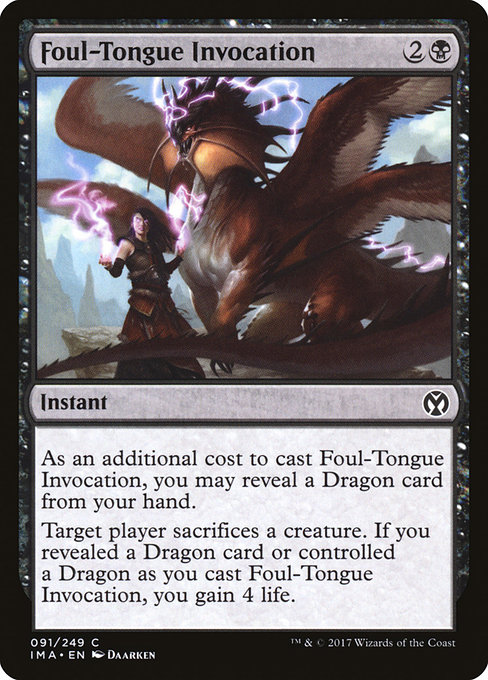
Foul-Tongue Invocation
Instant
common
As an additional cost to cast this spell, you may reveal a Dragon card from your hand. Target player sacrifices a creature of their choice. If you revealed a Dragon card or controlled a Dragon as you cast this spell, you gain 4 life.
 Card Kingdom
 Cardmarket
Semantic Tags
Format Legality
Price history
Loading price history…
Printings (2)
| Set | Rarity | TCGplayer | Card Kingdom | Cardmarket |
|---|---|---|---|---|
| Iconic Masters#91 | common | · | · | · |
| Dragons of Tarkir#102 | uncommon | · | · | · |
Related Rules
Subtypes of each card type except creature and plane are always single words and are listed after a long dash. Each word after the dash is a separate subtype. Subtypes of creature cards are one or two words and are listed after a long dash. Each word or two-word phrase, as listed in rule 205.3m, is a separate subtype. Objects other than planes may have multiple subtypes. Subtypes of planes are also listed after a long dash, but may be multiple words; all words after the dash are, collectively, a single subtype.
Artifact subtypes are always a single word and are listed after a long dash: “Artifact — Equipment.” Artifact subtypes are also called artifact types. Artifacts may have multiple subtypes. See rule 205.3g for the complete list of artifact types.
Creature subtypes are usually a single word long and are listed after a long dash: “Creature — Human Soldier,” “Artifact Creature — Golem,” and so on. Creature subtypes are also called creature types. Creatures may have multiple subtypes. See rule 205.3m for the complete list of creature types.
Enchantment subtypes are always a single word and are listed after a long dash: “Enchantment — Shrine.” Each word after the dash is a separate subtype. Enchantment subtypes are also called enchantment types. Enchantments may have multiple subtypes. See rule 205.3h for the complete list of enchantment types.
Instant subtypes are always a single word and are listed after a long dash: “Instant — Arcane.” Each word after the dash is a separate subtype. The set of instant subtypes is the same as the set of sorcery subtypes; these subtypes are called spell types. Instants may have multiple subtypes. See rule 205.3k for the complete list of spell types.
Land subtypes are always a single word and are listed after a long dash. Land subtypes are also called land types. Lands may have multiple subtypes. See rule 205.3i for the complete list of land types.
Planeswalker subtypes are always a single word and are listed after a long dash: “Planeswalker — Jace.” Each word after the dash is a separate subtype. Planeswalker subtypes are also called planeswalker types. Planeswalkers may have multiple subtypes. See rule 205.3j for the complete list of planeswalker types.
Sorcery subtypes are always a single word and are listed after a long dash: “Sorcery — Arcane.” Each word after the dash is a separate subtype. The set of sorcery subtypes is the same as the set of instant subtypes; these subtypes are called spell types. Sorceries may have multiple subtypes. See rule 205.3k for the complete list of spell types.
Rulings
You can’t reveal more than one Dragon card to multiply the bonus. There is also no additional benefit for both revealing a Dragon card as an additional cost and controlling a Dragon as you cast the spell.
If one of these spells is copied, the controller of the copy will get the “Dragon bonus” only if a Dragon card was revealed as an additional cost. The copy wasn’t cast, so whether you controlled a Dragon won’t matter.
You may cast Foul-Tongue Invocation targeting a player who controls no creatures. If you qualify for the “Dragon bonus,” you’ll just gain 4 life.
If you don’t reveal a Dragon card from your hand, you must control a Dragon as you are finished casting the spell to get the bonus. For example, if you lose control of your only Dragon while casting the spell (because, for example, you sacrificed it to activate a mana ability), you won’t get the bonus.