Search
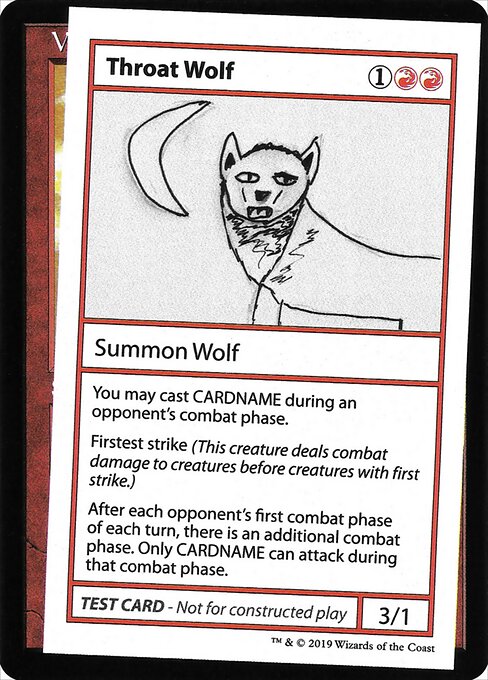
Throat Wolf
Summon Wolf
rare
You may cast Throat Wolf during an opponent's combat phase. Firstest strike (This creature deals combat damage to creatures before creatures with first strike.) After each opponent's first combat phase of each turn, there is an additional combat phase. Only Throat Wolf can attack during that combat phase.
3/1
 Card Kingdom
 Cardmarket
Semantic Tags
Takes extra combat phases for additional attacks and triggers.
A keyword ability that lets a creature deal its combat damage before other creatures. See rule 702.7, “First Strike.”
Has first strike or double strike — trades favorably in combat.
Format Legality
Price history
Loading price history…
Printings (2)
| Set | Rarity | TCGplayer | Card Kingdom | Cardmarket |
|---|---|---|---|---|
| Mystery Booster Playtest Cards 2021#65 | rare | · | · | · |
| Mystery Booster Playtest Cards 2019#65 | rare | · | · | · |
Related Rules
A keyword counter on a permanent or on a card in a zone other than the battlefield causes that object to gain that keyword. The keywords that a keyword counter can be are flying, first strike, double strike, deathtouch, decayed, exalted, haste, hexproof, indestructible, lifelink, menace, reach, shadow, trample, and vigilance, as well as any variants of those keywords. See rule 613.1f.
The combat phase has five steps, which proceed in order: beginning of combat, declare attackers, declare blockers, combat damage, and end of combat. The declare blockers and combat damage steps are skipped if no creatures are declared as attackers or put onto the battlefield attacking (see rule 508.8). There are two combat damage steps if any attacking or blocking creature has first strike (see rule 702.7) or double strike (see rule 702.4).
If at least one attacking or blocking creature has first strike (see rule 702.7) or double strike (see rule 702.4) as the combat damage step begins, the only creatures that assign combat damage in that step are those with first strike or double strike. After that step, instead of proceeding to the end of combat step, the phase gets a second combat damage step. The only creatures that assign combat damage in that step are the remaining attackers and blockers that had neither first strike nor double strike as the first combat damage step began, as well as the remaining attackers and blockers that currently have double strike. After that step, the phase proceeds to the end of combat step.
An effect may state that “the same is true for” a list of keyword abilities or similar. If one of those keyword abilities has variants or variables and the effect grants that keyword or counters of that keyword to one or more objects and/or players, it grants each appropriate variant and variable of that keyword.
If at least one attacking or blocking creature has first strike (see rule 702.7) or double strike as the combat damage step begins, the only creatures that assign combat damage in that step are those with first strike or double strike. After that step, instead of proceeding to the end of combat step, the phase gets a second combat damage step. The only creatures that assign combat damage in that step are the remaining attackers and blockers that had neither first strike nor double strike as the first combat damage step began, as well as the remaining attackers and blockers that currently have double strike. After that step, the phase proceeds to the end of combat step.
Giving double strike to a creature with first strike after it has already dealt combat damage in the first combat damage step will allow the creature to assign combat damage in the second combat damage step.
First strike is a static ability that modifies the rules for the combat damage step. (See rule 510, “Combat Damage Step.”)
If at least one attacking or blocking creature has first strike or double strike (see rule 702.4) as the combat damage step begins, the only creatures that assign combat damage in that step are those with first strike or double strike. After that step, instead of proceeding to the end of combat step, the phase gets a second combat damage step. The only creatures that assign combat damage in that step are the remaining attackers and blockers that had neither first strike nor double strike as the first combat damage step began, as well as the remaining attackers and blockers that currently have double strike. After that step, the phase proceeds to the end of combat step.
Rulings
If two players each control Throat Wolf, player A’s first combat phase will be followed by player B’s first combat phase from B’s Throat Wolf, which will be followed by player A’s second combat from A’s Throat Wolf. On player C’s turn (where C is the active player and player A is the next player in turn order) player C’s combat phase is followed by player A’s combat phase, then player B’s combat phase following player A’s, then player A’s following player B’s, then player B’s that follows player C’s finally happens.
As the declare blockers step ends, if any creatures have firstest strike, there’s an additional combat step where only those creatures deal damage. The game waits until after this step to determine whether there will be a first-strike combat damage step.
“Summon” isn’t a card type. Throat Wolf is a creature.
If a creature with firstest strike enters the battlefield during the firstest-strike combat damage step or the first-strike combat damage step, it deals regular combat damage instead.
Throat Wolf’s last ability reads like it’s pointless. Only Throat Wolf can attack, but it can’t attack, so nothing can attack. Rather than assume the text is pointless, this ability should be played as though it read “After each opponent’s first combat phase on each turn, you have a combat phase. Only Throat Wolf can attack during that combat phase.”
If a creature with firstest strike gains first strike, it deals damage during the first strike and firstest strike combat damage steps. If it gains double strike, it deals damage during all three combat damage steps.
While it’s your combat phase during your opponent’s turn, you’re the active player and the attacking player. However, any rules or effects that check whose turn it is will still know that it’s your opponent’s turn.