Search
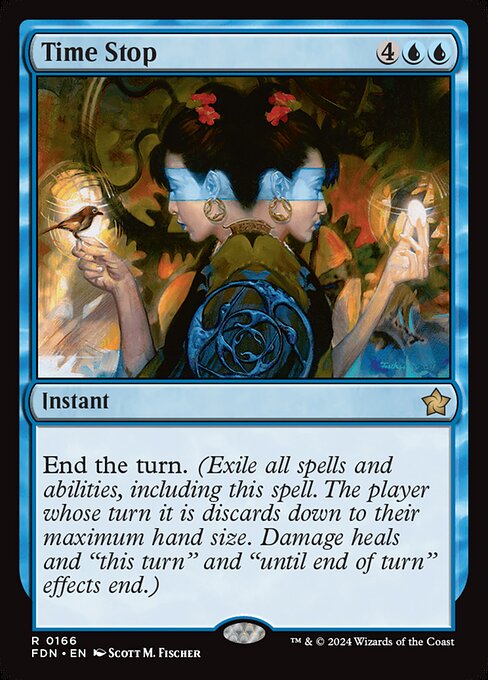
Time Stop
Instant
rare
End the turn. (Exile all spells and abilities, including this spell. The player whose turn it is discards down to their maximum hand size. Damage heals and "this turn" and "until end of turn" effects end.)
 Card Kingdom
 Cardmarket
Semantic Tags
A keyword ability that allows a player to cast a double-faced card transformed from the graveyard. See rule 702.146, “Disturb.”
Forces opponents to discard cards from their hand. Targeted discard, mass discard, and discard-or-pay effects.
Forces opponents to discard cards from their hand. Targeted discard, mass discard, and discard-or-pay effects.
A keyword ability that lets a player cast a card they discard. See rule 702.35, “Madness.”
Makes all players discard their hand and draw a new one. Named after Wheel of Fortune.
Format Legality
Price history
Loading price history…
Printings (7)
| Set | Rarity | TCGplayer | Card Kingdom | Cardmarket |
|---|---|---|---|---|
| Foundations#166 | rare | · | · | · |
| Foundations Promos#166s | rare | · | · | · |
| Secret Lair Drop#1500 | rare | · | · | · |
| Secret Lair Drop#1500★ | rare | · | · | · |
| Tenth Edition#117★ | rare | · | · | · |
| Tenth Edition#117 | rare | · | · | · |
| Champions of Kamigawa#97 | rare | · | · | · |
Related Rules
After resolving a madness triggered ability (see rule 702.35), if the exiled card wasn’t cast and was moved to a public zone, effects referencing the discarded card can find that object.
Madness
Madness is a keyword that represents two abilities. The first is a static ability that functions while the card with madness is in a player’s hand. The second is a triggered ability that functions when the first ability is applied. “Madness [cost]” means “If a player would discard this card, that player discards it, but exiles it instead of putting it into their graveyard” and “When this card is exiled this way, its owner may cast it by paying [cost] rather than paying its mana cost. If that player doesn’t, they put this card into their graveyard.”
Casting a spell using its madness ability follows the rules for paying alternative costs in rules 601.2b and 601.2f–h.
After resolving a madness triggered ability, if the exiled card wasn’t cast and was moved to a public zone, effects referencing the discarded card can find that card. See rule 400.7k.
Disturb
Disturb is an ability found on the front face of some double-faced cards (see rule 712, “Double-Faced Cards”). “Disturb [cost]” means “You may cast this card transformed from your graveyard by paying [cost] rather than its mana cost.” See rule 712.8c.
A resolving double-faced spell that was cast using its disturb ability enters the battlefield with its back face up.
Rulings
Exiling a spell or ability prevents that spell or ability from resolving, but it doesn't technically "counter" anything. This means that Time Stop can exile spells and abilities that "can't be countered."
Unless Time Stop is cast during the Ending phase, any "at the beginning of the end step"-triggered abilities don't get the chance to trigger on the turn Time Stop is cast. These abilities will trigger at the beginning of the next end step.
If any triggered abilities do trigger during this process, they're put onto the stack during the cleanup step. If this happens, players will have a chance to cast spells and activate abilities, then there will be another cleanup step before the turn finally ends.
Ending the turn this way means the following things happen in order: 1) All spells and abilities on the stack are exiled. This includes Time Stop, though it will continue to resolve. It also includes spells and abilities that can't be countered. 2) All attacking and blocking creatures are removed from combat. 3) State-based actions are checked. No player gets priority, and no triggered abilities are put onto the stack. 4) The current phase and/or step ends. The game skips straight to the cleanup step. The cleanup step happens in its entirety.