Search
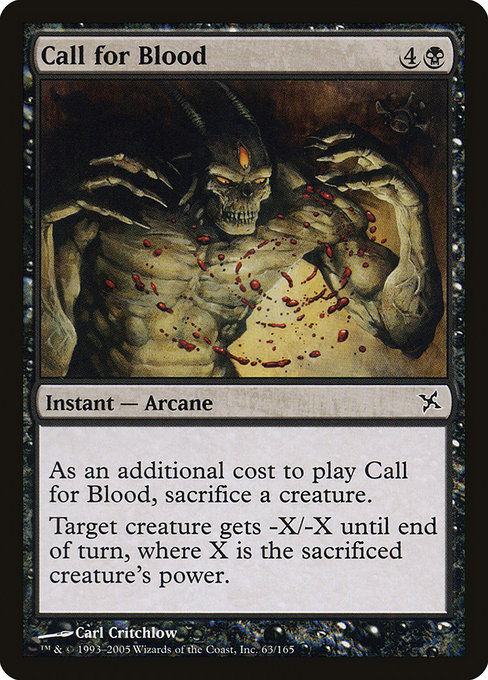
Call for Blood
Instant — Arcane
common
As an additional cost to cast this spell, sacrifice a creature. Target creature gets -X/-X until end of turn, where X is the sacrificed creature's power.
 Card Kingdom
 Cardmarket
Semantic Tags
A keyword ability that may let a player cast a random extra spell for no cost. See rule 702.85, “Cascade.”
Specifically removes creatures — destroy, exile, damage, or -X/-X.
A keyword ability found on creature cards that allows them to be cast for an alternative cost. See rule 702.109, “Dash.”
A keyword ability that lets a player cast a spell for less by sacrificing a creature. See rule 702.119, “Emerge.”
Answers an opponent's threat by destroying, exiling, bouncing, or otherwise removing a permanent or spell.
Broadly benefits from sacrificing permanents — overlaps aristocrats but includes non-creature sacrifice.
Lets you sacrifice your own creatures or permanents for value. Key enabler for aristocrats strategies.
Format Legality
Price history
Loading price history…
Printings (1)
| Set | Rarity | TCGplayer | Card Kingdom | Cardmarket |
|---|---|---|---|---|
| Betrayers of Kamigawa#63 | common | · | · | · |
Related Rules
Cascade
Subtypes of each card type except creature and plane are always single words and are listed after a long dash. Each word after the dash is a separate subtype. Subtypes of creature cards are one or two words and are listed after a long dash. Each word or two-word phrase, as listed in rule 205.3m, is a separate subtype. Objects other than planes may have multiple subtypes. Subtypes of planes are also listed after a long dash, but may be multiple words; all words after the dash are, collectively, a single subtype.
Artifact subtypes are always a single word and are listed after a long dash: “Artifact — Equipment.” Artifact subtypes are also called artifact types. Artifacts may have multiple subtypes. See rule 205.3g for the complete list of artifact types.
Creature subtypes are usually a single word long and are listed after a long dash: “Creature — Human Soldier,” “Artifact Creature — Golem,” and so on. Creature subtypes are also called creature types. Creatures may have multiple subtypes. See rule 205.3m for the complete list of creature types.
Enchantment subtypes are always a single word and are listed after a long dash: “Enchantment — Shrine.” Each word after the dash is a separate subtype. Enchantment subtypes are also called enchantment types. Enchantments may have multiple subtypes. See rule 205.3h for the complete list of enchantment types.
Instant subtypes are always a single word and are listed after a long dash: “Instant — Arcane.” Each word after the dash is a separate subtype. The set of instant subtypes is the same as the set of sorcery subtypes; these subtypes are called spell types. Instants may have multiple subtypes. See rule 205.3k for the complete list of spell types.
Land subtypes are always a single word and are listed after a long dash. Land subtypes are also called land types. Lands may have multiple subtypes. See rule 205.3i for the complete list of land types.
Planeswalker subtypes are always a single word and are listed after a long dash: “Planeswalker — Jace.” Each word after the dash is a separate subtype. Planeswalker subtypes are also called planeswalker types. Planeswalkers may have multiple subtypes. See rule 205.3j for the complete list of planeswalker types.
Rulings
You may sacrifice the creature chosen as the target for Call for Blood (if you control it) when you pay the additional cost for the spell. If you do, Call for Blood doesn’t resolve.
Uses last known information for the sacrificed creature’s power.
You must sacrifice exactly one creature to cast this spell; you cannot cast it without sacrificing a creature, and you cannot sacrifice additional creatures.
Players can only respond once this spell has been cast and all its costs have been paid. No one can try to destroy the creature you sacrificed to prevent you from casting this spell.