Search
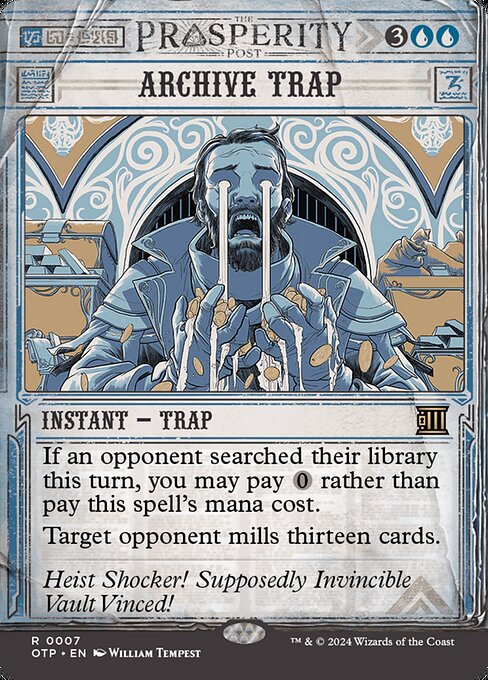
Archive Trap
Instant — Trap
rare
If an opponent searched their library this turn, you may pay rather than pay this spell's mana cost. Target opponent mills thirteen cards.
 Card Kingdom
 Cardmarket
Semantic Tags
To mill a number of cards, a player puts that many cards from the top of their library into their graveyard. See rule 701.17.
To mill a number of cards, a player puts that many cards from the top of their library into their graveyard. See rule 701.17.
An effect that puts cards from your own library into your graveyard for value.
An effect that puts cards from your own library into your graveyard for value.
Format Legality
Price history
Loading price history…
Printings (3)
| Set | Rarity | TCGplayer | Card Kingdom | Cardmarket |
|---|---|---|---|---|
| Breaking News#7 | rare | · | · | · |
| The List#ZEN-41 | rare | · | · | · |
| Zendikar#41 | rare | · | · | · |
Related Concepts
Related Rules
While applying a replacement effect that modifies how a permanent enters the battlefield, another replacement effect may cause a player to mill cards or exile cards from the top of a library. In that case, any card that is entering the battlefield from that library won’t be included in that effect, even though those cards are in the library as the effect is applied.
Mill
For a player to mill a number of cards, that player puts that many cards from the top of their library into their graveyard.
A player can’t mill a number of cards greater than the number of cards in their library. If given the choice to do so, they can’t choose to take that action. If instructed to do so, they mill as many as possible. Similarly, the player can’t pay a cost that includes milling a number of cards greater than the number of cards in their library.
Dredge is a static ability that functions only while the card with dredge is in a player’s graveyard. “Dredge N” means “As long as you have at least N cards in your library, if you would draw a card, you may instead mill N cards and return this card from your graveyard to your hand.”
A player with fewer cards in their library than the number required by a dredge ability can’t mill any of them this way.
If a trigger event includes an object moving out of or into a player’s range of influence, use the game state before or after the event as appropriate to determine whether the triggered ability will trigger. See rules 603.6 and 603.10.
Rulings
A spell or ability causes a player to search their library only if it specifically contains the word “search” in its text. For example, if a spell or ability lets a player look at the top four cards of their library and do something with one of those cards, that’s not a search.
Archive Trap checks only whether an opponent searched their library. It doesn’t matter whether that player found a card during the search.
You may ignore a Trap’s alternative cost condition and simply cast it for its normal mana cost. This is true even if its alternative cost condition has been met.
Casting a Trap by paying its alternative cost doesn’t change its mana cost or mana value. The only difference is the cost you actually pay.
Effects that increase or reduce the cost to cast a Trap will apply to whichever cost you chose to pay.
If the targeted opponent has fewer than thirteen cards in their library, that player puts their entire library into their graveyard.
If a search effect is affected by Aven Mindcensor’s ability (which causes a player to search the top four cards of their library instead), that still counts as searching that library.
The opponent you target doesn’t have to be the opponent who searched their library.