Search
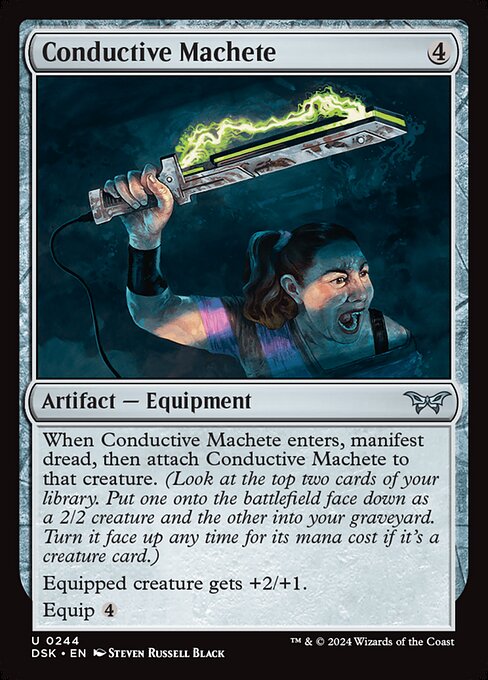
Conductive Machete
Artifact — Equipment
uncommon
When this Equipment enters, manifest dread, then attach this Equipment to that creature. (Look at the top two cards of your library. Put one onto the battlefield face down as a 2/2 creature and the other into your graveyard. Turn it face up any time for its mana cost if it's a creature card.) Equipped creature gets +2/+1. Equip
 Card Kingdom
 Cardmarket
Semantic Tags
A keyword ability that lets a player attach an Equipment to a creature they control. See rule 301, “Artifacts,” and rule 702.6, “Equip.”
Equipment-focused strategy — attaching, equip cost reduction, equipment ETBs.
Cares about cards in the graveyard, puts cards into the graveyard, or benefits from things dying.
A card or token on the battlefield. See rule 110, “Permanents.”
Cares about or manipulates the top card(s) of your library. Includes scry, surveil, and top-deck payoffs.
Cares about or manipulates the top of library — Sensei's Top, miracles, Future Sight.
Powers up a single creature with equipment or auras. Includes equipment, aura payoffs, and suited-up creature effects.
Format Legality
Price history
Loading price history…
Printings (1)
| Set | Rarity | TCGplayer | Card Kingdom | Cardmarket |
|---|---|---|---|---|
| Duskmourn: House of Horror#244 | uncommon | · | · | · |
Related Concepts
Related Rules
If an ability would produce one or more mana of an undefined type, it produces no mana instead.
Some abilities produce mana based on the type of mana another permanent or permanents “could produce.” The type of mana a permanent could produce at any time includes any type of mana that an ability of that permanent would produce if the ability were to resolve at that time, taking into account any applicable replacement effects in any possible order. Ignore whether any costs of the ability could or could not be paid. If that permanent wouldn’t produce any mana under these conditions, or no type of mana can be defined this way, there’s no type of mana it could produce.
To “tap [a permanent] for mana” is to activate a mana ability of that permanent that includes the {T} symbol in its activation cost. See rule 605, “Mana Abilities.”
An ability that triggers whenever a permanent “is tapped for mana” or is tapped for mana of a specified type triggers whenever such a mana ability resolves and produces mana or the specified type of mana.
A replacement effect that applies if a permanent “is tapped for mana” or tapped for mana of a specific type and/or amount modifies the mana production event while such an ability is resolving and producing mana or the specified type and/or amount of mana.
If an object’s enters-the-battlefield triggered ability or replacement effect refers to X, and the spell that became that object as it resolved had a value of X chosen for any of its costs, the value of X for that ability is the same as the value of X for that spell, although the value of X for that permanent is 0. This is an exception to rule 107.3i.
The tap symbol is {T}. The tap symbol in an activation cost means “Tap this permanent.” A permanent that’s already tapped can’t be tapped again to pay the cost. A creature’s activated ability with the tap symbol in its activation cost can’t be activated unless the creature has been under its controller’s control continuously since their most recent turn began. See rule 302.6.
The untap symbol is {Q}. The untap symbol in an activation cost means “Untap this permanent.” A permanent that’s already untapped can’t be untapped again to pay the cost. A creature’s activated ability with the untap symbol in its activation cost can’t be activated unless the creature has been under its controller’s control continuously since their most recent turn began. See rule 302.6.
Rulings
Some cards in the Duskmourn release have abilities that trigger "whenever you manifest dread." In circumstances where you are instructed to manifest dread but can't perform some or all of the steps of manifesting dread (probably because your library has one or fewer cards in it), these abilities will still trigger.
If something tries to turn a face-down instant or sorcery card on the battlefield face up, reveal that card to show all players it's an instant or sorcery card. The permanent remains on the battlefield face down. Abilities that trigger when a permanent turns face up won't trigger, because even though you revealed the card, it never turned face up.
You must ensure that your face-down spells and permanents can be easily differentiated from each other. You're not allowed to mix up the cards that represent them on the battlefield to confuse other players. The order in which they entered should remain clear, as well as what ability caused them to be face down. (This includes manifest, disguise, cloak, morph, and a few older effects that turn cards face down.) Common methods for doing this include using markers or dice, or simply placing them in order on the battlefield.
Because face-down creatures don't have a name, they can't have the same name as any other creature, even another face-down creature.
You'll still manifest dread even if this Equipment isn't on the battlefield when its first ability resolves.
If a double-faced card is manifested, it will be put onto the battlefield face down. While face down, it can't transform. If the front face of the card is a creature card, you can turn it face up by paying its mana cost. If you do, its front face will be up.
A permanent that turns face up or face down changes characteristics but is otherwise the same permanent. Spells and abilities that were targeting that permanent and Auras and Equipment that were attached to that permanent aren't affected unless the new characteristics of the object change the legality of those targets or attachments.
Turning a permanent face up or face down doesn't change whether that permanent is tapped or untapped.
Unlike a face-down creature that was cast using a disguise or morph ability, a manifested creature may still be turned face up after it loses its abilities if it's a creature card.
At any time, you can look at a face-down spell or permanent you control. You can't look at face-down permanents or spells you don't control unless an effect instructs or allows you to do so.
To manifest dread, look at the top two cards of your library. Manifest one (by putting it onto the battlefield face down) and put the other into your graveyard. The card you put onto the battlefield becomes a 2/2 face-down creature with no name, mana cost, creature types, or abilities. It's colorless and has a mana value of 0. Other effects that apply to the permanent can still grant it any characteristics it doesn't have or change the characteristics it does have.
Any time you have priority, you can turn a manifested permanent you control face up by revealing that it's a creature card (ignoring any copy effects or type-changing effects that might be applying to it) and paying its mana cost. This is a special action. It doesn't use the stack and can't be responded to.
If your library contains only one card when you manifest dread, you'll look at that card and put it onto the battlefield face down. You won't have the option to put it into your graveyard instead. If your library contains no cards when you manifest dread, you won't do anything.
Because the permanent is on the battlefield both before and after it's turned face up, turning a permanent face up doesn't cause any enters-the-battlefield abilities to trigger.
If a face-down creature loses its abilities, it can't be turned face up with a disguise or morph ability because it will no longer have that ability (or the associated cost) once face up.
If a manifested creature would have disguise or morph if it were face up, you may also turn it face up by paying its disguise or morph cost, as appropriate.
If a face-down spell leaves the stack and goes to any zone other than the battlefield (if it was countered, for example), you must reveal it. Similarly, if a face-down permanent leaves the battlefield, you must reveal it. You must also reveal all face-down spells and permanents you control if you leave the game or the game ends.