Search
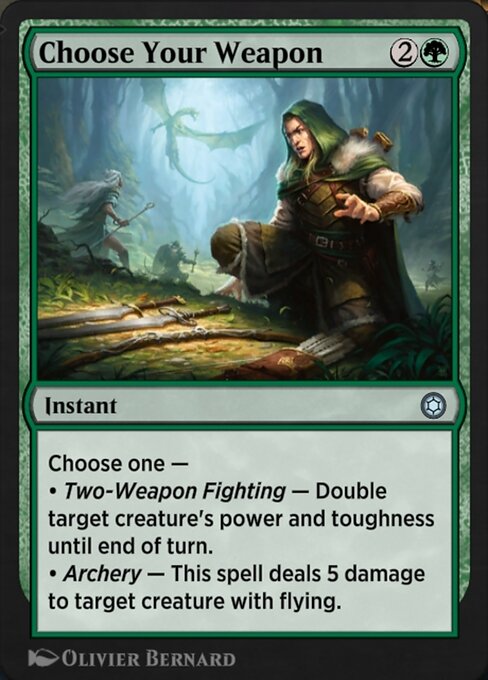
Choose Your Weapon
Instant
uncommon
Choose one — • Two-Weapon Fighting — Double target creature's power and toughness until end of turn. • Archery — This spell deals 5 damage to target creature with flying.
Semantic Tags
A spell that deals direct damage to creatures or players.
Specifically removes creatures — destroy, exile, damage, or -X/-X.
A keyword ability that lets a creature deal its combat damage twice. See rule 702.4, “Double Strike.”
Answers an opponent's threat by destroying, exiling, bouncing, or otherwise removing a permanent or spell.
Format Legality
Price history
Loading price history…
Printings (2)
| Set | Rarity | TCGplayer | Card Kingdom | Cardmarket |
|---|---|---|---|---|
| Alchemy Horizons: Baldur's Gate#202 | uncommon | · | · | · |
| Adventures in the Forgotten Realms#175 | uncommon | · | · | · |
Related Concepts
Related Rules
Some spells or abilities that produce mana restrict how that mana can be spent, have an additional effect that affects the spell or ability that mana is spent on, or create a delayed triggered ability (see rule 603.7a) that triggers when that mana is spent. This doesn’t affect the mana’s type.
An Incubator token is a double-faced token. Its front face is a colorless Incubator artifact with “{2}: Transform this token.” Its back face is a 0/0 colorless Phyrexian artifact creature named Phyrexian Token.
A keyword counter on a permanent or on a card in a zone other than the battlefield causes that object to gain that keyword. The keywords that a keyword counter can be are flying, first strike, double strike, deathtouch, decayed, exalted, haste, hexproof, indestructible, lifelink, menace, reach, shadow, trample, and vigilance, as well as any variants of those keywords. See rule 613.1f.
If a player wants to choose the name of the back face of a double-faced card, the player may do so. (See rule 712.) If a player is instructed to choose a card name with certain characteristics, use only the characteristics of the back face to determine if this name can be chosen.
The mana value of an object with no mana cost is 0, unless that object is the back face of a nonmodal double-faced permanent or spell, or it is a melded permanent.
The mana value of the back face of a nonmodal double-faced permanent or spell’s back face is calculated as though it had the mana cost of its front face. If a permanent or spell is a copy of the back face of a nonmodal double-faced object (even if the card representing that copy is itself a double-faced card), the mana value of the copy is 0.
The combat phase has five steps, which proceed in order: beginning of combat, declare attackers, declare blockers, combat damage, and end of combat. The declare blockers and combat damage steps are skipped if no creatures are declared as attackers or put onto the battlefield attacking (see rule 508.8). There are two combat damage steps if any attacking or blocking creature has first strike (see rule 702.7) or double strike (see rule 702.4).
If at least one attacking or blocking creature has first strike (see rule 702.7) or double strike (see rule 702.4) as the combat damage step begins, the only creatures that assign combat damage in that step are those with first strike or double strike. After that step, instead of proceeding to the end of combat step, the phase gets a second combat damage step. The only creatures that assign combat damage in that step are the remaining attackers and blockers that had neither first strike nor double strike as the first combat damage step began, as well as the remaining attackers and blockers that currently have double strike. After that step, the phase proceeds to the end of combat step.
Rulings
If a creature's power is less than 0 when it's doubled, instead that creature gets -X/-0, where X is how much less than 0 its power is. For example, if an effect has given a 2/2 creature -4/-0 so that it's a -2/2 creature, doubling its power and toughness gives it -2/+2, and it becomes a -4/4 creature.
If an effect instructs you to “double” a creature's power, that creature gets +X/+0, where X is its power as that effect begins to apply. The same is true for toughness.