Search
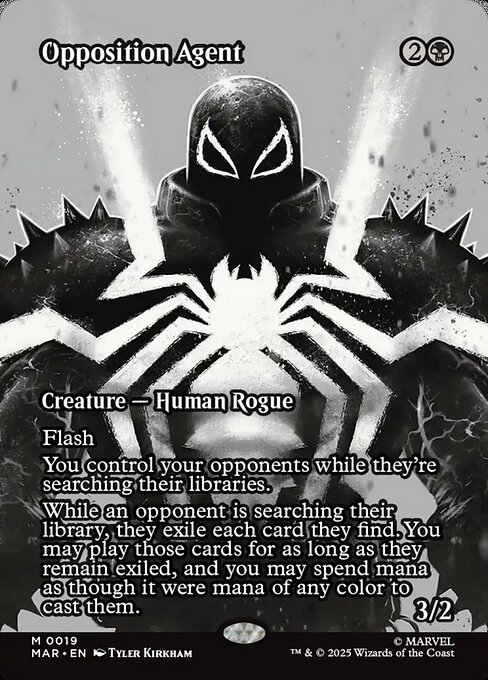
Opposition Agent
Creature — Human Rogue
rare
Flash You control your opponents while they're searching their libraries. While an opponent is searching their library, they exile each card they find. You may play those cards for as long as they remain exiled, and you may spend mana as though it were mana of any color to cast them.
3/2
 Card Kingdom
 Cardmarket
Semantic Tags
A keyword ability that can make a creature better in combat. See rule 702.83, “Exalted.”
A keyword ability that lets a player play a card any time they could cast an instant. See rule 702.8, “Flash.”
A keyword ability that lets a player play a card any time they could cast an instant. See rule 702.8, “Flash.”
Flash-focused strategy — playing at instant speed for tempo and information advantage.
Flash-focused strategy — playing at instant speed for tempo and information advantage.
Exile-based card advantage — exile cards from the top of your library and cast them temporarily. Red's primary draw mechanic.
Helps produce colors you need. Includes multicolor lands, color filtering, and 'any color' mana sources.
A card or token on the battlefield. See rule 110, “Permanents.”
Prevents players from searching their libraries. Shuts down tutors and fetchlands.
Format Legality
Price history
Loading price history…
Printings (6)
| Set | Rarity | TCGplayer | Card Kingdom | Cardmarket |
|---|---|---|---|---|
| Marvel Universe#19 | mythic | · | · | · |
| Through the Omenpaths Bonus Sheet#19 | mythic | · | · | · |
| Commander Legends Promos#141p | rare | · | · | · |
| Magic Online Promos#86078 | rare | · | · | · |
| Commander Legends#651 | rare | · | · | · |
| Commander Legends#141 | rare | · | · | · |
Related Concepts
Related Rules
If an ability would produce one or more mana of an undefined type, it produces no mana instead.
Some abilities produce mana based on the type of mana another permanent or permanents “could produce.” The type of mana a permanent could produce at any time includes any type of mana that an ability of that permanent would produce if the ability were to resolve at that time, taking into account any applicable replacement effects in any possible order. Ignore whether any costs of the ability could or could not be paid. If that permanent wouldn’t produce any mana under these conditions, or no type of mana can be defined this way, there’s no type of mana it could produce.
To “tap [a permanent] for mana” is to activate a mana ability of that permanent that includes the {T} symbol in its activation cost. See rule 605, “Mana Abilities.”
An ability that triggers whenever a permanent “is tapped for mana” or is tapped for mana of a specified type triggers whenever such a mana ability resolves and produces mana or the specified type of mana.
A replacement effect that applies if a permanent “is tapped for mana” or tapped for mana of a specific type and/or amount modifies the mana production event while such an ability is resolving and producing mana or the specified type and/or amount of mana.
If an object’s enters-the-battlefield triggered ability or replacement effect refers to X, and the spell that became that object as it resolved had a value of X chosen for any of its costs, the value of X for that ability is the same as the value of X for that spell, although the value of X for that permanent is 0. This is an exception to rule 107.3i.
The tap symbol is {T}. The tap symbol in an activation cost means “Tap this permanent.” A permanent that’s already tapped can’t be tapped again to pay the cost. A creature’s activated ability with the tap symbol in its activation cost can’t be activated unless the creature has been under its controller’s control continuously since their most recent turn began. See rule 302.6.
The untap symbol is {Q}. The untap symbol in an activation cost means “Untap this permanent.” A permanent that’s already untapped can’t be untapped again to pay the cost. A creature’s activated ability with the untap symbol in its activation cost can’t be activated unless the creature has been under its controller’s control continuously since their most recent turn began. See rule 302.6.
Rulings
You can't have the player find cards in their library that aren't asked for by the search instruction. For example, if the opponent is searching their library for a basic land card, you can't have them find a different card, such as a creature card.
If more than one player controls an Opposition Agent, and another player searches their library, the controller of the Opposition Agent that most recently entered the battlefield controls that player during the search. Because the last ability of each Opposition Agent is trying to exile the card and give permission to play it, the owner of the exiled card chooses which effect wins. However, that owner will be under another player's control, so that player controlling that owner actually makes the decision. In other words, the player who controls the Opposition Agent whose effect applies (and thus controls the opponent) can choose to give themselves all the play permissions unless they're feeling very generous.
You'll still pay all costs for a spell cast this way, including additional costs. You may also pay alternative costs if any are available.
If the search instruction states a quality of the card to find, such as a color or card type, you may have the opponent not find any cards. If the search is simply for a number of cards without stating a quality, you must have them find that many cards (or as many as possible, if their library doesn't contain that many cards).
The cards found in the search will be exiled rather than be put wherever the spell or ability tells the opponent to put them after finding them. Any other effects the spell or ability has will still apply. If such an effect refers to the found cards, it can't see them in exile.
If a spell or ability instructs an opponent you control to search multiple zones including the library, you decide what cards they find in all zones. They'll exile all cards they find in any of the zones.
While controlling an opponent, you can't make any choices or decisions for that player related to tournament rules. You can't make them concede or have them agree to an intentional draw.
In a multiplayer game, if a player leaves the game, all cards that player owns leave as well.
You must follow the normal timing permissions and restrictions for each exiled card. If one is a land, you can't play it unless you have land plays available.
While controlling an opponent, you make all choices and decisions for that player. However, because the control effect is limited to while they're searching their libraries, it's unlikely the player will be allowed to make any decisions other than what to find with the search.