Search
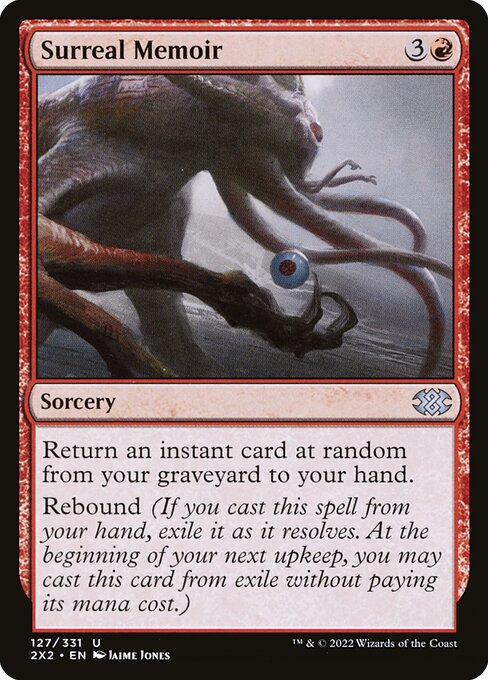
Surreal Memoir
Sorcery
uncommon
Return an instant card at random from your graveyard to your hand. Rebound (If you cast this spell from your hand, exile it as it resolves. At the beginning of your next upkeep, you may cast this card from exile without paying its mana cost.)
 Card Kingdom
 Cardmarket
Semantic Tags
Random, chaotic, or coin-flip effects that create unpredictable game states.
A keyword ability that allows a player to cast a double-faced card transformed from the graveyard. See rule 702.146, “Disturb.”
A keyword ability that lets a player return a card from their graveyard to their hand. See rule 702.52, “Dredge.”
A keyword ability that lets a player cast a card from their graveyard. See rule 702.34, “Flashback.”
Cares about cards in the graveyard, puts cards into the graveyard, or benefits from things dying.
Returns cards from the graveyard to your hand, the battlefield, or the top of your library.
Returns cards from graveyard to hand or library (not battlefield — that is reanimation).
Format Legality
Price history
Loading price history…
Printings (4)
| Set | Rarity | TCGplayer | Card Kingdom | Cardmarket |
|---|---|---|---|---|
| Double Masters 2022#127 | uncommon | · | · | · |
| Commander 2020#161 | uncommon | · | · | · |
| Iconic Masters#148 | uncommon | · | · | · |
| Rise of the Eldrazi#167 | uncommon | · | · | · |
Related Concepts
Related Rules
If the spell is modal, the player announces the mode choice (see rule 700.2). If the player wishes to splice any cards onto the spell (see rule 702.47), they reveal those cards in their hand. If the spell has alternative or additional costs that will be paid as it’s being cast such as buyback or kicker costs (see rules 118.8 and 118.9), the player announces their intentions to pay any or all of those costs (see rule 601.2f). A player can’t apply two alternative methods of casting or two alternative costs to a single spell. If the spell has a variable cost that will be paid as it’s being cast (such as an {X} in its mana cost; see rule 107.3), the player announces the value of that variable. If the value of that variable is defined in the text of the spell by a choice that player would make later in the announcement or resolution of the spell, that player makes that choice at this time instead of that later time. If a cost that will be paid as the spell is being cast includes hybrid mana symbols, the player announces the nonhybrid equivalent cost they intend to pay. If a cost that will be paid as the spell is being cast includes Phyrexian mana symbols, the player announces whether they intend to pay 2 life or a corresponding colored mana cost for each of those symbols. Previously made choices (such as choosing to cast a spell with flashback from a graveyard or choosing to cast a creature with morph face down) may restrict the player’s options when making these choices.
If two effects state that a player may (or a creature can) do the same thing “as though” different conditions were true, both conditions could apply. If one “as though” effect satisfies the requirements for another “as though” effect, then both effects will apply.
If an effect would cause a player to shuffle one or more specific objects into a library, that library is shuffled even if none of those objects are in the zone they’re expected to be in or an effect causes all of those objects to be moved to another zone or remain in their current zone.
An effect that grants an object a keyword ability may define a variable in that ability based on characteristics of that object or other information about the game state. For these abilities, the value of that variable is constantly reevaluated.
Flashback
Flashback appears on some instants and sorceries. It represents two static abilities: one that functions while the card is in a player’s graveyard and another that functions while the card is on the stack. “Flashback [cost]” means “You may cast this card from your graveyard if the resulting spell is an instant or sorcery spell by paying [cost] rather than paying its mana cost” and “If the flashback cost was paid, exile this card instead of putting it anywhere else any time it would leave the stack.” Casting a spell using its flashback ability follows the rules for paying alternative costs in rules 601.2b and 601.2f–h.
Dredge
Dredge is a static ability that functions only while the card with dredge is in a player’s graveyard. “Dredge N” means “As long as you have at least N cards in your library, if you would draw a card, you may instead mill N cards and return this card from your graveyard to your hand.”
Rulings
If a spell with rebound that you cast from your hand doesn't resolve for any reason (due being countered by a spell like Cancel, or because all of its targets are illegal), rebound has no effect. The spell is simply put into your graveyard. You won't get to cast it again next turn.
If you have only one instant card in your graveyard as Surreal Memoir resolves, that's the one you'll return to your hand.
If you cast a spell with rebound from anywhere other than your hand (such as from your graveyard due to Sins of the Past, from your library due to cascade, or from your opponent's hand due to Sen Triplets), rebound won't have any effect. If you do cast it from your hand, rebound will work regardless of whether you paid its mana cost (for example, if you cast it from your hand due to Maelstrom Archangel).
If you cast a spell with rebound from your hand and it resolves, it isn't put into your graveyard. Rather, it's exiled directly from the stack. Effects that care about cards being put into your graveyard won't do anything.
If you are unable to cast a card from exile this way, or you choose not to, nothing happens when the delayed triggered ability resolves. The card remains exiled for the rest of the game, and you won't get another chance to cast the card. The same is true if the ability is countered (due to Stifle, perhaps).
If you're playing a format involving cards printed earlier than the _Urza's Saga_ set, you may not reorder your graveyard. In this case, you need to be more careful when selecting an instant card at random, perhaps by using dice, writing the names of the instant cards on slips of paper and choosing one of them randomly, or carefully noting the existing graveyard order so you can reestablish it after performing the method suggested above, for example.
Rebound will have no effect on copies of spells because you don't cast them from your hand.
If you're playing a format involving only cards from the _Urza's Saga_(TM) set and later, you may change the order of your graveyard at any time. That means the easiest way to choose an instant card at random from your graveyard is to take all the instant cards in your graveyard, turn them face down, shuffle them, and pick a card. Then you just put the rest back.
If a replacement effect would cause a spell with rebound that you cast from your hand to be put somewhere else instead of your graveyard (such as Leyline of the Void might), you choose whether to apply the rebound effect or the other effect as the spell resolves.
At the beginning of your upkeep, all delayed triggered abilities created by rebound effects trigger. You may handle them in any order. If you want to cast a card this way, you do so as part of the resolution of its delayed triggered ability. Timing restrictions based on the card's type (if it's a sorcery) are ignored. Other restrictions are not (such as the one from Rule of Law).
All players get to see which card you chose at random.
If you cast a card from exile this way, it will go to your graveyard when it resolves, fails to resolve, or is countered. It won't go back to exile.
Surreal Memoir isn't targeted. You don't choose an instant card at random from your graveyard until it resolves. Once you randomly select a card, it's too late for players to respond.
If you have multiple instant cards in your graveyard with the same name, and one of them is being targeted by another spell on the stack or is enchanted (with Spellweaver Volute, for example), you must differentiate them so you know which one (if any) is chosen at random. In that case, it may be better to use dice or another method that allows you to differentiate between the instant cards to choose one at random.