Search
Psychotic Episode
Sorcery
common
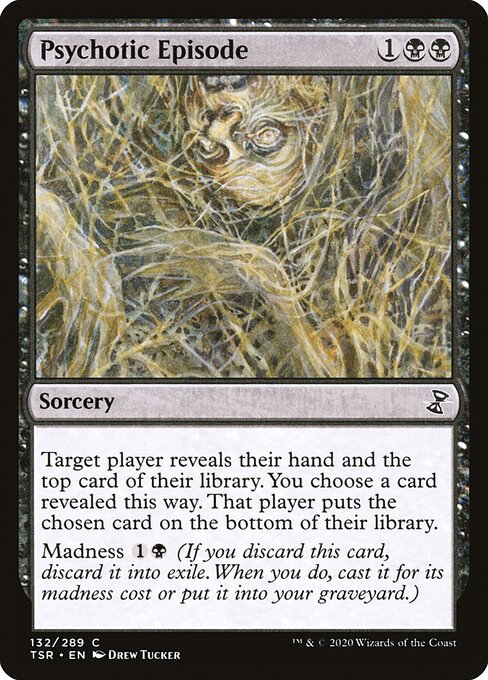
Target player reveals their hand and the top card of their library. You choose a card revealed this way. That player puts the chosen card on the bottom of their library. Madness (If you discard this card, discard it into exile. When you do, cast it for its madness cost or put it into your graveyard.)
 Card Kingdom
 Cardmarket
Semantic Tags
Benefits from discarding cards — madness, Waste Not effects, Oskar strategies.
A keyword ability that allows a player to cast a double-faced card transformed from the graveyard. See rule 702.146, “Disturb.”
Cares about cards in the graveyard, puts cards into the graveyard, or benefits from things dying.
Forces opponents to discard cards from their hand. Targeted discard, mass discard, and discard-or-pay effects.
A keyword ability that lets a player cast a card they discard. See rule 702.35, “Madness.”
A keyword ability that lets a player cast a card they discard. See rule 702.35, “Madness.”
Cares about or manipulates the top of library — Sensei's Top, miracles, Future Sight.
Format Legality
Price history
Loading price history…
Printings (2)
| Set | Rarity | TCGplayer | Card Kingdom | Cardmarket |
|---|---|---|---|---|
| Time Spiral Remastered#132 | common | · | · | · |
| Time Spiral#126 | common | · | · | · |
Related Concepts
Related Rules
After resolving a madness triggered ability (see rule 702.35), if the exiled card wasn’t cast and was moved to a public zone, effects referencing the discarded card can find that object.
Madness
Madness is a keyword that represents two abilities. The first is a static ability that functions while the card with madness is in a player’s hand. The second is a triggered ability that functions when the first ability is applied. “Madness [cost]” means “If a player would discard this card, that player discards it, but exiles it instead of putting it into their graveyard” and “When this card is exiled this way, its owner may cast it by paying [cost] rather than paying its mana cost. If that player doesn’t, they put this card into their graveyard.”
Casting a spell using its madness ability follows the rules for paying alternative costs in rules 601.2b and 601.2f–h.
After resolving a madness triggered ability, if the exiled card wasn’t cast and was moved to a public zone, effects referencing the discarded card can find that card. See rule 400.7k.
Disturb
Disturb is an ability found on the front face of some double-faced cards (see rule 712, “Double-Faced Cards”). “Disturb [cost]” means “You may cast this card transformed from your graveyard by paying [cost] rather than its mana cost.” See rule 712.8c.
A resolving double-faced spell that was cast using its disturb ability enters the battlefield with its back face up.
Rulings
You can choose any card that Psychotic Episode instructs the player to reveal, even if that card was already revealed for another effect.
A card with madness that's discarded counts as having been discarded even though it's put into exile rather than a graveyard. If it was discarded to pay a cost, that cost is still paid. Abilities that trigger when a card is discarded will still trigger.
A spell cast for its madness cost is put onto the stack like any other spell. It can be countered, copied, and so on. As it resolves, it's put onto the battlefield if it's a permanent card or into its owner's graveyard if it's an instant or sorcery card.
Casting a spell with madness ignores the timing rules based on the card's card type. For example, you can cast a sorcery with madness if you discard it during an opponent's turn.
To determine the total cost of a spell, start with the mana cost or alternative cost (such as a madness cost) you're paying, add any cost increases, then apply any cost reductions. The mana value of the spell is determined by only its mana cost, no matter what the total cost to cast that spell was.
If you discard a card with madness while a spell or ability is resolving, it moves immediately to exile. Continue resolving that spell or ability, noting that the card you discarded is not in your graveyard at this time. Its madness triggered ability will be placed onto the stack once that spell or ability has completely resolved.
Madness works independently of why you're discarding the card. You could discard it to pay a cost, because a spell or ability tells you to, or because you have too many cards in your hand during your cleanup step. You can't discard a card with madness just because you want to, though.
Cards are discarded in a Magic game only from a player's hand. Effects that put cards into a player's graveyard from anywhere else do not cause those cards to be discarded.
If you discard a card with madness to pay the cost of a spell or activated ability, that card's madness triggered ability (and the spell that card becomes, if you choose to cast it) will resolve before the spell or ability the discard paid for.
If you choose not to cast a card with madness when the madness triggered ability resolves, it's put into your graveyard. Madness doesn't give you another chance to cast it later.