Search
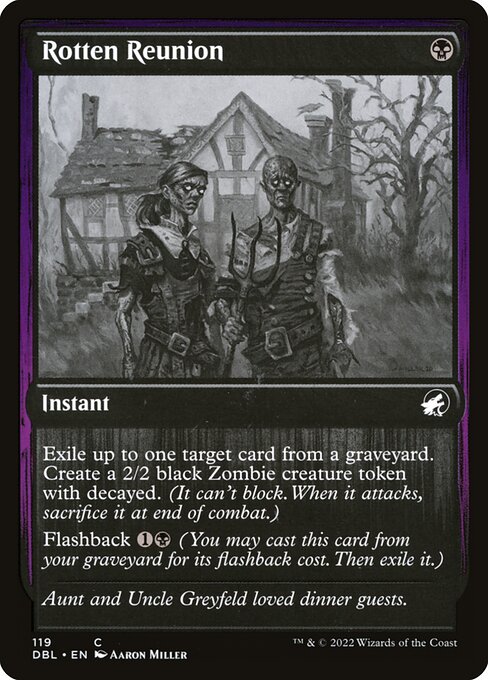
Rotten Reunion
Instant
common
Exile up to one target card from a graveyard. Create a 2/2 black Zombie creature token with decayed. (It can't block. When it attacks, sacrifice it at end of combat.) Flashback (You may cast this card from your graveyard for its flashback cost. Then exile it.)
 Card Kingdom
 Cardmarket
Semantic Tags
A keyword ability that lets a card be discarded and replaced with a new card. See rule 702.29, “Cycling.”
A keyword ability that lets a player play a card any time they could cast an instant. See rule 702.8, “Flash.”
A keyword ability that lets a player cast a card from their graveyard. See rule 702.34, “Flashback.”
A keyword ability that lets a player cast a card from their graveyard. See rule 702.34, “Flashback.”
A keyword ability that lets a player exile cards from their hand and cast them for an alternative cost on future turns. See rule 702.143, “Foretell.”
Exiles cards from graveyards or prevents graveyard interaction. Shuts down recursion, flashback, and graveyard-matters strategies.
Exiles cards from graveyards or prevents graveyard interaction. Shuts down recursion, flashback, and graveyard-matters strategies.
Cares about cards in the graveyard, puts cards into the graveyard, or benefits from things dying.
Returns cards from the graveyard to your hand, the battlefield, or the top of your library.
Creates copies of tokens — populate keyword and similar effects.
A keyword ability that provides an alternative way to play a card. See rule 702.62, “Suspend.” A card is “suspended” if it’s in the exile zone, has suspend, and has a time counter on it.
Creates creature tokens, Treasure tokens, Food tokens, Clue tokens, or other token types.
Prevents token creation or punishes tokens on the battlefield.
Prevents token creation or punishes tokens on the battlefield.
Format Legality
Price history
Loading price history…
Printings (2)
| Set | Rarity | TCGplayer | Card Kingdom | Cardmarket |
|---|---|---|---|---|
| Innistrad: Double Feature#119 | common | · | · | · |
| Innistrad: Midnight Hunt#119 | common | · | · | · |
Related Concepts
Related Rules
If a cost associated with a special action, such as a suspend cost or a morph cost, has an {X} or an X in it, the value of X is chosen by the player taking the special action immediately before they pay that cost.
A player who has a card with suspend in their hand may exile that card. This is a special action. A player can take this action any time they have priority, but only if they could begin to cast that card by putting it onto the stack. See rule 702.62, “Suspend.”
A player who has a card with foretell in their hand may pay {2} and exile that card face down. This is a special action. A player may take this action any time they have priority during their turn. See rule 702.143, “Foretell.”
If the spell is modal, the player announces the mode choice (see rule 700.2). If the player wishes to splice any cards onto the spell (see rule 702.47), they reveal those cards in their hand. If the spell has alternative or additional costs that will be paid as it’s being cast such as buyback or kicker costs (see rules 118.8 and 118.9), the player announces their intentions to pay any or all of those costs (see rule 601.2f). A player can’t apply two alternative methods of casting or two alternative costs to a single spell. If the spell has a variable cost that will be paid as it’s being cast (such as an {X} in its mana cost; see rule 107.3), the player announces the value of that variable. If the value of that variable is defined in the text of the spell by a choice that player would make later in the announcement or resolution of the spell, that player makes that choice at this time instead of that later time. If a cost that will be paid as the spell is being cast includes hybrid mana symbols, the player announces the nonhybrid equivalent cost they intend to pay. If a cost that will be paid as the spell is being cast includes Phyrexian mana symbols, the player announces whether they intend to pay 2 life or a corresponding colored mana cost for each of those symbols. Previously made choices (such as choosing to cast a spell with flashback from a graveyard or choosing to cast a creature with morph face down) may restrict the player’s options when making these choices.
If an effect allows a player to cast a spell with certain qualities as though it had flash, that player may consider any choices to be made during that spell’s proposal that may cause that spell’s qualities to change. If any such choices could cause that effect to apply, that player may begin to cast that spell as though it had flash.
If an effect allows a player to cast a spell as though it had flash only if an alternative or additional cost is paid, that player may begin to cast that spell as though it had flash.
If a spell would have flash only if certain conditions are met, its controller may begin to cast that spell as though it had flash if those conditions are met.
Once a player has begun casting a spell that had flash because certain conditions were met or that could be cast as though it had flash because certain conditions were met (see 601.3d), they may continue to cast that spell as though it had flash even if those conditions stop being met.
Rulings
Decayed does not create any attacking requirements. You may choose not to attack with a creature that has decayed.
You don't have to choose any targets for Rotten Reunion. However, if you do, and that target is illegal as Rotten Reunion tries to resolve (perhaps because your opponent responded with their own Rotten Reunion), it will be removed from the stack and you won't create a Zombie token.
Decayed represents a static ability and a triggered ability. "Decayed" means "This creature can't block" and "When this creature attacks, sacrifice it at end of combat."
Once a creature with decayed attacks, it will be sacrificed at end of combat, even if it no longer has decayed at that time.
Decayed does not grant haste. Creatures with decayed that enter the battlefield during your turn may not attack until your next turn.