Search
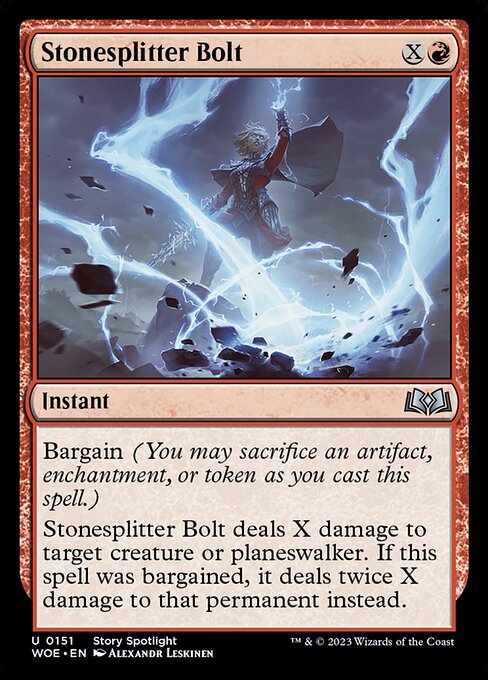
Stonesplitter Bolt
Instant
uncommon
Bargain (You may sacrifice an artifact, enchantment, or token as you cast this spell.) Stonesplitter Bolt deals X damage to target creature or planeswalker. If this spell was bargained, it deals twice X damage to that permanent instead.
 Card Kingdom
 Cardmarket
Semantic Tags
Specifically damages, destroys, or shuts down planeswalkers.
Broadly benefits from sacrificing permanents — overlaps aristocrats but includes non-creature sacrifice.
Lets you sacrifice your own creatures or permanents for value. Key enabler for aristocrats strategies.
Format Legality
Price history
Loading price history…
Printings (1)
| Set | Rarity | TCGplayer | Card Kingdom | Cardmarket |
|---|---|---|---|---|
| Wilds of Eldraine#151 | uncommon | · | · | · |
Related Concepts
Related Rules
Bargain
Bargain is a static ability that functions while the spell with bargain is on the stack. “Bargain” means “As an additional cost to cast this spell, you may sacrifice an artifact, enchantment, or token.” Paying a spell’s bargain cost follows the rules for paying additional costs in rules 601.2b and 601.2f–h.
If a spell’s controller declares the intention to pay that spell’s bargain cost, that spell has been “bargained.” See rule 601.2b.
Objects with bargain have additional abilities that specify what happens if they were bargained. These abilities are linked to the bargain ability printed on that object: they can refer only to that specific bargain ability. See rule 607, “Linked Abilities.”
Rulings
Bargain means “As an additional cost to cast this spell, you may sacrifice an artifact, enchantment, or token.”
You may sacrifice only one artifact, enchantment, or token to pay a spell’s bargain cost.
If you copy a bargained spell, the copy is also bargained. If a card or token enters the battlefield as a copy of a permanent that’s already on the battlefield, the new permanent isn’t bargained, even if the original was.
Some instant and sorcery spells require additional targets if they’re bargained. You ignore those targeting requirements if those spells aren’t bargained, and you can’t bargain those spells unless you can choose the appropriate targets. On the other hand, you can bargain a permanent spell even if you won’t be able to choose targets for an enters-the-battlefield ability of that permanent once the spell resolves.
Bargain represents an optional additional cost. A spell cast with that additional cost paid is “bargained.”