Search
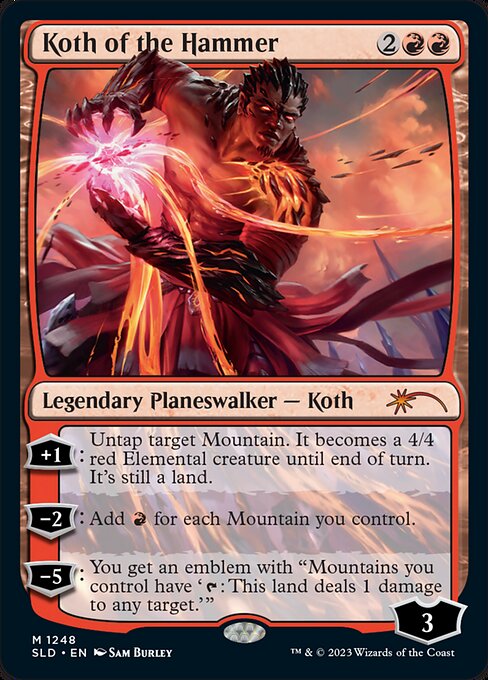
Koth of the Hammer
Legendary Planeswalker — Koth
mythic
+1: Untap target Mountain. It becomes a 4/4 red Elemental creature until end of turn. It's still a land. −2: Add for each Mountain you control. −5: You get an emblem with "Mountains you control have ': This land deals 1 damage to any target.'"
Loyalty: 3
 Card Kingdom
 Cardmarket
Semantic Tags
A spell that deals direct damage to creatures or players.
A permanent with a repeatable activated ability that converts excess mana into value.
A card or token on the battlefield. See rule 110, “Permanents.”
Specifically removes planeswalkers.
Accelerates mana production beyond the one-land-per-turn baseline. Umbrella tag — see ramp subtypes for land ramp, mana dorks, mana rocks, and rituals.
Answers an opponent's threat by destroying, exiling, bouncing, or otherwise removing a permanent or spell.
Planeswalker-heavy strategy — proliferate, Doubling Season, planeswalker synergies.
Planeswalker-heavy strategy — proliferate, Doubling Season, planeswalker synergies.
An effect that untaps permanents, enabling reuse of tap abilities or mana.
Format Legality
Price history
Loading price history…
Printings (3)
| Set | Rarity | TCGplayer | Card Kingdom | Cardmarket |
|---|---|---|---|---|
| Secret Lair Drop#1248 | mythic | · | · | · |
| Duel Decks: Venser vs. Koth#44 | mythic | · | · | · |
| Scars of Mirrodin#94 | mythic | · | · | · |
Related Rules
If an ability would produce one or more mana of an undefined type, it produces no mana instead.
Some abilities produce mana based on the type of mana another permanent or permanents “could produce.” The type of mana a permanent could produce at any time includes any type of mana that an ability of that permanent would produce if the ability were to resolve at that time, taking into account any applicable replacement effects in any possible order. Ignore whether any costs of the ability could or could not be paid. If that permanent wouldn’t produce any mana under these conditions, or no type of mana can be defined this way, there’s no type of mana it could produce.
To “tap [a permanent] for mana” is to activate a mana ability of that permanent that includes the {T} symbol in its activation cost. See rule 605, “Mana Abilities.”
An ability that triggers whenever a permanent “is tapped for mana” or is tapped for mana of a specified type triggers whenever such a mana ability resolves and produces mana or the specified type of mana.
A replacement effect that applies if a permanent “is tapped for mana” or tapped for mana of a specific type and/or amount modifies the mana production event while such an ability is resolving and producing mana or the specified type and/or amount of mana.
If an object’s enters-the-battlefield triggered ability or replacement effect refers to X, and the spell that became that object as it resolved had a value of X chosen for any of its costs, the value of X for that ability is the same as the value of X for that spell, although the value of X for that permanent is 0. This is an exception to rule 107.3i.
The tap symbol is {T}. The tap symbol in an activation cost means “Tap this permanent.” A permanent that’s already tapped can’t be tapped again to pay the cost. A creature’s activated ability with the tap symbol in its activation cost can’t be activated unless the creature has been under its controller’s control continuously since their most recent turn began. See rule 302.6.
The untap symbol is {Q}. The untap symbol in an activation cost means “Untap this permanent.” A permanent that’s already untapped can’t be untapped again to pay the cost. A creature’s activated ability with the untap symbol in its activation cost can’t be activated unless the creature has been under its controller’s control continuously since their most recent turn began. See rule 302.6.
Rulings
Emblems behave similarly to enchantments: They have an ability that, in a general sense, continually affects the game. The primary difference between them is that emblems aren’t permanents and don’t exist on the battlefield. Nothing in the game can remove an emblem, simply because no other spell or ability references them. Once you get an emblem, you keep it for the rest of the game. Emblems have no color, name, card type, or other characteristics beyond the listed ability.
If Koth’s first ability animates a Mountain that came under your control that turn, it will have “summoning sickness” and be unable to attack. It will also be unable to be tapped to activate an ability with the {T} symbol in its cost, such as the Mountain’s mana ability or the ability granted to it by Koth’s emblem.
Loyalty abilities can’t be mana abilities. Koth’s second ability uses the stack and can be countered or otherwise responded to. Like all loyalty abilities, it can be activated only once per turn, during your main phase, when the stack is empty, and only if no other loyalty abilities of this permanent have been activated this turn.
Koth’s emblem grants an activated ability to each Mountain you control at any given time for the rest of the game. It will continuously check which permanents you control are Mountains to determine what has the ability. For example, a Mountain that comes under your control later in the game will have the ability, while a Mountain you controlled at the time the emblem was created, but that later came under the control of another player, will no longer have the ability.
Koth’s first ability can target any Mountain, including an untapped Mountain and/or a Mountain another player controls.