Search
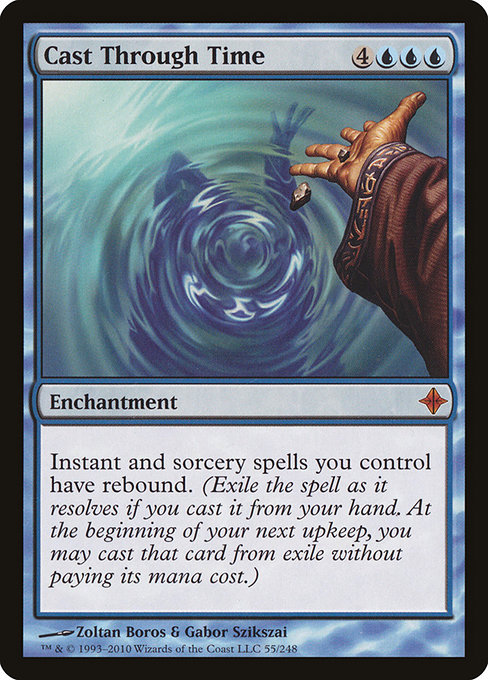
Cast Through Time
Enchantment
mythic
Instant and sorcery spells you control have rebound. (Exile the spell as it resolves if you cast it from your hand. At the beginning of your next upkeep, you may cast that card from exile without paying its mana cost.)
 Card Kingdom
 Cardmarket
Semantic Tags
A keyword ability that reduces how much mana you need to spend to cast a spell. See rule 702.41, “Affinity.”
A card or token on the battlefield. See rule 110, “Permanents.”
Rewards casting instants and sorceries. Includes magecraft, prowess triggers, and spell-count payoffs.
Format Legality
Price history
Loading price history…
Printings (1)
| Set | Rarity | TCGplayer | Card Kingdom | Cardmarket |
|---|---|---|---|---|
| Rise of the Eldrazi#55 | mythic | · | · | · |
Related Rules
If an ability would produce one or more mana of an undefined type, it produces no mana instead.
Some abilities produce mana based on the type of mana another permanent or permanents “could produce.” The type of mana a permanent could produce at any time includes any type of mana that an ability of that permanent would produce if the ability were to resolve at that time, taking into account any applicable replacement effects in any possible order. Ignore whether any costs of the ability could or could not be paid. If that permanent wouldn’t produce any mana under these conditions, or no type of mana can be defined this way, there’s no type of mana it could produce.
To “tap [a permanent] for mana” is to activate a mana ability of that permanent that includes the {T} symbol in its activation cost. See rule 605, “Mana Abilities.”
An ability that triggers whenever a permanent “is tapped for mana” or is tapped for mana of a specified type triggers whenever such a mana ability resolves and produces mana or the specified type of mana.
A replacement effect that applies if a permanent “is tapped for mana” or tapped for mana of a specific type and/or amount modifies the mana production event while such an ability is resolving and producing mana or the specified type and/or amount of mana.
If an object’s enters-the-battlefield triggered ability or replacement effect refers to X, and the spell that became that object as it resolved had a value of X chosen for any of its costs, the value of X for that ability is the same as the value of X for that spell, although the value of X for that permanent is 0. This is an exception to rule 107.3i.
The tap symbol is {T}. The tap symbol in an activation cost means “Tap this permanent.” A permanent that’s already tapped can’t be tapped again to pay the cost. A creature’s activated ability with the tap symbol in its activation cost can’t be activated unless the creature has been under its controller’s control continuously since their most recent turn began. See rule 302.6.
The untap symbol is {Q}. The untap symbol in an activation cost means “Untap this permanent.” A permanent that’s already untapped can’t be untapped again to pay the cost. A creature’s activated ability with the untap symbol in its activation cost can’t be activated unless the creature has been under its controller’s control continuously since their most recent turn began. See rule 302.6.
Rulings
You’ll be able to cast a spell with flashback three times this way. First you can cast it from your hand. It will be exiled due to rebound as it resolves. Then you can cast it from exile due to rebound’s delayed triggered ability. It will be put into your graveyard as it resolves. Then you can cast it from your graveyard due to flashback. It will be exiled due to flashback as it resolves.
If a spell moves itself into another zone as part of its resolution (as Arc Blade, All Suns’ Dawn, and Beacon of Unrest do), rebound won’t get a chance to apply.
If a spell with rebound that you cast from your hand doesn’t resolve for any reason (due being countered by a spell like Cancel, or because all of its targets are illegal), rebound has no effect. The spell is simply put into your graveyard. You won’t get to cast it again next turn.
If you are unable to cast a card from exile this way, or you choose not to, nothing happens when the delayed triggered ability resolves. The card remains exiled for the rest of the game, and you won’t get another chance to cast the card. The same is true if the ability is countered (due to Stifle, perhaps).
If a replacement effect would cause a spell with rebound that you cast from your hand to be put somewhere else instead of your graveyard (such as Leyline of the Void might), you choose whether to apply the rebound effect or the other effect as the spell resolves.
Rebound will have no effect on copies of spells because you don’t cast them from your hand.
Similarly, if you gain control of an instant or sorcery spell with Commandeer, it will have rebound, but the ability won’t do anything because that spell wasn’t cast from your hand.
If you cast a card from exile “without paying its mana cost,” you can’t pay any alternative costs. Any X in the mana cost will be 0. On the other hand, if the card has optional additional costs (such as kicker or multikicker), you may pay those when you cast the card. If the card has mandatory additional costs (such as Momentous Fall does), you must pay those if you choose to cast the card.
If you cast an instant or sorcery spell from your hand and it’s exiled due to rebound, the delayed triggered ability will allow you to cast it during your next upkeep even if Cast Through Time has left the battlefield by then.
The rebound effect is not optional. Each instant and sorcery spell you cast from your hand is exiled instead of being put into your graveyard as it resolves, whether you want it to be or not. Casting the spell during your next upkeep is optional, however.
If you cast a card from exile this way, it will go to your graveyard when it resolves, fails to resolve, or is countered. It won’t go back to exile.
If you cast a spell with rebound from your hand and it resolves, it isn’t put into your graveyard. Rather, it’s exiled directly from the stack. Effects that care about cards being put into your graveyard won’t do anything.
At the beginning of your upkeep, all delayed triggered abilities created by rebound effects trigger. You may handle them in any order. If you want to cast a card this way, you do so as part of the resolution of its delayed triggered ability. Timing restrictions based on the card’s type (if it’s a sorcery) are ignored. Other restrictions are not (such as the one from Rule of Law).
Multiple instances of rebound on the same spell are redundant.
If you cast a spell using the madness or suspend abilities, you’re casting it from exile, not from your hand. Although those spells will have rebound, the ability won’t have any effect.
If a spell has restrictions on when it can be cast (for example, “Cast [this spell] only during the declare blockers step”), those restrictions may prevent you from casting it from exile during your upkeep.
If you cast a spell with rebound from anywhere other than your hand (such as from your graveyard due to Sins of the Past, from your library due to cascade, or from your opponent’s hand due to Sen Triplets), rebound won’t have any effect. If you do cast it from your hand, rebound will work regardless of whether you paid its mana cost (for example, if you cast it from your hand due to Maelstrom Archangel).
For the rebound effect to happen, Cast Through Time needs to be on the battlefield as the spell _finishes_ resolving. For example, if you cast Warp World from your hand, and as part of its resolution it puts Cast Through Time onto the battlefield, Warp World will rebound. Conversely, if Warp World shuffles your Cast Through Time into your library as part of its resolution, and doesn’t put another one onto the battlefield, it will not rebound.
If a spell you cast from your hand has both rebound and buyback (and the buyback cost was paid), you choose which effect to apply as it resolves.