Search
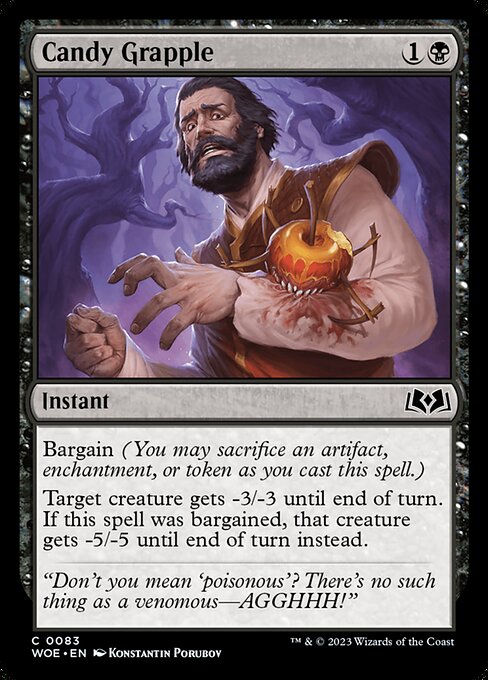
Candy Grapple
Instant
common
Bargain (You may sacrifice an artifact, enchantment, or token as you cast this spell.) Target creature gets -3/-3 until end of turn. If this spell was bargained, that creature gets -5/-5 until end of turn instead.
 Card Kingdom
 Cardmarket
Semantic Tags
Specifically removes creatures — destroy, exile, damage, or -X/-X.
A keyword ability found on creature cards that allows them to be cast for an alternative cost. See rule 702.109, “Dash.”
Answers an opponent's threat by destroying, exiling, bouncing, or otherwise removing a permanent or spell.
Broadly benefits from sacrificing permanents — overlaps aristocrats but includes non-creature sacrifice.
Lets you sacrifice your own creatures or permanents for value. Key enabler for aristocrats strategies.
Format Legality
Price history
Loading price history…
Printings (1)
| Set | Rarity | TCGplayer | Card Kingdom | Cardmarket |
|---|---|---|---|---|
| Wilds of Eldraine#83 | common | · | · | · |
Related Concepts
Related Rules
Subtypes of each card type except creature and plane are always single words and are listed after a long dash. Each word after the dash is a separate subtype. Subtypes of creature cards are one or two words and are listed after a long dash. Each word or two-word phrase, as listed in rule 205.3m, is a separate subtype. Objects other than planes may have multiple subtypes. Subtypes of planes are also listed after a long dash, but may be multiple words; all words after the dash are, collectively, a single subtype.
Artifact subtypes are always a single word and are listed after a long dash: “Artifact — Equipment.” Artifact subtypes are also called artifact types. Artifacts may have multiple subtypes. See rule 205.3g for the complete list of artifact types.
Creature subtypes are usually a single word long and are listed after a long dash: “Creature — Human Soldier,” “Artifact Creature — Golem,” and so on. Creature subtypes are also called creature types. Creatures may have multiple subtypes. See rule 205.3m for the complete list of creature types.
Enchantment subtypes are always a single word and are listed after a long dash: “Enchantment — Shrine.” Each word after the dash is a separate subtype. Enchantment subtypes are also called enchantment types. Enchantments may have multiple subtypes. See rule 205.3h for the complete list of enchantment types.
Instant subtypes are always a single word and are listed after a long dash: “Instant — Arcane.” Each word after the dash is a separate subtype. The set of instant subtypes is the same as the set of sorcery subtypes; these subtypes are called spell types. Instants may have multiple subtypes. See rule 205.3k for the complete list of spell types.
Land subtypes are always a single word and are listed after a long dash. Land subtypes are also called land types. Lands may have multiple subtypes. See rule 205.3i for the complete list of land types.
Planeswalker subtypes are always a single word and are listed after a long dash: “Planeswalker — Jace.” Each word after the dash is a separate subtype. Planeswalker subtypes are also called planeswalker types. Planeswalkers may have multiple subtypes. See rule 205.3j for the complete list of planeswalker types.
Sorcery subtypes are always a single word and are listed after a long dash: “Sorcery — Arcane.” Each word after the dash is a separate subtype. The set of sorcery subtypes is the same as the set of instant subtypes; these subtypes are called spell types. Sorceries may have multiple subtypes. See rule 205.3k for the complete list of spell types.
Rulings
If you copy a bargained spell, the copy is also bargained. If a card or token enters the battlefield as a copy of a permanent that’s already on the battlefield, the new permanent isn’t bargained, even if the original was.
Some instant and sorcery spells require additional targets if they’re bargained. You ignore those targeting requirements if those spells aren’t bargained, and you can’t bargain those spells unless you can choose the appropriate targets. On the other hand, you can bargain a permanent spell even if you won’t be able to choose targets for an enters-the-battlefield ability of that permanent once the spell resolves.
Bargain represents an optional additional cost. A spell cast with that additional cost paid is “bargained.”
You may sacrifice only one artifact, enchantment, or token to pay a spell’s bargain cost.
Bargain means “As an additional cost to cast this spell, you may sacrifice an artifact, enchantment, or token.”