Search
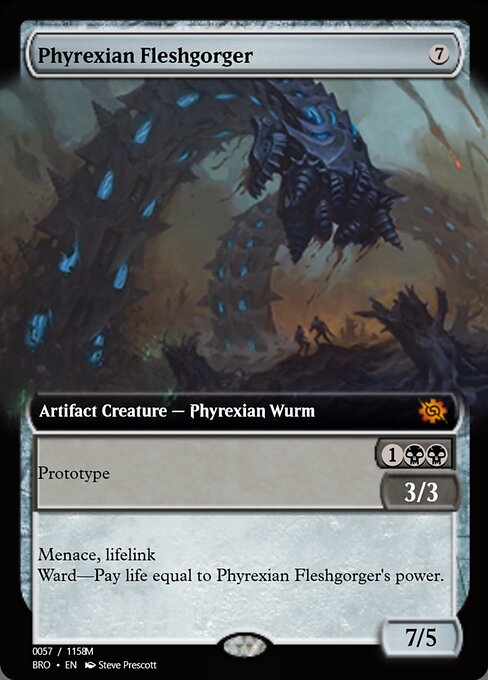
Phyrexian Fleshgorger
Artifact Creature — Phyrexian Wurm
mythic
Prototype — 3/3 (You may cast this spell with different mana cost, color, and size. It keeps its abilities and types.) Menace, lifelink Ward—Pay life equal to this creature's power.
7/5
Semantic Tags
Difficult to block or grants evasion. Includes flying, menace, fear, intimidate, shadow, skulk, horsemanship, unblockable effects, and cards that grant these abilities.
Gains you life. Relevant for lifegain-matters strategies and general survivability.
A keyword ability that causes a player to gain life. See rule 702.15, “Lifelink.”
An evasion ability that makes creatures unblockable by a single creature. See rule 702.111, “Menace.”
A card or token on the battlefield. See rule 110, “Permanents.”
Cares about power of creatures — Fling effects, power-based draw, Xenagos strategies.
A keyword ability that provides a range of benefits against objects with a specific quality. See rule 702.16, “Protection.”
A triggered ability that can counter spells or abilities that target the permanent with ward. See rule 702.21, “Ward.”
Format Legality
Price history
Loading price history…
Printings (5)
| Set | Rarity | TCGplayer | Card Kingdom | Cardmarket |
|---|---|---|---|---|
| Magic Online Promos#105722 | mythic | · | · | · |
| The Brothers' War#332 | mythic | · | · | · |
| The Brothers' War Promos#121p | mythic | · | · | · |
| The Brothers' War Promos#121s | mythic | · | · | · |
| The Brothers' War#121 | mythic | · | · | · |
Related Concepts
Related Rules
If an ability would produce one or more mana of an undefined type, it produces no mana instead.
Some abilities produce mana based on the type of mana another permanent or permanents “could produce.” The type of mana a permanent could produce at any time includes any type of mana that an ability of that permanent would produce if the ability were to resolve at that time, taking into account any applicable replacement effects in any possible order. Ignore whether any costs of the ability could or could not be paid. If that permanent wouldn’t produce any mana under these conditions, or no type of mana can be defined this way, there’s no type of mana it could produce.
To “tap [a permanent] for mana” is to activate a mana ability of that permanent that includes the {T} symbol in its activation cost. See rule 605, “Mana Abilities.”
An ability that triggers whenever a permanent “is tapped for mana” or is tapped for mana of a specified type triggers whenever such a mana ability resolves and produces mana or the specified type of mana.
A replacement effect that applies if a permanent “is tapped for mana” or tapped for mana of a specific type and/or amount modifies the mana production event while such an ability is resolving and producing mana or the specified type and/or amount of mana.
If an object’s enters-the-battlefield triggered ability or replacement effect refers to X, and the spell that became that object as it resolved had a value of X chosen for any of its costs, the value of X for that ability is the same as the value of X for that spell, although the value of X for that permanent is 0. This is an exception to rule 107.3i.
The tap symbol is {T}. The tap symbol in an activation cost means “Tap this permanent.” A permanent that’s already tapped can’t be tapped again to pay the cost. A creature’s activated ability with the tap symbol in its activation cost can’t be activated unless the creature has been under its controller’s control continuously since their most recent turn began. See rule 302.6.
The untap symbol is {Q}. The untap symbol in an activation cost means “Untap this permanent.” A permanent that’s already untapped can’t be untapped again to pay the cost. A creature’s activated ability with the untap symbol in its activation cost can’t be activated unless the creature has been under its controller’s control continuously since their most recent turn began. See rule 302.6.
Rulings
When cast as a prototyped spell, that spell has the mana cost, power, and toughness characteristics shown in its colored, secondary text box rather than the normal values of those characteristics. Its color and mana value are determined by that mana cost. The permanent that spell becomes as it resolves has the same characteristics. If the spell leaves the stack in any other way, or the permanent it becomes leaves the battlefield, it immediately resumes using its normal characteristics.
The amount of life an opponent needs to pay for that spell or ability to resolve is equal to Phyrexian Fleshgorger's power at the time the ward ability resolves, which may be different from its power when the ward ability triggered. If Phyrexian Fleshgorger is no longer on the battlefield at the time the ward ability resolves, use the power it had the last time it was on the battlefield to determine how much life that player must pay (though if Phyrexian Fleshgorger was the only target, the spell has no legal targets anymore and hence it would not resolve even if they pay the life).
Regardless of how it was cast, a prototype card always has the same name, abilities, types, and so on. Only the mana cost, mana value, color, power, and toughness change depending on whether the card was cast as a prototyped spell.
If an effect copies a prototyped spell, that copy (as well as the token it becomes on the battlefield) will have the same characteristics as the prototyped spell. Similarly, if an effect creates a token that's a copy of a prototyped permanent or causes another permanent to become a copy of it, the copy would have the same characteristics as the prototyped permanent.
The prototype ability functions in any zone that the spell could be cast from. For example, if an effect allows you to cast artifact spells from your graveyard, you could cast a prototyped Blitz Automaton from your graveyard.
A prototype card is a colorless card in every zone except the stack or the battlefield, as well as while on the stack or the battlefield if not cast as a prototyped spell. Ignore its alternative characteristics in those cases. For example, while it's in your graveyard, Blitz Automaton is a colorless creature card with mana value 7. It can't be the target of Recommission, a spell that targets an artifact or creature card with mana value 3 or less in your graveyard.
Casting a prototyped spell isn't the same as casting it for an alternative cost, and an alternative cost may be applied to a spell cast this way. For example, if an effect allows you to cast an artifact card without paying its mana cost, you could either cast Blitz Automaton normally, or as a prototyped spell.
When casting a prototyped spell, use only its prototype characteristics to determine whether it's legal to cast it. For example, if Blitz Automaton is exiled with the last ability of Chandra, Dressed to Kill, you would be able to cast it for {2}{R} (because it's a red spell), even though you wouldn't be able to cast it as a colorless spell for its normal cost.