Search
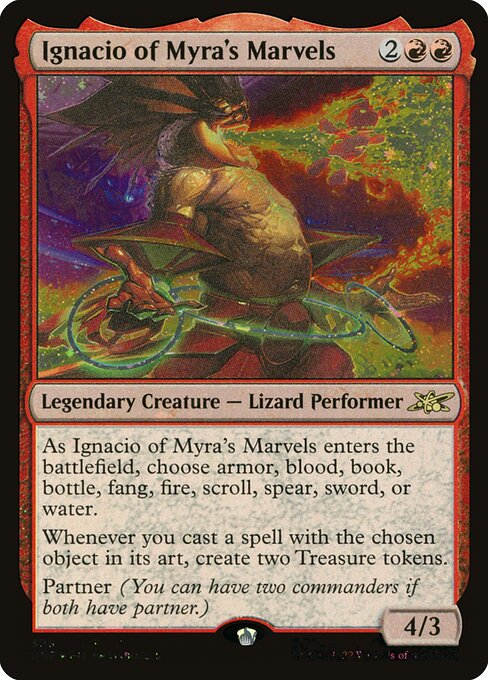
Ignacio of Myra's Marvels
Legendary Creature — Lizard Performer
rare
As Ignacio of Myra's Marvels enters, choose armor, blood, book, bottle, fang, fire, scroll, spear, sword, or water. Whenever you cast a spell with the chosen object in its art, create two Treasure tokens. Partner (You can have two commanders if both have partner.)
4/3
 Card Kingdom
 Cardmarket
Semantic Tags
A card or token on the battlefield. See rule 110, “Permanents.”
Creates creature tokens, Treasure tokens, Food tokens, Clue tokens, or other token types.
Creates Treasure tokens for mana or sacrifice synergies.
Synergies with Treasure tokens beyond just mana — sacrifice triggers, artifact counts.
Format Legality
Price history
Loading price history…
Printings (4)
| Set | Rarity | TCGplayer | Card Kingdom | Cardmarket |
|---|---|---|---|---|
| Unfinity#398 | rare | · | · | · |
| Unfinity#250 | rare | · | · | · |
| Unfinity#501 | rare | · | · | · |
| Unfinity#112 | rare | · | · | · |
Related Rules
If an ability would produce one or more mana of an undefined type, it produces no mana instead.
Some abilities produce mana based on the type of mana another permanent or permanents “could produce.” The type of mana a permanent could produce at any time includes any type of mana that an ability of that permanent would produce if the ability were to resolve at that time, taking into account any applicable replacement effects in any possible order. Ignore whether any costs of the ability could or could not be paid. If that permanent wouldn’t produce any mana under these conditions, or no type of mana can be defined this way, there’s no type of mana it could produce.
To “tap [a permanent] for mana” is to activate a mana ability of that permanent that includes the {T} symbol in its activation cost. See rule 605, “Mana Abilities.”
An ability that triggers whenever a permanent “is tapped for mana” or is tapped for mana of a specified type triggers whenever such a mana ability resolves and produces mana or the specified type of mana.
A replacement effect that applies if a permanent “is tapped for mana” or tapped for mana of a specific type and/or amount modifies the mana production event while such an ability is resolving and producing mana or the specified type and/or amount of mana.
If an object’s enters-the-battlefield triggered ability or replacement effect refers to X, and the spell that became that object as it resolved had a value of X chosen for any of its costs, the value of X for that ability is the same as the value of X for that spell, although the value of X for that permanent is 0. This is an exception to rule 107.3i.
The tap symbol is {T}. The tap symbol in an activation cost means “Tap this permanent.” A permanent that’s already tapped can’t be tapped again to pay the cost. A creature’s activated ability with the tap symbol in its activation cost can’t be activated unless the creature has been under its controller’s control continuously since their most recent turn began. See rule 302.6.
The untap symbol is {Q}. The untap symbol in an activation cost means “Untap this permanent.” A permanent that’s already untapped can’t be untapped again to pay the cost. A creature’s activated ability with the untap symbol in its activation cost can’t be activated unless the creature has been under its controller’s control continuously since their most recent turn began. See rule 302.6.
Rulings
A scroll is one or more pages or parchments, usually designed to be rolled up. Scrolls can be open or closed. Books are not scrolls. They are books. See: Book.
A bottle is a device intended to hold liquid or small objects. It is usually made of glass. Bottles typically have necks and are designed to pour their contents. The bottle may be empty, but it should clearly be designed to hold something.
A book is any bound pages of writing, usually with a spine of some sort. Scrolls are not books. They are scrolls. See: Scroll.
Blood is a liquid, usually red, that comes from within a creature’s circulatory system. If the blood isn’t with its previous owner—say it’s in a pool on the floor—the previous owner doesn’t need to be in the art. The blood does need to contextually be blood. Red liquid in a goblet might not be blood. Red liquid in a goblet held by a vampire? Blood. Red anything at a wedding for a pair of ancient vampires? Take a wild guess.
Water is a liquid found in lakes, oceans, pools, wells, rivers, and glasses both half-empty and half-full. The liquid must contextually be water. Rain counts. Note that you must see the water. A well wouldn’t count if you couldn’t see the water inside, for example, even if the water is implied.
Fire is combustion or burning, whereby substances combine chemically with oxygen from the air and typically give out bright light, heat, and smoke. Fire is usually red, orange, or yellow, but it can be other colors. Note that being a hot thing doesn’t necessarily make something fire. Magma and lava, for example, are not inherently fire, although they may cause fire.
A fang is a tooth, typically longer than a creature’s other teeth, and typically used to puncture enemies, often to drink their blood. The presence of non-fang teeth is important to establish that what you see are fangs and the creature just doesn’t have very long teeth.
If all players can’t agree on what’s in the art, you may consult an outside person for a final determination.
A spear is the recommended serving size of pickle. It is also a pole with a pointed blade on one end. It is traditionally a weapon. For our purposes, the spear can be thrown (javelins are okay), as long the weapon’s general shape clearly implies spear. It can be sticking out of a body.
A sword is a bladed weapon with a handle. If a creature is wearing a scabbard with a sword in it, and all you can see is the handle, that counts.
Armor is a covering worn on the body to protect against damage. It is typically metal or leather, although it can be made from anything. It can’t be a natural part of the creature.