Search
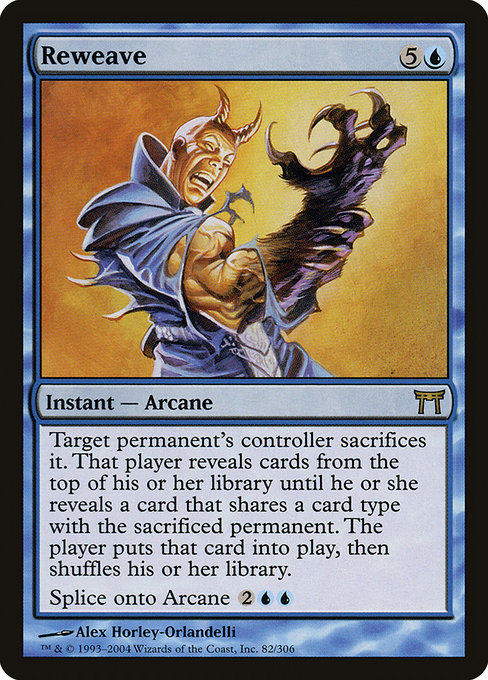
Reweave
Instant — Arcane
rare
Target permanent's controller sacrifices it. If the player does, they reveal cards from the top of their library until they reveal a permanent card that shares a card type with the sacrificed permanent, put that card onto the battlefield, then shuffle. Splice onto Arcane (As you cast an Arcane spell, you may reveal this card from your hand and pay its splice cost. If you do, add this card's effects to that spell.)
 Card Kingdom
 Cardmarket
Semantic Tags
Cares about or manipulates the top card(s) of your library. Includes scry, surveil, and top-deck payoffs.
Format Legality
Price history
Loading price history…
Printings (1)
| Set | Rarity | TCGplayer | Card Kingdom | Cardmarket |
|---|---|---|---|---|
| Champions of Kamigawa#82 | rare | · | · | · |
Related Concepts
Related Rules
If an ability of an object refers to that object by name, and an object with a different name gains that ability, each instance of the first name in the gained ability that refers to the first object by name should be treated as the second name.
If the spell is modal, the player announces the mode choice (see rule 700.2). If the player wishes to splice any cards onto the spell (see rule 702.47), they reveal those cards in their hand. If the spell has alternative or additional costs that will be paid as it’s being cast such as buyback or kicker costs (see rules 118.8 and 118.9), the player announces their intentions to pay any or all of those costs (see rule 601.2f). A player can’t apply two alternative methods of casting or two alternative costs to a single spell. If the spell has a variable cost that will be paid as it’s being cast (such as an {X} in its mana cost; see rule 107.3), the player announces the value of that variable. If the value of that variable is defined in the text of the spell by a choice that player would make later in the announcement or resolution of the spell, that player makes that choice at this time instead of that later time. If a cost that will be paid as the spell is being cast includes hybrid mana symbols, the player announces the nonhybrid equivalent cost they intend to pay. If a cost that will be paid as the spell is being cast includes Phyrexian mana symbols, the player announces whether they intend to pay 2 life or a corresponding colored mana cost for each of those symbols. Previously made choices (such as choosing to cast a spell with flashback from a graveyard or choosing to cast a creature with morph face down) may restrict the player’s options when making these choices.
Splice
You can’t choose to use a splice ability if you can’t make the required choices (targets, etc.) for that card’s rules text. You can’t splice any one card onto the same spell more than once. If you’re splicing more than one card onto a spell, reveal them all at once and choose the order in which their effects will happen. The effects of the main spell must happen first.
A splice ability changes a spell’s text by adding the rules text of the card with splice to the spell, following that spell’s own rules text. It doesn’t modify or replace any of that spell’s own text. (See rule 702.47, “Splice.”)
Splice is a static ability that functions while a card is in your hand. “Splice onto [quality] [cost]” means “You may reveal this card from your hand as you cast a [quality] spell. If you do, that spell gains the text of this card’s rules text and you pay [cost] as an additional cost to cast that spell.” Paying a card’s splice cost follows the rules for paying additional costs in rules 601.2b and 601.2f–h.
The spell has the characteristics of the main spell, plus the rules text of each of the spliced cards. This is a text-changing effect (see rule 612, “Text-Changing Effects”). The spell doesn’t gain any other characteristics (name, mana cost, color, supertypes, card types, subtypes, etc.) of the spliced cards. Text gained by the spell that refers to a card by name refers to the spell on the stack, not the card from which the text was copied.
The spell loses any splice changes once it leaves the stack for any reason.
Rulings
When Reweave resolves it uses the type(s) that the permanent had right before it was sacrificed.
The player reveals cards only if the targeted permanent gets sacrificed.
With the introduction of the kindred type it became possible for an instant or sorcery card to share a type with the sacrificed permanent (ie, a kindred instant card shares a type with a kindred enchantment card). Reweave has received errata so that the effect looks for a *permanent* card that shares a type with the sacrificed permanent. A permanent card is a card that could be put onto the battlefield, which is any card that isn't an instant or sorcery.
You choose all targets for the spell after revealing cards you want to splice, including any targets required by the text of any of those cards. You may choose a different target for each instance of the word "target" on the resulting spell.
A card with a splice ability can't be spliced onto itself because the spell is on the stack (and not in your hand) when you reveal the cards you want to splice onto it.
You reveal all cards you intend to splice at the same time. Each individual card can be spliced only once onto any one spell.
If all of the spell's targets are illegal when the spell tries to resolve, it won't resolve and none of its effects will happen.