Search
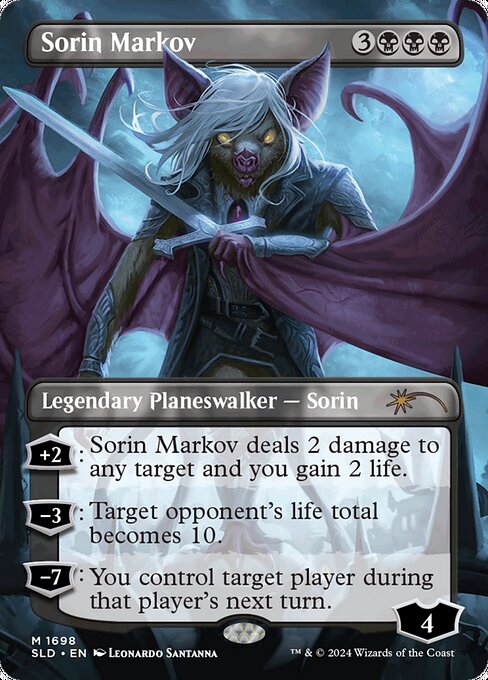
Sorin Markov
Legendary Planeswalker — Sorin
mythic
+2: Sorin Markov deals 2 damage to any target and you gain 2 life. −3: Target opponent's life total becomes 10. −7: You control target player during that player's next turn.
Loyalty: 4
 Card Kingdom
 Cardmarket
Semantic Tags
A spell that deals direct damage to creatures or players.
Gains you life. Relevant for lifegain-matters strategies and general survivability.
A card or token on the battlefield. See rule 110, “Permanents.”
Specifically removes planeswalkers.
Answers an opponent's threat by destroying, exiling, bouncing, or otherwise removing a permanent or spell.
Planeswalker-heavy strategy — proliferate, Doubling Season, planeswalker synergies.
Planeswalker-heavy strategy — proliferate, Doubling Season, planeswalker synergies.
Format Legality
Price history
Loading price history…
Printings (6)
| Set | Rarity | TCGplayer | Card Kingdom | Cardmarket |
|---|---|---|---|---|
| Secret Lair Drop#1698 | mythic | · | · | · |
| The List#M12-109 | mythic | · | · | · |
| The List#ZEN-111 | mythic | · | · | · |
| Mythic Edition#RA3 | mythic | · | · | · |
| Magic 2012#109 | mythic | · | · | · |
| Zendikar#111 | mythic | · | · | · |
Related Rules
If an ability would produce one or more mana of an undefined type, it produces no mana instead.
Some abilities produce mana based on the type of mana another permanent or permanents “could produce.” The type of mana a permanent could produce at any time includes any type of mana that an ability of that permanent would produce if the ability were to resolve at that time, taking into account any applicable replacement effects in any possible order. Ignore whether any costs of the ability could or could not be paid. If that permanent wouldn’t produce any mana under these conditions, or no type of mana can be defined this way, there’s no type of mana it could produce.
To “tap [a permanent] for mana” is to activate a mana ability of that permanent that includes the {T} symbol in its activation cost. See rule 605, “Mana Abilities.”
An ability that triggers whenever a permanent “is tapped for mana” or is tapped for mana of a specified type triggers whenever such a mana ability resolves and produces mana or the specified type of mana.
A replacement effect that applies if a permanent “is tapped for mana” or tapped for mana of a specific type and/or amount modifies the mana production event while such an ability is resolving and producing mana or the specified type and/or amount of mana.
If an object’s enters-the-battlefield triggered ability or replacement effect refers to X, and the spell that became that object as it resolved had a value of X chosen for any of its costs, the value of X for that ability is the same as the value of X for that spell, although the value of X for that permanent is 0. This is an exception to rule 107.3i.
The tap symbol is {T}. The tap symbol in an activation cost means “Tap this permanent.” A permanent that’s already tapped can’t be tapped again to pay the cost. A creature’s activated ability with the tap symbol in its activation cost can’t be activated unless the creature has been under its controller’s control continuously since their most recent turn began. See rule 302.6.
The untap symbol is {Q}. The untap symbol in an activation cost means “Untap this permanent.” A permanent that’s already untapped can’t be untapped again to pay the cost. A creature’s activated ability with the untap symbol in its activation cost can’t be activated unless the creature has been under its controller’s control continuously since their most recent turn began. See rule 302.6.
Rulings
You can use only the affected player’s resources (cards, mana, and so on) to pay costs for that player; you can’t use your own. Similarly, you can use the affected player’s resources only to pay that player’s costs; you can’t spend them on your costs.
While controlling another player, you also continue to make your own choices and decisions.
While controlling another player, you make all choices and decisions that player is allowed to make or is told to make during that turn. For example: -- You choose which lands the other player plays. -- You choose which spells the other player casts, and make all decisions as those spells are cast and as they resolve. For example, you choose the value of X for that player's Earthquake, the target for that player's Lightning Bolt, what mana that player spends to cast Day of Judgment, and what card that player gets with Diabolic Tutor. -- You choose which activated abilities the other player activates, and make all decisions as those abilities are activated and as they resolve. For example, you can have your opponent sacrifice their creatures to their Vampire Aristocrat or have your opponent's Caller of Gales give one of your creatures flying. -- You make all decisions for the other player's triggered abilities, including what they target and any decisions made when they resolve. -- You choose which creatures controlled by the other player attack, who or what they attack, and how they assign their combat damage. -- You make any choices and decisions that player would make for any other reason. For example, you could cast Fact or Fiction, choose that player to divide the revealed cards into piles, and thus divide those cards into piles yourself.
If the player affected by Sorin’s third ability skips their next turn, the ability will wait. You’ll control the next turn the affected player actually takes.
Multiple player-controlling effects that affect the same player overwrite each other. The last one to be created is the one that works.
Sorin’s third ability allows you to control another player. This effect applies to the next turn that the affected player actually takes.
You only control the player. You don’t control any of the other player’s permanents, spells, or abilities.
The player who is being controlled is still the active player.
You could gain control of yourself using Sorin’s third ability, but unless you do so to overwrite someone else’s player-controlling effect, this doesn’t do anything.
You can’t make the affected player concede. That player may choose to concede at any time, even while you’re controlling their turn.
For a player’s life total to become 10, what actually happens is that the player gains or loses the appropriate amount of life. For example, if the targeted opponent’s life total is 4 when this ability resolves, it will cause that player to gain 6 life; alternately, if the targeted player’s life total is 17 when this ability resolves, it will cause that player to lose 7 life. Other cards that interact with life gain or life loss will interact with this effect accordingly.
If the targeted permanent or player is an illegal target by the time Sorin’s first ability resolves, the entire ability doesn’t resolve. You won’t gain life.
You can’t make any illegal decisions or illegal choices — you can’t do anything that player couldn’t do. You can’t make choices or decisions for that player that aren’t called for by the game rules or by any cards, permanents, spells, abilities, and so on. If an effect causes another player to make decisions that the affected player would normally make (such as Master Warcraft does), that effect takes precedence. (In other words, if the affected player wouldn’t make a decision, you wouldn’t make that decision on their behalf.) You also can’t make any choices or decisions for the player that would be called for by the tournament rules (such as whether to take an intentional draw or whether to call a judge).
In a Two-Headed Giant game, Sorin’s second ability causes the targeted opponent’s team’s life total to become 10. Only the targeted player is actually considered to have actually gained or lost life.
Controlling a player doesn’t allow you to look at that player’s sideboard. If an effect instructs that player to choose a card from outside the game, you can’t have that player choose any card.
While controlling another player, you can see all cards in the game that player can see. This includes cards in that player’s hand, face-down cards that player controls, and any cards in that player’s library the player may look at.