Search
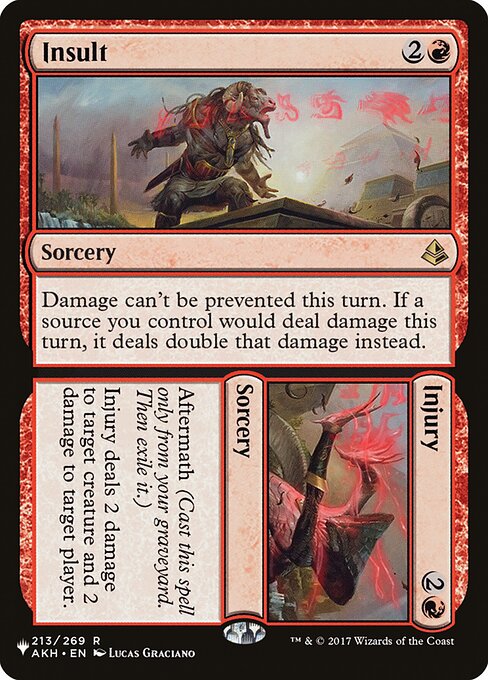
Insult // Injury
Sorcery // Sorcery
rare
Insult
Sorcery
Damage can't be prevented this turn. If a source you control would deal damage this turn, it deals double that damage instead.
Injury
Sorcery
Aftermath (Cast this spell only from your graveyard. Then exile it.) Injury deals 2 damage to target creature and 2 damage to target player or planeswalker.
 Card Kingdom
 Cardmarket
Format Legality
Price history
Loading price history…
Printings (4)
| Set | Rarity | TCGplayer | Card Kingdom | Cardmarket |
|---|---|---|---|---|
| The List#AKH-213 | rare | · | · | · |
| Amonkhet Remastered#162 | rare | · | · | · |
| Amonkhet Promos#213s | rare | · | · | · |
| Amonkhet#213 | rare | · | · | · |
Related Concepts
Related Rules
Some spells or abilities that produce mana restrict how that mana can be spent, have an additional effect that affects the spell or ability that mana is spent on, or create a delayed triggered ability (see rule 603.7a) that triggers when that mana is spent. This doesn’t affect the mana’s type.
An Incubator token is a double-faced token. Its front face is a colorless Incubator artifact with “{2}: Transform this token.” Its back face is a 0/0 colorless Phyrexian artifact creature named Phyrexian Token.
If a player wants to choose the name of the back face of a double-faced card, the player may do so. (See rule 712.) If a player is instructed to choose a card name with certain characteristics, use only the characteristics of the back face to determine if this name can be chosen.
The mana value of an object with no mana cost is 0, unless that object is the back face of a nonmodal double-faced permanent or spell, or it is a melded permanent.
The mana value of the back face of a nonmodal double-faced permanent or spell’s back face is calculated as though it had the mana cost of its front face. If a permanent or spell is a copy of the back face of a nonmodal double-faced object (even if the card representing that copy is itself a double-faced card), the mana value of the copy is 0.
An ability printed on either face of a nonmodal double-faced object (see rule 712) is considered to be “printed on” that object for these purposes, regardless of which face is up.
A double-faced permanent receives a new timestamp each time it transforms or converts.
A replacement effect doesn’t invoke itself repeatedly; it gets only one opportunity to affect an event or any modified events that may replace that event.
Rulings
If another effect allows you to cast a split card with aftermath from any zone other than a graveyard, you can't cast the half with aftermath.
If another effect allows you to cast a split card with aftermath from a graveyard, you may cast either half. If you cast the half that has aftermath, you'll exile the card if it would leave the stack.
Split cards with aftermath have a new frame treatment—the half you can cast from your hand is oriented the same as other cards you'd cast from your hand, while the half you can cast from your graveyard is a traditional split card half. This frame treatment is for your convenience and has no rules significance.
If you cast two Insults in one turn, damage dealt by sources you control this turn will be multiplied by 4. If you cast three Insults, it will be multiplied by 8, and so on. How rude.
Each split card has two names. If an effect instructs you to choose a card name, you may choose one, but not both.
A spell with aftermath cast from a graveyard will always be exiled afterward, whether it resolves, it's countered, or it leaves the stack in some other way.
You can't cast Injury unless you target both a creature and a player. If one target is illegal as Injury resolves, the spell deals damage to the remaining legal target.
If you cast the first half of a split card with aftermath during your turn, you'll have priority immediately after it resolves. You can cast the half with aftermath from your graveyard before any player can take any other action if it's legal for you to do so.
While not on the stack, the characteristics of a split card are the combination of its two halves. For example, Destined // Lead is a green and black card, it is both an instant card and a sorcery card, and its mana value is 6. This means that if an effect allows you to cast a card with mana value 2 from your hand, you can't cast Destined. This is a change from the previous rules for split cards.
If a creature with trample you control would deal combat damage to a blocking creature this turn, you must assign its unmodified damage. For example, a 3/3 creature with trample blocked by a 2/2 creature can only have 1 damage assigned to the defending player. It will then deal 4 damage to the blocking creature and 2 to the defending player.
If an effect such as that of Chandra's Pyrohelix asks you to divide damage among targets, you must divide the unmodified damage before doubling it.
Each split card is a single card. For example, if you discard one, you've discarded one card, not two. If an effect counts the number of instant and sorcery cards in your graveyard, Destined // Lead counts once, not twice.
All split cards have two card faces on a single card, and you put a split card onto the stack with only the half you're casting. The characteristics of the half of the card you didn't cast are ignored while the spell is on the stack. For example, if an effect prevents you from casting green spells, you can cast Destined of Destined // Lead, but not Lead.
Once you've started to cast a spell with aftermath from your graveyard, the card is immediately moved to the stack. Opponents can't try to stop the ability by exiling the card with an effect such as that of Crook of Condemnation.