Search
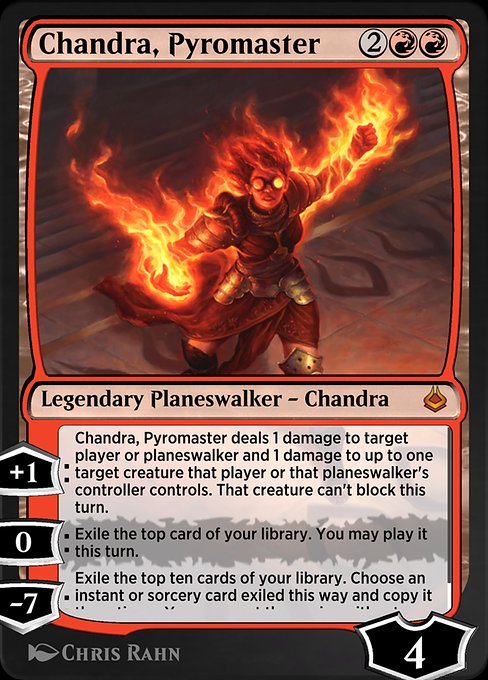
Chandra, Pyromaster
Legendary Planeswalker — Chandra
mythic
+1: Chandra deals 1 damage to target player or planeswalker and 1 damage to up to one target creature that player or that planeswalker's controller controls. That creature can't block this turn. 0: Exile the top card of your library. You may play it this turn. −7: Exile the top ten cards of your library. Choose an instant or sorcery card exiled this way and copy it three times. You may cast the copies without paying their mana costs.
Loyalty: 4
Semantic Tags
A spell that deals direct damage to creatures or players.
Exile-based card advantage — exile cards from the top of your library and cast them temporarily. Red's primary draw mechanic.
A card or token on the battlefield. See rule 110, “Permanents.”
Specifically damages, destroys, or shuts down planeswalkers.
Specifically removes planeswalkers.
Answers an opponent's threat by destroying, exiling, bouncing, or otherwise removing a permanent or spell.
Planeswalker-heavy strategy — proliferate, Doubling Season, planeswalker synergies.
Planeswalker-heavy strategy — proliferate, Doubling Season, planeswalker synergies.
Cares about or manipulates the top card(s) of your library. Includes scry, surveil, and top-deck payoffs.
Format Legality
Price history
Loading price history…
Printings (7)
| Set | Rarity | TCGplayer | Card Kingdom | Cardmarket |
|---|---|---|---|---|
| Amonkhet Remastered#146 | mythic | · | · | · |
| Magic Online Promos#65007 | mythic | · | · | · |
| Archenemy: Nicol Bolas#42 | mythic | · | · | · |
| Magic 2015#134 | mythic | · | · | · |
| San Diego Comic-Con 2014#134 | mythic | · | · | · |
| Magic 2014#132 | mythic | · | · | · |
| San Diego Comic-Con 2013#132★ | mythic | · | · | · |
Related Rules
If an ability would produce one or more mana of an undefined type, it produces no mana instead.
Some abilities produce mana based on the type of mana another permanent or permanents “could produce.” The type of mana a permanent could produce at any time includes any type of mana that an ability of that permanent would produce if the ability were to resolve at that time, taking into account any applicable replacement effects in any possible order. Ignore whether any costs of the ability could or could not be paid. If that permanent wouldn’t produce any mana under these conditions, or no type of mana can be defined this way, there’s no type of mana it could produce.
To “tap [a permanent] for mana” is to activate a mana ability of that permanent that includes the {T} symbol in its activation cost. See rule 605, “Mana Abilities.”
An ability that triggers whenever a permanent “is tapped for mana” or is tapped for mana of a specified type triggers whenever such a mana ability resolves and produces mana or the specified type of mana.
A replacement effect that applies if a permanent “is tapped for mana” or tapped for mana of a specific type and/or amount modifies the mana production event while such an ability is resolving and producing mana or the specified type and/or amount of mana.
If an object’s enters-the-battlefield triggered ability or replacement effect refers to X, and the spell that became that object as it resolved had a value of X chosen for any of its costs, the value of X for that ability is the same as the value of X for that spell, although the value of X for that permanent is 0. This is an exception to rule 107.3i.
The tap symbol is {T}. The tap symbol in an activation cost means “Tap this permanent.” A permanent that’s already tapped can’t be tapped again to pay the cost. A creature’s activated ability with the tap symbol in its activation cost can’t be activated unless the creature has been under its controller’s control continuously since their most recent turn began. See rule 302.6.
The untap symbol is {Q}. The untap symbol in an activation cost means “Untap this permanent.” A permanent that’s already untapped can’t be untapped again to pay the cost. A creature’s activated ability with the untap symbol in its activation cost can’t be activated unless the creature has been under its controller’s control continuously since their most recent turn began. See rule 302.6.
Rulings
To activate the first ability, you must target a player but you can choose to not target any creatures.
While resolving the third ability, you create the copies of the card in exile and cast them from exile. You can cast zero, one, two, or all three copies. The card itself isn't cast. It remains exiled.
Because you're casting the copies "without paying their mana costs," you can't pay any alternative costs for the copies. You can pay additional costs, such as kicker costs. If the copies have any mandatory additional costs, you must pay those.
If you exile a land card using the second ability, you may play that land only if you have any available land plays. Normally, this means you can play the land only if you haven't played a land yet that turn.
In the third ability, "exiled this way" means the cards you just exiled because of that ability resolving. Cards exiled with the second ability or with previous activations of the third ability don't count.
If the first ability resolves but the damage is prevented or redirected, the target creature still won't be able to block that turn.
The card exiled by the second ability is exiled face up. Playing it follows the normal rules for playing that card. You must pay its costs, and you must follow all applicable timing rules. For example, if it's a creature card, you can cast it only during your main phase while the stack is empty.
If the copied card has {X} in its mana cost, you must choose 0 as its value when casting the copies.
While casting the copies created by the third ability, timing restrictions based on the card's type (such as creature or sorcery) are ignored. Other restrictions, such as "Cast [this spell] only during combat," are not.