Search
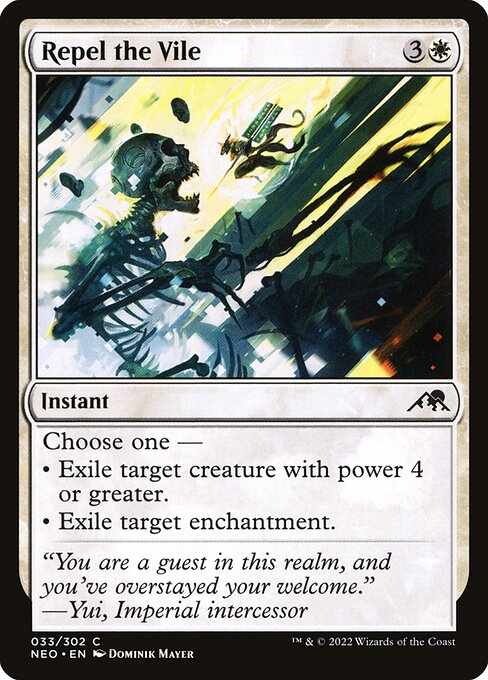
Repel the Vile
Instant
common
Choose one — • Exile target creature with power 4 or greater. • Exile target enchantment.
 Card Kingdom
 Cardmarket
Semantic Tags
A keyword ability that lets you tap creatures rather than pay mana to cast a spell. See rule 702.51, “Convoke.”
Specifically removes creatures — destroy, exile, damage, or -X/-X.
Specifically removes creatures — destroy, exile, damage, or -X/-X.
Specifically destroys, exiles, or shuts down enchantments.
Specifically destroys, exiles, or shuts down enchantments.
Specifically removes enchantments.
Specifically removes enchantments.
A keyword ability that can make a creature better in combat. See rule 702.83, “Exalted.”
Removes threats by exiling rather than destroying — bypasses indestructible and death triggers.
Removes threats by exiling rather than destroying — bypasses indestructible and death triggers.
A keyword ability that lets a creature ignore the “summoning sickness” rule. See rule 702.10, “Haste,” and rule 302.6.
Cares about power of creatures — Fling effects, power-based draw, Xenagos strategies.
Answers an opponent's threat by destroying, exiling, bouncing, or otherwise removing a permanent or spell.
Format Legality
Price history
Loading price history…
Printings (1)
| Set | Rarity | TCGplayer | Card Kingdom | Cardmarket |
|---|---|---|---|---|
| Kamigawa: Neon Dynasty#33 | common | · | · | · |
Related Rules
A spell or ability that creates a token sets both its name and its subtype(s). If the spell or ability doesn’t specify the name of the token, its name is the same as its subtype(s) plus the word “Token.” Once a token is on the battlefield, changing its name doesn’t change its subtype(s), and vice versa.
If an effect instructs a player to create a token that is a copy of a nonexistent object, no token is created (see rule 707, “Copying Objects”). This does not apply to an effect that would use the last known information of an object.
A keyword counter on a permanent or on a card in a zone other than the battlefield causes that object to gain that keyword. The keywords that a keyword counter can be are flying, first strike, double strike, deathtouch, decayed, exalted, haste, hexproof, indestructible, lifelink, menace, reach, shadow, trample, and vigilance, as well as any variants of those keywords. See rule 613.1f.
The active player chooses which creatures that they control, if any, will attack. The chosen creatures must be untapped, they can’t also be battles, and each one must either have haste or have been controlled by the active player continuously since the turn began.
A creature’s activated ability with the tap symbol ({T}) or the untap symbol ({Q}) in its activation cost can’t be activated unless the creature has been under its controller’s control since the start of their most recent turn. Ignore this rule for creatures with haste (see rule 702.10).
If an effect should be applied in different layers and/or sublayers, the parts of the effect each apply in their appropriate ones. If an effect starts to apply in one layer and/or sublayer, it will continue to be applied to the same set of objects in each other applicable layer and/or sublayer, even if the ability generating the effect is removed during this process.
“Earthbend N” means “Target land you control becomes a 0/0 land creature with haste in addition to its other types. Put N +1/+1 counters on it. When that land dies or is put into exile, return it to the battlefield tapped under your control.”
Haste