Search
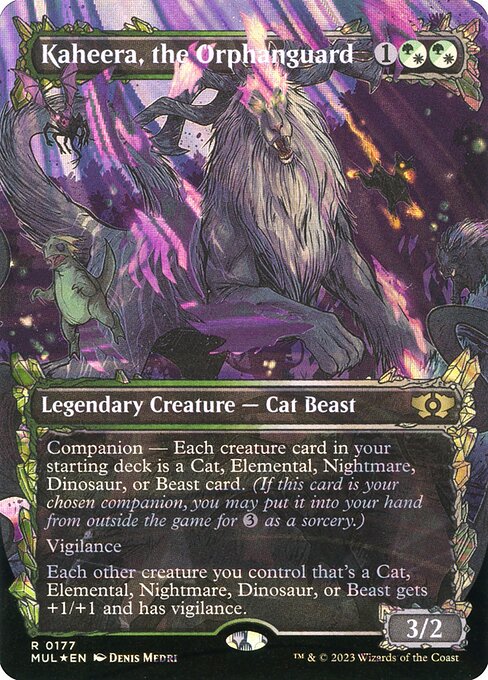
Kaheera, the Orphanguard
Legendary Creature — Cat Beast
rare
Companion — Each creature card in your starting deck is a Cat, Elemental, Nightmare, Dinosaur, or Beast card. (If this card is your chosen companion, you may put it into your hand from outside the game for as a sorcery.) Vigilance Each other creature you control that's a Cat, Elemental, Nightmare, Dinosaur, or Beast gets +1/+1 and has vigilance.
3/2
 Card Kingdom
 Cardmarket
Semantic Tags
Puts additional cards into your hand. Includes direct draw, 'look/reveal and put into hand' effects, and conditional draw triggers.
Suited for blocking and defense. Includes defender, reach, vigilance, and cards that incentivize blocking.
A card or token on the battlefield. See rule 110, “Permanents.”
Cares about creature types — lords, type-matters effects, and changeling.
A keyword ability that lets a creature attack without tapping. See rule 702.20, “Vigilance.”
Format Legality
Price history
Loading price history…
Printings (9)
| Set | Rarity | TCGplayer | Card Kingdom | Cardmarket |
|---|---|---|---|---|
| Multiverse Legends#177 | rare | · | · | · |
| Multiverse Legends#177z | rare | · | · | · |
| Multiverse Legends#47 | rare | · | · | · |
| Multiverse Legends#112 | rare | · | · | · |
| Magic Online Promos#80861 | rare | · | · | · |
| Ikoria: Lair of Behemoths Promos#224p | rare | · | · | · |
| Ikoria: Lair of Behemoths#353 | rare | · | · | · |
| Ikoria: Lair of Behemoths Promos#224s | rare | · | · | · |
| Ikoria: Lair of Behemoths#224 | rare | · | · | · |
Related Concepts
A keyword ability that allows a player to choose one creature card from outside the game as a companion if the restriction of that card’s companion ability is met. Once a player has chosen a companion, that player may pay {3} to put it into their hand once during the game. See rule 702.139, “Companion.”
Related Rules
If any players wish to reveal a card with a companion ability that they own from outside the game, they may do so. A player may reveal no more than one card this way, and they may do so only if their deck fulfills the condition of that card’s companion ability. The revealed card remains outside the game. (See rule 702.139, “Companion.”)
If an ability would produce one or more mana of an undefined type, it produces no mana instead.
Some abilities produce mana based on the type of mana another permanent or permanents “could produce.” The type of mana a permanent could produce at any time includes any type of mana that an ability of that permanent would produce if the ability were to resolve at that time, taking into account any applicable replacement effects in any possible order. Ignore whether any costs of the ability could or could not be paid. If that permanent wouldn’t produce any mana under these conditions, or no type of mana can be defined this way, there’s no type of mana it could produce.
To “tap [a permanent] for mana” is to activate a mana ability of that permanent that includes the {T} symbol in its activation cost. See rule 605, “Mana Abilities.”
An ability that triggers whenever a permanent “is tapped for mana” or is tapped for mana of a specified type triggers whenever such a mana ability resolves and produces mana or the specified type of mana.
A replacement effect that applies if a permanent “is tapped for mana” or tapped for mana of a specific type and/or amount modifies the mana production event while such an ability is resolving and producing mana or the specified type and/or amount of mana.
If an object’s enters-the-battlefield triggered ability or replacement effect refers to X, and the spell that became that object as it resolved had a value of X chosen for any of its costs, the value of X for that ability is the same as the value of X for that spell, although the value of X for that permanent is 0. This is an exception to rule 107.3i.
The tap symbol is {T}. The tap symbol in an activation cost means “Tap this permanent.” A permanent that’s already tapped can’t be tapped again to pay the cost. A creature’s activated ability with the tap symbol in its activation cost can’t be activated unless the creature has been under its controller’s control continuously since their most recent turn began. See rule 302.6.
Rulings
Before shuffling your deck to become your library, you may reveal one card from outside the game to be your companion if your starting deck meets the requirements of the companion ability. You can't reveal more than one. It remains revealed outside the game as the game begins.
You may have one companion in the Commander variant. Your deck, including your commander, must meet its companion requirement. Your companion is not one of your one hundred cards.
The requirements of the companion ability apply only to your starting deck. They do not apply to your sideboard.
If more than one player wishes to reveal a companion, the starting player does so first, and players proceed in turn order. Once a player has chosen not to reveal a companion, that player can't change their mind.
The companion's other abilities apply only if the creature is on the battlefield. They have no effect while the companion is outside the game.
Paying {3} to put your companion into your hand is a special action. It doesn't use the stack and players can't respond to it. Once you take this action, you may cast that card if it's legal to do so before any other player can take actions.
A creature that's more than one of the five types gets +1/+1 only once from Kaheera's last ability.
The companion ability has no effect if the card is in your starting deck and creates no restriction on putting a card with a companion ability into your starting deck. For example, Zirda may be in your starting deck even if your other permanent cards don't all have activated abilities.
If you reveal a companion outside the game, for as long as it remains there, you may pay {3} any time you could cast a sorcery (that is, you have priority during your main phase and the stack is empty). Once you do, you put it into your hand and behaves like any other card you've brought into the game. For example, if it's discard, countered, or destroyed, it's put into your graveyard, remaining in the game. This is a change from previous rules.
Creature cards in your deck may be a mix of the five creature types that Kaheera cares about. They may also have additional types, as long as each creature card is at least one of those five. Noncreature cards may have any subtypes.
Your companion begins the game outside the game. In tournament play, this means your sideboard. In casual play, it's simply a card you own that's not in your starting deck.
Once you put your companion into your hand, it behaves like any other card you’ve brought into the game. For example, if it’s countered or destroyed, it’s put into your graveyard, remaining in the game.
Paying {3} to put your companion into your hand is a special action. It doesn't use the stack and players can't respond to it. Once you take this action, you may cast that card if it's legal to do so before any other player can take actions.
If you reveal a companion outside the game, for as long as it remains there, you may pay {3} any time you could cast a sorcery (that is, you have priority during your main phase and the stack is empty). Once you do, you put it into your hand and behaves like any other card you've brought into the game. For example, if it's discarded, countered, or destroyed, it's put into your graveyard, remaining in the game. This is a change from previous rules.
Wizards of the Coast has issued functional errata for the Companion mechanic. Instead of casting companions from outside the game: Once per game, any time you could cast a sorcery (during your main phase when the stack is empty), you can pay {3} to put your companion from your sideboard into your hand. This is a special action, not an activated ability. It happens immediately and can’t be responded to. It can’t be countered or stopped by cards like Phyrexian Revoker. For more information please see https://magic.wizards.com/en/articles/archive/news/june-1-2020-banned-and-restricted-announcement