Search
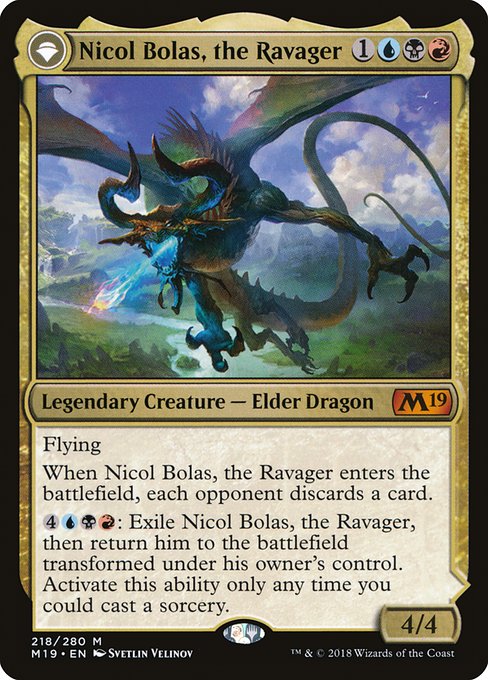
Nicol Bolas, the Ravager
Legendary Creature — Elder Dragon
mythic
Flying When Nicol Bolas enters, each opponent discards a card. : Exile Nicol Bolas, then return him to the battlefield transformed under his owner's control. Activate only as a sorcery.
4/4
 Card Kingdom
 Cardmarket
Semantic Tags
Difficult to block or grants evasion. Includes flying, menace, fear, intimidate, shadow, skulk, horsemanship, unblockable effects, and cards that grant these abilities.
A keyword ability that restricts how a creature may be blocked. See rule 702.9, “Flying.”
A card or token on the battlefield. See rule 110, “Permanents.”
Planeswalker-heavy strategy — proliferate, Doubling Season, planeswalker synergies.
Format Legality
Price history
Loading price history…
Printings (5)
| Set | Rarity | TCGplayer | Card Kingdom | Cardmarket |
|---|---|---|---|---|
| Secret Lair Drop#1158 | mythic | · | · | · |
| Secret Lair Drop#1211 | mythic | · | · | · |
| Judge Gift Cards 2021#9 | mythic | · | · | · |
| Core Set 2019#218 | mythic | · | · | · |
| Core Set 2019 Promos#218s | mythic | · | · | · |
Related Concepts
Related Rules
If an ability would produce one or more mana of an undefined type, it produces no mana instead.
Some abilities produce mana based on the type of mana another permanent or permanents “could produce.” The type of mana a permanent could produce at any time includes any type of mana that an ability of that permanent would produce if the ability were to resolve at that time, taking into account any applicable replacement effects in any possible order. Ignore whether any costs of the ability could or could not be paid. If that permanent wouldn’t produce any mana under these conditions, or no type of mana can be defined this way, there’s no type of mana it could produce.
To “tap [a permanent] for mana” is to activate a mana ability of that permanent that includes the {T} symbol in its activation cost. See rule 605, “Mana Abilities.”
An ability that triggers whenever a permanent “is tapped for mana” or is tapped for mana of a specified type triggers whenever such a mana ability resolves and produces mana or the specified type of mana.
A replacement effect that applies if a permanent “is tapped for mana” or tapped for mana of a specific type and/or amount modifies the mana production event while such an ability is resolving and producing mana or the specified type and/or amount of mana.
If an object’s enters-the-battlefield triggered ability or replacement effect refers to X, and the spell that became that object as it resolved had a value of X chosen for any of its costs, the value of X for that ability is the same as the value of X for that spell, although the value of X for that permanent is 0. This is an exception to rule 107.3i.
The tap symbol is {T}. The tap symbol in an activation cost means “Tap this permanent.” A permanent that’s already tapped can’t be tapped again to pay the cost. A creature’s activated ability with the tap symbol in its activation cost can’t be activated unless the creature has been under its controller’s control continuously since their most recent turn began. See rule 302.6.
The untap symbol is {Q}. The untap symbol in an activation cost means “Untap this permanent.” A permanent that’s already untapped can’t be untapped again to pay the cost. A creature’s activated ability with the untap symbol in its activation cost can’t be activated unless the creature has been under its controller’s control continuously since their most recent turn began. See rule 302.6.
Rulings
While a double-faced card isn't on the battlefield, consider only the characteristics of its front face. For example, Nicol Bolas has the characteristics of its creature face in the graveyard, even if it was a planeswalker on the battlefield before it was put into the graveyard.
The mana value of a double-faced card is the mana value of its front face, even while it's on the battlefield with its back face up. For example, the mana value of Nicol Bolas, the Arisen is 4.
A double-faced card enters the battlefield with its front face up by default, unless a spell or ability instructs you to put it onto the battlefield transformed, in which case it enters with its back face up. The back face of a double-faced card can't be played.
Nicol Bolas, the Arisen has a color indicator on its typeline. This color indicator means that it's a blue, black, and red permanent.
In a multiplayer game, if a player leaves the game, all cards that player owns leave as well. If you leave the game, any permanents you control from Nicol Bolas's third loyalty ability that came from other players' graveyards are exiled.
If another permanent that isn't a double-faced card (such as Mirror Image) becomes a copy of Nicol Bolas, the Ravager, activating the ability to exile it and return it transformed will only exile it. It won't return to the battlefield at all.
In some rare cases, a spell or ability may cause Nicol Bolas to transform while it's a creature on the battlefield. If this happens, the resulting planeswalker won't have any loyalty counters on it and will subsequently be put into its owner's graveyard.
Each face of a double-faced card has its own set of characteristics: name, types, subtypes, abilities, and so on. While a double-faced card is on the battlefield, consider only the characteristics of the face that's currently up. The other set of characteristics is ignored.
You can activate one of the planeswalker's loyalty abilities the turn it enters the battlefield.
If Nicol Bolas leaves the battlefield after his creature face's activated ability has been activated but before it resolves, the card remains in whichever zone it moves to. It won't be exiled or return transformed.
When Nicol Bolas's enters-the-battlefield triggered ability resolves, first the next opponent in turn order (or, if it's an opponent's turn, that opponent) chooses a card in their hand without revealing it, then each other opponent in turn order does the same. Then all the chosen cards are discarded at the same time.