Search
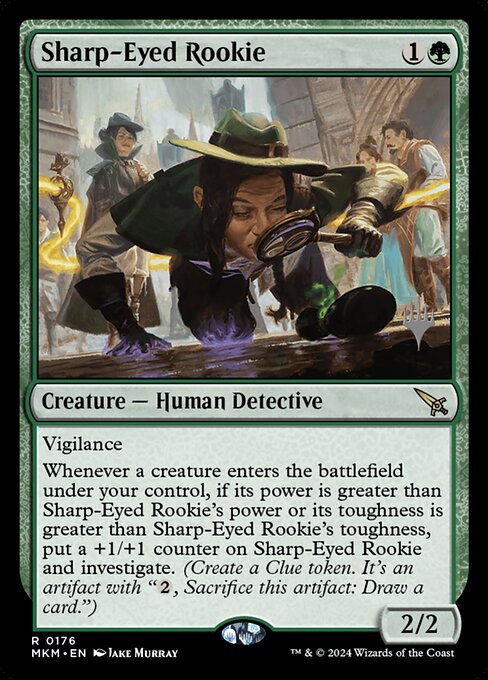
Sharp-Eyed Rookie
Creature — Human Detective
rare
Vigilance Whenever a creature you control enters, if its power is greater than this creature's power or its toughness is greater than this creature's toughness, put a +1/+1 counter on this creature and investigate. (Create a Clue token. It's an artifact with ", Sacrifice this token: Draw a card.")
2/2
 Card Kingdom
 Cardmarket
Semantic Tags
A spell that replaces itself by drawing a card as part of its resolution.
Puts additional cards into your hand. Includes direct draw, 'look/reveal and put into hand' effects, and conditional draw triggers.
Clue token and investigate synergies — card draw and artifact interactions.
Clue token and investigate synergies — card draw and artifact interactions.
Cares about +1/+1 counters — places, moves, doubles, or benefits from counters on creatures.
Suited for blocking and defense. Includes defender, reach, vigilance, and cards that incentivize blocking.
A permanent with a repeatable activated ability that converts excess mana into value.
A card or token on the battlefield. See rule 110, “Permanents.”
Creates creature tokens, Treasure tokens, Food tokens, Clue tokens, or other token types.
A keyword ability that lets a creature attack without tapping. See rule 702.20, “Vigilance.”
A keyword ability that lets a creature attack without tapping. See rule 702.20, “Vigilance.”
Format Legality
Price history
Loading price history…
Printings (4)
| Set | Rarity | TCGplayer | Card Kingdom | Cardmarket |
|---|---|---|---|---|
| Murders at Karlov Manor Promos#176p | rare | · | · | · |
| Murders at Karlov Manor#176 | rare | · | · | · |
| Murders at Karlov Manor#353 | rare | · | · | · |
| Murders at Karlov Manor Promos#176s | rare | · | · | · |
Related Concepts
A keyword action that creates a Clue artifact token. See rule 701.16, “Investigate.”
Related Rules
If an ability would produce one or more mana of an undefined type, it produces no mana instead.
Some abilities produce mana based on the type of mana another permanent or permanents “could produce.” The type of mana a permanent could produce at any time includes any type of mana that an ability of that permanent would produce if the ability were to resolve at that time, taking into account any applicable replacement effects in any possible order. Ignore whether any costs of the ability could or could not be paid. If that permanent wouldn’t produce any mana under these conditions, or no type of mana can be defined this way, there’s no type of mana it could produce.
To “tap [a permanent] for mana” is to activate a mana ability of that permanent that includes the {T} symbol in its activation cost. See rule 605, “Mana Abilities.”
An ability that triggers whenever a permanent “is tapped for mana” or is tapped for mana of a specified type triggers whenever such a mana ability resolves and produces mana or the specified type of mana.
A replacement effect that applies if a permanent “is tapped for mana” or tapped for mana of a specific type and/or amount modifies the mana production event while such an ability is resolving and producing mana or the specified type and/or amount of mana.
If an object’s enters-the-battlefield triggered ability or replacement effect refers to X, and the spell that became that object as it resolved had a value of X chosen for any of its costs, the value of X for that ability is the same as the value of X for that spell, although the value of X for that permanent is 0. This is an exception to rule 107.3i.
The tap symbol is {T}. The tap symbol in an activation cost means “Tap this permanent.” A permanent that’s already tapped can’t be tapped again to pay the cost. A creature’s activated ability with the tap symbol in its activation cost can’t be activated unless the creature has been under its controller’s control continuously since their most recent turn began. See rule 302.6.
The untap symbol is {Q}. The untap symbol in an activation cost means “Untap this permanent.” A permanent that’s already untapped can’t be untapped again to pay the cost. A creature’s activated ability with the untap symbol in its activation cost can’t be activated unless the creature has been under its controller’s control continuously since their most recent turn began. See rule 302.6.
Rulings
Some abilities trigger "whenever you sacrifice a Clue". Those abilities trigger whenever you sacrifice a Clue for any reason, not just to activate a Clue's activated ability.
If an effect refers to a Clue, it means any Clue artifact, not just a Clue artifact token. For example, you can sacrifice Wrench to pay for Alquist Proft, Master Sleuth's activated ability.
Some spells and abilities that investigate may require targets. If each target chosen is an illegal target as that spell or ability tries to resolve, it won't resolve. You won't create any Clue tokens.
You can't sacrifice a Clue to pay multiple costs. For example, you can't sacrifice a Clue token to activate its own ability and also to activate Alquist Proft, Master Sleuth's ability.
If multiple creatures enter the battlefield at the same time, Sharp-Eyed Rookie's triggered ability may trigger multiple times, although the stat comparison will take place each time one of those abilities tries to resolve. For example, if you control a 2/2 Sharp-Eyed Rookie and two 3/3 creatures enter the battlefield, Sharp-Eyed Rookie's triggered ability will trigger twice. The first ability will resolve, and you'll put a +1/+1 counter on Sharp-Eyed Rookie and investigate. When the second ability tries to resolve, neither the power nor the toughness of the new creature is greater than that of Sharp-Eyed Rookie, so that ability does nothing.
If Sharp-Eyed Rookie's triggered ability triggers, the stat comparison will happen again when the ability tries to resolve. If neither stat of the new creature is greater, the ability will do nothing. If the creature that entered the battlefield leaves the battlefield before the ability tries to resolve, use its power and toughness as it last existed on the battlefield for the purposes of the comparison.
When a creature enters the battlefield under your control, check its power and toughness against Sharp-Eyed Rookie's power and toughness. If neither stat of the new creature is greater, Sharp-Eyed Rookie's triggered ability won't trigger at all.
If a creature enters the battlefield with +1/+1 counters on it, consider those counters when determining if Sharp-Eyed Rookie's triggered ability will trigger. For example, a 1/1 creature that enters the battlefield with two +1/+1 counters on it will cause a 2/2 Sharp-Eyed Rookie's ability to trigger.
When comparing the stats as Sharp-Eyed Rookie's ability resolves, it's possible that the stat that's greater changes from power to toughness or vice versa. If this happens, the ability will still resolve and you'll put a +1/+1 counter on Sharp-Eyed Rookie and investigate. For example, if you control a 2/2 Sharp-Eyed Rookie and a 1/3 creature enters the battlefield under your control, its toughness is greater, so Sharp-Eyed Rookie's triggered ability will trigger. In response, the 1/3 creature gets +2/-2. When Sharp-Eyed Rookie's ability tries to resolve, the other creature's power is greater, so you'll put a +1/+1 counter on Sharp-Eyed Rookie and investigate.
Clue is an artifact type. Even though it appears on some cards with other permanent types, it's never a creature type, a land type, or anything but an artifact type.