Search
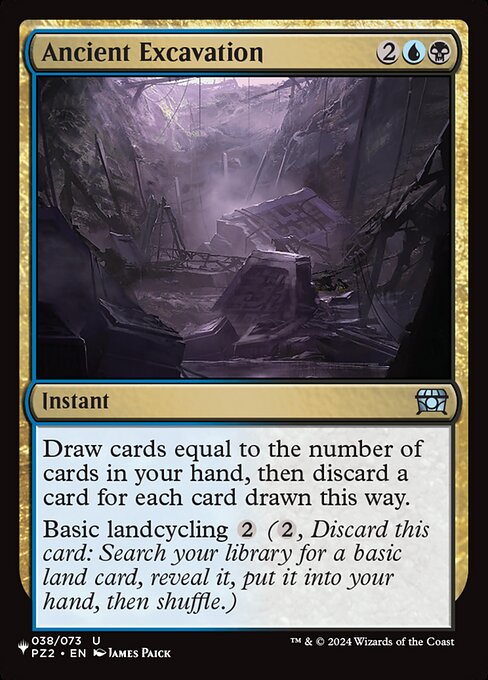
Ancient Excavation
Instant
uncommon
Draw cards equal to the number of cards in your hand, then discard a card for each card drawn this way. Basic landcycling (, Discard this card: Search your library for a basic land card, reveal it, put it into your hand, then shuffle.)
 Card Kingdom
 Cardmarket
Semantic Tags
Puts additional cards into your hand. Includes direct draw, 'look/reveal and put into hand' effects, and conditional draw triggers.
A keyword ability that lets a card be discarded and replaced with a new card. See rule 702.29, “Cycling.”
A keyword ability that lets a card be discarded and replaced with a new card. See rule 702.29, “Cycling.”
Cycling-focused strategy — payoffs for cycling, cycling triggers, Astral Drift effects.
Benefits from discarding cards — madness, Waste Not effects, Oskar strategies.
A permanent or ability that lets you discard cards for value or at will.
Forces opponents to discard cards from their hand. Targeted discard, mass discard, and discard-or-pay effects.
Destroys or removes lands.
Puts additional lands onto the battlefield or searches for lands. Cultivate, Kodama's Reach, fetchlands.
Draw-then-discard or discard-then-draw effects that improve hand quality without net card advantage.
Draw-then-discard or discard-then-draw effects that improve hand quality without net card advantage.
A permanent with a repeatable activated ability that converts excess mana into value.
Accelerates mana production beyond the one-land-per-turn baseline. Umbrella tag — see ramp subtypes for land ramp, mana dorks, mana rocks, and rituals.
Makes all players discard their hand and draw a new one. Named after Wheel of Fortune.
Format Legality
Price history
Loading price history…
Printings (4)
| Set | Rarity | TCGplayer | Card Kingdom | Cardmarket |
|---|---|---|---|---|
| The List#PZ2-38 | uncommon | · | · | · |
| Commander Anthology Volume II#150 | uncommon | · | · | · |
| Treasure Chest#38 | uncommon | · | · | · |
| Commander 2016#27 | uncommon | · | · | · |
Related Concepts
A variant of the cycling ability. See rule 702.29, “Cycling.”
Related Rules
Cycling
Cycling is an activated ability that functions only while the card with cycling is in a player’s hand. “Cycling [cost]” means “[Cost], Discard this card: Draw a card.”
Although the cycling ability can be activated only if the card is in a player’s hand, it continues to exist while the object is on the battlefield and in all other zones. Therefore objects with cycling will be affected by effects that depend on objects having one or more activated abilities.
Some cards with cycling have abilities that trigger when they’re cycled. “When you cycle this card” means “When you discard this card to pay an activation cost of a cycling ability.” These abilities trigger from whatever zone the card winds up in after it’s cycled.
Typecycling is a variant of the cycling ability. “[Type]cycling [cost]” means “[Cost], Discard this card: Search your library for a [type] card, reveal it, and put it into your hand. Then shuffle your library.” This type is usually a subtype (as in “mountaincycling”) but can be any card type, subtype, supertype, or combination thereof (as in “basic landcycling”).
Typecycling abilities are cycling abilities, and typecycling costs are cycling costs. Any cards that trigger when a player cycles a card will trigger when a card is discarded to pay an activation cost of a typecycling ability. Any effect that stops players from cycling cards will stop players from activating cards’ typecycling abilities. Any effect that increases or reduces a cycling cost will increase or reduce a typecycling cost. Any effect that looks for a card with cycling will find a card with typecycling.
Rulings
The number of cards drawn this way might not be equal to the number of cards in your hand (for example, if you apply Necroplasm’s dredge ability instead of drawing one of those cards). The number of cards that you actually drew is what determines how many cards you discard.
The number of cards in your hand is counted only as Ancient Excavation resolves. Ancient Excavation is on the stack at this time, so it’s not counted.