Search
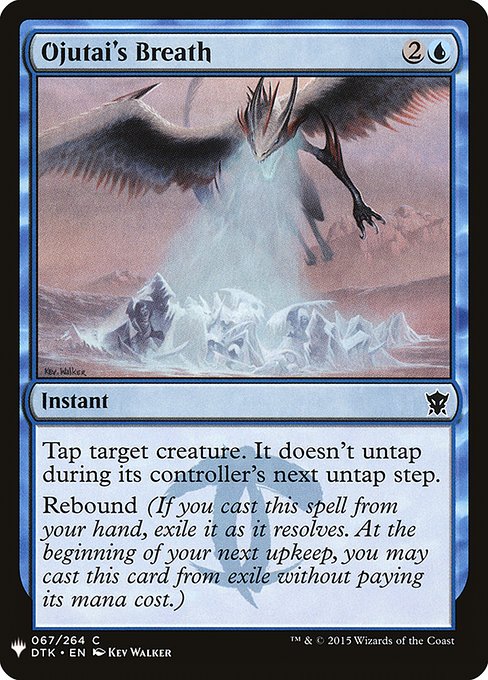
Ojutai's Breath
Instant
common
Tap target creature. It doesn't untap during its controller's next untap step. Rebound (If you cast this spell from your hand, exile it as it resolves. At the beginning of your next upkeep, you may cast this card from exile without paying its mana cost.)
 Card Kingdom
 Cardmarket
Semantic Tags
Format Legality
Price history
Loading price history…
Printings (3)
| Set | Rarity | TCGplayer | Card Kingdom | Cardmarket |
|---|---|---|---|---|
| The List#DTK-67 | common | · | · | · |
| Iconic Masters#68 | common | · | · | · |
| Dragons of Tarkir#67 | common | · | · | · |
Related Concepts
Related Rules
Convoke
Convoke is a static ability that functions while the spell with convoke is on the stack. “Convoke” means “For each colored mana in this spell’s total cost, you may tap an untapped creature of that color you control rather than pay that mana. For each generic mana in this spell’s total cost, you may tap an untapped creature you control rather than pay that mana.”
The convoke ability isn’t an additional or alternative cost and applies only after the total cost of the spell with convoke is determined.
Multiple instances of convoke on the same spell are redundant.
Rebound
Rebound appears on some instants and sorceries. It represents a static ability that functions while the spell is on the stack and may create a delayed triggered ability. “Rebound” means “If this spell was cast from your hand, instead of putting it into your graveyard as it resolves, exile it and, at the beginning of your next upkeep, you may cast this card from exile without paying its mana cost.”
Casting a spell as an effect of its rebound ability follows the rules for paying alternative costs in rules 601.2b and 601.2f–h.
Multiple instances of rebound on the same spell are redundant.
Rulings
Casting the card again due to the delayed triggered ability is optional. If you choose not to cast the card, or if you can’t (perhaps because there are no legal targets available), the card will stay exiled. You won’t get another chance to cast it on a future turn.
If you cast a card from exile this way, it will go to its owner’s graveyard when it resolves, fails to resolve, or is countered. It won’t go back to exile.
If a replacement effect (such as the one created by Rest in Peace) would cause a spell with rebound that you cast from your hand to be put somewhere other than into your graveyard as it resolves, you can choose whether to apply the rebound effect or the other effect as the spell resolves.
At the beginning of your upkeep, all delayed triggered abilities created by rebound effects trigger. You may handle them in any order. If you want to cast a card this way, you do so as part of the resolution of its delayed triggered ability. Timing restrictions based on the card’s type (if it’s a sorcery) are ignored. Other restrictions, such as “Cast [this spell] only during combat,” must be followed.
Rebound will have no effect on copies of spells because you don’t cast them from your hand.
If a spell with rebound that you cast from your hand doesn’t resolve for any reason (either because another spell or ability counters it or because all its targets are illegal as it tries to resolve), none of its effects will happen, including rebound. The spell will be put into its owner’s graveyard and you won’t get to cast it again on your next turn.
If you cast a spell with rebound from any zone other than your hand (including your opponent’s hand), rebound will have no effect.
As long as you cast a spell with rebound from your hand, rebound will work regardless of whether you paid its mana cost or an alternative cost you were permitted to pay.
Ojutai’s Breath can target a creature that’s already tapped. It still won’t untap during its controller’s next untap step.