Search
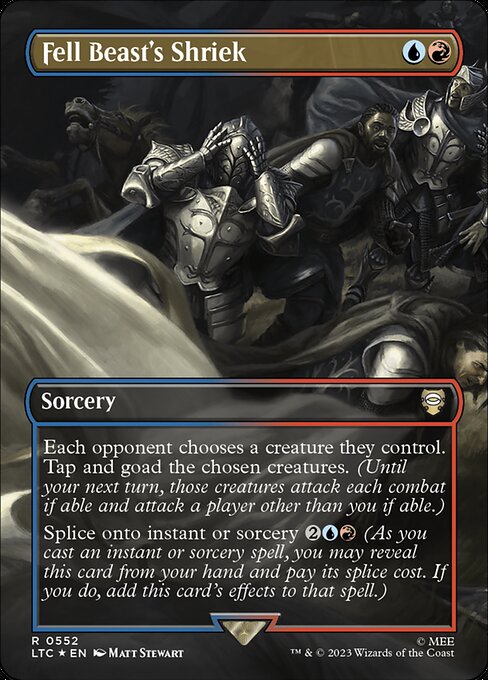
Fell Beast's Shriek
Sorcery
rare
Each opponent chooses a creature they control. Tap and goad the chosen creatures. (Until your next turn, those creatures attack each combat if able and attack a player other than you if able.) Splice onto instant or sorcery (As you cast an instant or sorcery spell, you may reveal this card from your hand and pay its splice cost. If you do, add this card's effects to that spell.)
 Card Kingdom
 Cardmarket
Format Legality
Price history
Loading price history…
Printings (2)
| Set | Rarity | TCGplayer | Card Kingdom | Cardmarket |
|---|---|---|---|---|
| Tales of Middle-earth Commander#552 | rare | · | · | · |
| Tales of Middle-earth Commander#508 | rare | · | · | · |
Related Concepts
Related Rules
If an ability of an object refers to that object by name, and an object with a different name gains that ability, each instance of the first name in the gained ability that refers to the first object by name should be treated as the second name.
If the spell is modal, the player announces the mode choice (see rule 700.2). If the player wishes to splice any cards onto the spell (see rule 702.47), they reveal those cards in their hand. If the spell has alternative or additional costs that will be paid as it’s being cast such as buyback or kicker costs (see rules 118.8 and 118.9), the player announces their intentions to pay any or all of those costs (see rule 601.2f). A player can’t apply two alternative methods of casting or two alternative costs to a single spell. If the spell has a variable cost that will be paid as it’s being cast (such as an {X} in its mana cost; see rule 107.3), the player announces the value of that variable. If the value of that variable is defined in the text of the spell by a choice that player would make later in the announcement or resolution of the spell, that player makes that choice at this time instead of that later time. If a cost that will be paid as the spell is being cast includes hybrid mana symbols, the player announces the nonhybrid equivalent cost they intend to pay. If a cost that will be paid as the spell is being cast includes Phyrexian mana symbols, the player announces whether they intend to pay 2 life or a corresponding colored mana cost for each of those symbols. Previously made choices (such as choosing to cast a spell with flashback from a graveyard or choosing to cast a creature with morph face down) may restrict the player’s options when making these choices.
Splice
You can’t choose to use a splice ability if you can’t make the required choices (targets, etc.) for that card’s rules text. You can’t splice any one card onto the same spell more than once. If you’re splicing more than one card onto a spell, reveal them all at once and choose the order in which their effects will happen. The effects of the main spell must happen first.
Goad
Certain spells and abilities can goad a creature. Until the next turn of the controller of that spell or ability, that creature is goaded.
A splice ability changes a spell’s text by adding the rules text of the card with splice to the spell, following that spell’s own rules text. It doesn’t modify or replace any of that spell’s own text. (See rule 702.47, “Splice.”)
Splice is a static ability that functions while a card is in your hand. “Splice onto [quality] [cost]” means “You may reveal this card from your hand as you cast a [quality] spell. If you do, that spell gains the text of this card’s rules text and you pay [cost] as an additional cost to cast that spell.” Paying a card’s splice cost follows the rules for paying additional costs in rules 601.2b and 601.2f–h.
Rulings
Attacking with a goaded creature doesn't cause it to stop being goaded. If there is an additional combat phase that turn, or if another player gains control of it before it stops being goaded, it must attack again if able.
Any cards you splice onto a spell remain in your hand, regardless of what happens to the spell after you cast it.
The abilities spliced onto the spell happen last, after all of that spell's other effects.
If a spell is copied, choices made while casting it are copied, so the copy will have the same abilities spliced onto it as the original.
If a creature you control has been goaded by multiple opponents, it must attack one of your opponents that hasn't goaded it, as that fulfills the maximum number of goad requirements. If a creature you control has been goaded by each of your opponents, the creature must attack an opponent (rather than a planeswalker or battle), but you choose which opponent it attacks.
If all of the spell's targets are illegal when the spell tries to resolve, it won't resolve and none of its effects will happen, including those from cards spliced onto it.
Being goaded isn't an ability the creature has. Once it's been goaded, it must attack as detailed above even if it loses all abilities.
If, during a player's declare attackers step, a creature that player controls that's been goaded is tapped, is affected by a spell or ability that says it can't attack, or hasn't been under that player's control continuously since the turn began (and doesn't have haste), then it doesn't attack. If there's a cost associated with having a creature attack a player, its controller isn't forced to pay that cost, so it doesn't have to attack that player.
You reveal all cards you intend to splice at the same time. Each individual card can be spliced only once onto any spell, although multiple cards with the same name may be spliced onto one spell.
If the creature doesn't meet any of the above exceptions and can attack, it must attack a player other than the controller of the spell or ability that goaded it if able. If the creature can't attack any of those players but could otherwise attack, it must attack a planeswalker an opponent controls, a battle an opponent protects, or a player who goaded it.