Search
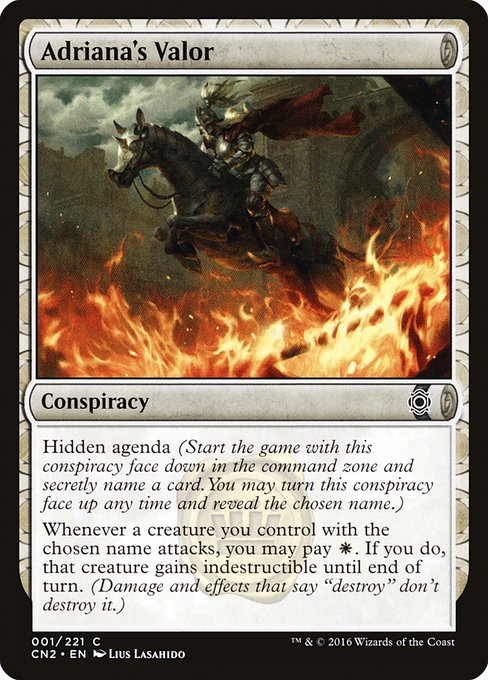
Adriana's Valor
Conspiracy
common
Hidden agenda (Start the game with this conspiracy face down in the command zone and secretly choose a card name. You may turn this conspiracy face up any time and reveal that name.) Whenever a creature you control with the chosen name attacks, you may pay . If you do, that creature gains indestructible until end of turn. (Damage and effects that say "destroy" don't destroy it.)
 Card Kingdom
 Cardmarket
Semantic Tags
Benefits from attacking — attack triggers, combat damage triggers, exalted.
A card that makes a strategy possible or consistent without being the payoff itself.
A keyword ability that provides a range of benefits against objects with a specific quality. See rule 702.16, “Protection.”
Format Legality
Price history
Loading price history…
Printings (1)
| Set | Rarity | TCGplayer | Card Kingdom | Cardmarket |
|---|---|---|---|---|
| Conspiracy: Take the Crown#1 | common | · | · | · |
Related Rules
The text that a name sticker is modifying may change due to other effects and/or a permanent’s face-down status (see rule 708, “Face-Down Spells and Permanents”). To determine the name of an object with one or more name stickers, start with the object’s copiable values, then apply each name sticker’s effect and each other text-changing effect in timestamp order. The position of each name sticker will continue to be after the number of words that were before it in the object’s name when it was placed. If there are fewer words in the object’s current name, the word on that sticker is added at the end of its name instead. The position and timestamp order of each name sticker on an object is remembered as the object that sticker is on moves from one public zone to another, and it continues to apply to the new object it becomes in that zone (see rule 123.5). This is an exception to rule 400.7.
One card (Golgothian Sylex) refers to permanents with a name originally printed in the Antiquities™ expansion. Those names are Amulet of Kroog, Argivian Archaeologist, Argivian Blacksmith, Argothian Pixies, Argothian Treefolk, Armageddon Clock, Artifact Blast, Artifact Possession, Artifact Ward, Ashnod’s Altar, Ashnod’s Battle Gear, Ashnod’s Transmogrant, Atog, Battering Ram, Bronze Tablet, Candelabra of Tawnos, Circle of Protection: Artifacts, Citanul Druid, Clay Statue, Clockwork Avian, Colossus of Sardia, Coral Helm, Crumble, Cursed Rack, Damping Field, Detonate, Drafna’s Restoration, Dragon Engine, Dwarven Weaponsmith, Energy Flux, Feldon’s Cane, Gaea’s Avenger, Gate to Phyrexia, Goblin Artisans, Golgothian Sylex, Grapeshot Catapult, Haunting Wind, Hurkyl’s Recall, Ivory Tower, Jalum Tome, Martyrs of Korlis, Mightstone, Millstone, Mishra’s Factory, Mishra’s War Machine, Mishra’s Workshop, Obelisk of Undoing, Onulet, Orcish Mechanics, Ornithopter, Phyrexian Gremlins, Power Artifact, Powerleech, Priest of Yawgmoth, Primal Clay, The Rack, Rakalite, Reconstruction, Reverse Polarity, Rocket Launcher, Sage of Lat-Nam, Shapeshifter, Shatterstorm, Staff of Zegon, Strip Mine, Su-Chi, Tablet of Epityr, Tawnos’s Coffin, Tawnos’s Wand, Tawnos’s Weaponry, Tetravus, Titania’s Song, Transmute Artifact, Triskelion, Urza’s Avenger, Urza’s Chalice, Urza’s Mine, Urza’s Miter, Urza’s Power Plant, Urza’s Tower, Wall of Spears, Weakstone, Xenic Poltergeist, Yawgmoth Demon, and Yotian Soldier.
If an object gains an ability that refers to a choice, but either (a) doesn’t copy that ability’s linked ability or (b) does copy the linked ability but no choice is made for it, then the choice is considered to be “undefined.” If an ability refers to an undefined choice, that part of the ability won’t do anything.
If the spell or ability specifies targets, it checks whether the targets are still legal. A target that’s no longer in the zone it was in when it was targeted is illegal. Other changes to the game state may cause a target to no longer be legal; for example, its characteristics may have changed or an effect may have changed the text of the spell. If the source of an ability has left the zone it was in, its last known information is used during this process. If all its targets, for every instance of the word “target,” are now illegal, the spell or ability doesn’t resolve. It’s removed from the stack and, if it’s a spell, put into its owner’s graveyard. Otherwise, the spell or ability will resolve normally. Illegal targets, if any, won’t be affected by parts of a resolving spell’s effect for which they’re illegal. Other parts of the effect for which those targets are not illegal may still affect them. If the spell or ability creates any continuous effects that affect game rules (see rule 613.11), those effects don’t apply to illegal targets. If part of the effect requires information about an illegal target, it fails to determine any such information. Any part of the effect that requires that information won’t happen.
Some continuous effects affect players rather than objects. For example, an effect might give a player protection from red. All such effects are applied in timestamp order after the determination of objects’ characteristics. See also the rules for timestamp order and dependency (rules 613.7 and 613.8).
Some replacement effects modify how a permanent enters the battlefield. (See rules 614.1c–d.) Such effects may come from the permanent itself if they affect only that permanent (as opposed to a general subset of permanents that includes it). They may also come from other sources. To determine which replacement effects apply and how they apply, check the characteristics of the permanent as it would exist on the battlefield, taking into account replacement effects that have already modified how it enters the battlefield (see rule 616.1), continuous effects from the permanent’s own static abilities that would apply to it once it’s on the battlefield, and continuous effects that already exist and would apply to the permanent.
An effect may state that “the same is true for” a list of keyword abilities or similar. If one of those keyword abilities has variants or variables and the effect grants that keyword or counters of that keyword to one or more objects and/or players, it grants each appropriate variant and variable of that keyword.
Protection is a static ability, written “Protection from [quality].” This quality is usually a color (as in “protection from black”) but can be any characteristic value or information. If the quality happens to be a card name, it is treated as such only if the protection ability specifies that the quality is a name. If the quality is a card type, subtype, or supertype, the ability applies to sources that are permanents with that card type, subtype, or supertype and to any sources not on the battlefield that are of that card type, subtype, or supertype. This is an exception to rule 109.2.
Rulings
You must name a Magic card. Notably, you can't name a token.
Conspiracies aren't legal for any sanctioned Constructed format, but may be included in other Limited formats, such as Cube Draft.
A conspiracy doesn't count as a card in your deck for purposes of meeting minimum deck size requirements. (In most drafts, the minimum deck size is 40 cards.)
At the end of the game, you must reveal any face-down conspiracies you own in the command zone to all players. Notably, you can't bluff conspiracies with hidden agenda by putting other cards into the command zone face down as the game starts.
As a special action, you may turn a face-down conspiracy face up. You may do so any time you have priority. This action doesn't use the stack and can't be responded to. Once face up, the named card is revealed and the conspiracy's abilities will affect the game.
At the end of the game, you must reveal any face-down conspiracies you own in the command zone to all players.
Conspiracies are colorless, have no mana cost, and can't be cast as spells.
A conspiracy's static and triggered abilities function as long as that conspiracy is face-up in the command zone.
There are several ways to secretly name a card, including writing the name on a piece of paper that's kept with the face-down conspiracy. If you have multiple face-down conspiracies, you may name a different card for each one. It's important that each named card is clearly associated with only one of the conspiracies.
Conspiracies are never put into your deck. Instead, you put any number of conspiracies from your card pool into the command zone as the game begins. These conspiracies are face up unless they have hidden agenda, in which case they begin the game face down.
You can look at any player's face-up conspiracies at any time. You'll also know how many face-down conspiracies a player has in the command zone, although you won't know what they are.
You name the card as the game begins, as you put the conspiracy into the command zone, not as you turn the face-down conspiracy face up.
If you play multiple games after the draft, you can name a different card in each new game.
A conspiracy with hidden agenda that has a triggered ability must be face up before that ability's trigger condition is met in order for it to trigger. Turning it face up afterward won't have any effect.
The last ability triggers once for each creature with the chosen name that attacks. You choose whether to pay {W} as the ability resolves. Notably, someone could respond to the ability and destroy the creature before it gains indestructible.
You don't have to play with any conspiracy you draft. However, you have only one opportunity to put conspiracies into the command zone, as the game begins. You can't put conspiracies into the command zone after this point.