Search
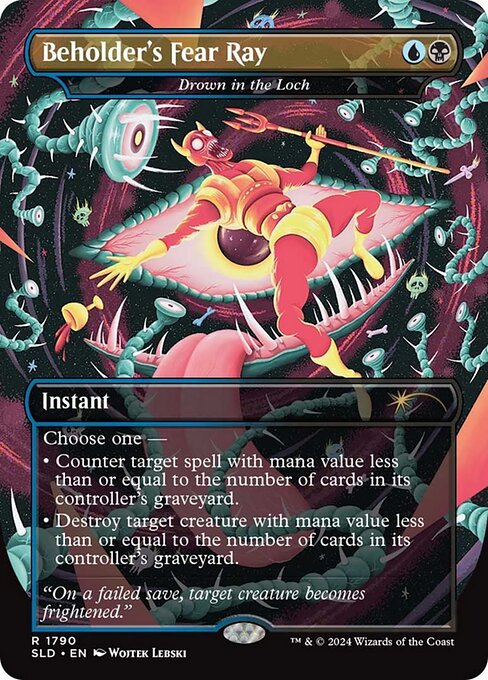
Drown in the Loch
Instant
uncommon
Choose one — • Counter target spell with mana value less than or equal to the number of cards in its controller's graveyard. • Destroy target creature with mana value less than or equal to the number of cards in its controller's graveyard.
 Card Kingdom
 Cardmarket
Semantic Tags
Prevents a spell or ability from resolving.
Specifically removes creatures — destroy, exile, damage, or -X/-X.
Cards that directly win the game or threaten to end it quickly. Includes 'you win the game' effects and massive threats.
A keyword ability that allows a spell to affect either a single target or many objects. See rule 702.96, “Overload.”
Answers an opponent's threat by destroying, exiling, bouncing, or otherwise removing a permanent or spell.
Answers an opponent's threat by destroying, exiling, bouncing, or otherwise removing a permanent or spell.
Format Legality
Price history
Loading price history…
Printings (6)
| Set | Rarity | TCGplayer | Card Kingdom | Cardmarket |
|---|---|---|---|---|
| Secret Lair Drop#1790 | rare | · | · | · |
| Special Guests#27 | mythic | · | · | · |
| Wizards Play Network 2023#4 | rare | · | · | · |
| Commander Legends: Battle for Baldur's Gate#842 | uncommon | · | · | · |
| Secret Lair Drop#270 | rare | · | · | · |
| Throne of Eldraine#188 | uncommon | · | · | · |
Related Rules
Overload
Overload is a keyword that represents two static abilities that function while the spell with overload is on the stack. Overload [cost] means “You may choose to pay [cost] rather than pay this spell’s mana cost” and “If you chose to pay this spell’s overload cost, change its text by replacing all instances of the word ‘target’ with the word ‘each.’” Casting a spell using its overload ability follows the rules for paying alternative costs in rules 601.2b and 601.2f–h.
If a player chooses to pay the overload cost of a spell, that spell won’t require any targets. It may affect objects that couldn’t be chosen as legal targets if the spell were cast without its overload cost being paid.
Overload’s second ability creates a text-changing effect. See rule 612, “Text-Changing Effects.”
Rulings
If a creature on the battlefield has {X} in its mana cost, X is considered to be 0.
For spells with {X} in their mana costs, use the value chosen for X to determine the spell's mana value.