Search
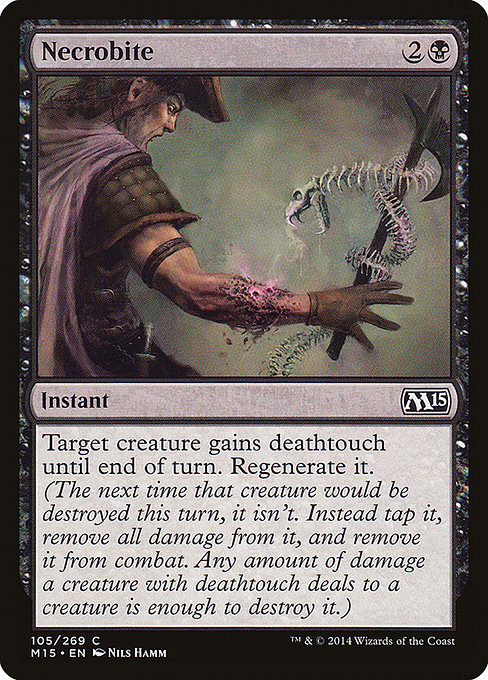
Necrobite
Instant
common
Target creature gains deathtouch until end of turn. Regenerate it. (The next time that creature would be destroyed this turn, instead tap it, remove it from combat, and heal all damage on it.)
 Card Kingdom
 Cardmarket
Semantic Tags
A keyword ability that causes damage dealt by an object to be especially effective. See rule 702.2, “Deathtouch.”
Has or grants deathtouch — kills anything it damages, effective deterrent and combat removal.
Has or grants deathtouch — kills anything it damages, effective deterrent and combat removal.
Format Legality
Price history
Loading price history…
Printings (3)
| Set | Rarity | TCGplayer | Card Kingdom | Cardmarket |
|---|---|---|---|---|
| Magic 2015#105 | common | · | · | · |
| Born of the Gods#77 | common | · | · | · |
| Avacyn Restored#115 | common | · | · | · |
Related Concepts
To replace a permanent’s destruction with an alternate sequence of events. See rule 701.19, “Regenerate.”
Related Rules
First, if an effect that’s causing damage to be dealt states that excess damage that would be dealt to a permanent is dealt to another permanent or player instead, the damage event is modified accordingly. If the first permanent is a creature, the excess damage is the amount of damage in excess of what would be lethal damage, taking into account damage already marked on the creature and damage from other sources that would be dealt at the same time. (See rule 120.6.) Any amount of damage greater than 1 is excess damage if the source dealing that damage to a creature has deathtouch. (See rule 702.2.) If the first permanent is a planeswalker, the excess damage is the amount of damage in excess of that planeswalker’s loyalty, taking into account damage from other sources that would be dealt at the same time. If the first permanent is a battle, the excess damage is the amount of damage in excess of that battle’s defense, taking into account damage from other sources that would be dealt at the same time. If the first permanent has multiple card types from among the list of creature, planeswalker, and battle, the excess damage is the greatest of the calculated amounts for each of the card types it has.
Damage marked on a creature remains until the cleanup step, even if that permanent stops being a creature. If the total damage marked on a creature is greater than or equal to its toughness, that creature has been dealt lethal damage and is destroyed as a state-based action (see rule 704). All damage marked on a permanent is removed when it regenerates (see rule 701.19, “Regenerate”) and during the cleanup step (see rule 514.2).
A keyword counter on a permanent or on a card in a zone other than the battlefield causes that object to gain that keyword. The keywords that a keyword counter can be are flying, first strike, double strike, deathtouch, decayed, exalted, haste, hexproof, indestructible, lifelink, menace, reach, shadow, trample, and vigilance, as well as any variants of those keywords. See rule 613.1f.
If an ability of an object refers to that object by name, and an object with a different name gains that ability, each instance of the first name in the gained ability that refers to the first object by name should be treated as the second name.
Damage dealt to a creature by a source with neither wither nor infect is marked on that creature (see rule 120.3). If the total damage marked on that creature is greater than or equal to its toughness, that creature has been dealt lethal damage and is destroyed as a state-based action (see rule 704). All damage marked on a creature is removed when it regenerates (see rule 701.19, “Regenerate”) and during the cleanup step (see rule 514.2).
Replacement effects must exist before the appropriate event occurs—they can’t “go back in time” and change something that’s already happened. Spells or abilities that generate these effects are often cast or activated in response to whatever would produce the event and thus resolve before that event would occur.
Regeneration is a destruction-replacement effect. The word “instead” doesn’t appear on the card but is implicit in the definition of regeneration. “Regenerate [permanent]” means “The next time [permanent] would be destroyed this turn, instead remove all damage marked on it and its controller taps it. If it’s an attacking or blocking creature, remove it from combat.” Abilities that trigger from damage being dealt still trigger even if the permanent regenerates. See rule 701.19.
The only ways a permanent can be destroyed are as a result of an effect that uses the word “destroy” or as a result of the state-based actions that check for lethal damage (see rule 704.5g) or damage from a source with deathtouch (see rule 704.5h). If a permanent is put into its owner’s graveyard for any other reason, it hasn’t been “destroyed.”