Search
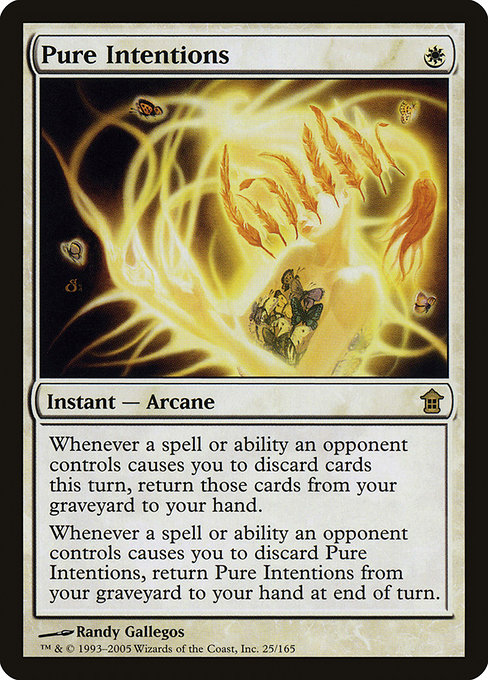
Pure Intentions
Instant — Arcane
rare
Whenever a spell or ability an opponent controls causes you to discard cards this turn, return those cards from your graveyard to your hand. When a spell or ability an opponent controls causes you to discard this card, return this card from your graveyard to your hand at the beginning of the next end step.
 Card Kingdom
 Cardmarket
Semantic Tags
A keyword ability that lets a card be discarded and replaced with a new card. See rule 702.29, “Cycling.”
Benefits from discarding cards — madness, Waste Not effects, Oskar strategies.
Cares about cards in the graveyard, puts cards into the graveyard, or benefits from things dying.
Returns cards from the graveyard to your hand, the battlefield, or the top of your library.
Returns cards from the graveyard to your hand, the battlefield, or the top of your library.
Forces opponents to discard cards from their hand. Targeted discard, mass discard, and discard-or-pay effects.
A keyword ability that lets a player cast a card they discard. See rule 702.35, “Madness.”
Returns cards from graveyard to hand or library (not battlefield — that is reanimation).
Format Legality
Price history
Loading price history…
Printings (1)
| Set | Rarity | TCGplayer | Card Kingdom | Cardmarket |
|---|---|---|---|---|
| Saviors of Kamigawa#25 | rare | · | · | · |
Related Rules
After resolving a madness triggered ability (see rule 702.35), if the exiled card wasn’t cast and was moved to a public zone, effects referencing the discarded card can find that object.
Madness
Cycling
Cycling is an activated ability that functions only while the card with cycling is in a player’s hand. “Cycling [cost]” means “[Cost], Discard this card: Draw a card.”
Although the cycling ability can be activated only if the card is in a player’s hand, it continues to exist while the object is on the battlefield and in all other zones. Therefore objects with cycling will be affected by effects that depend on objects having one or more activated abilities.
Some cards with cycling have abilities that trigger when they’re cycled. “When you cycle this card” means “When you discard this card to pay an activation cost of a cycling ability.” These abilities trigger from whatever zone the card winds up in after it’s cycled.
Typecycling is a variant of the cycling ability. “[Type]cycling [cost]” means “[Cost], Discard this card: Search your library for a [type] card, reveal it, and put it into your hand. Then shuffle your library.” This type is usually a subtype (as in “mountaincycling”) but can be any card type, subtype, supertype, or combination thereof (as in “basic landcycling”).
Typecycling abilities are cycling abilities, and typecycling costs are cycling costs. Any cards that trigger when a player cycles a card will trigger when a card is discarded to pay an activation cost of a typecycling ability. Any effect that stops players from cycling cards will stop players from activating cards’ typecycling abilities. Any effect that increases or reduces a cycling cost will increase or reduce a typecycling cost. Any effect that looks for a card with cycling will find a card with typecycling.
Rulings
Discarding Pure Intentions to your own spell or ability doesn't trigger its abilities.
The first part of Pure Intentions is the effect of casting Pure Intentions. The second part is a triggered ability that triggers whenever an opponent's spell or ability causes a player to discard Pure Intentions.
Neither part cares who decides which card to discard — only the controller of the spell or ability matters.
If a spell or ability an opponent controls causes a player to discard multiple cards, such as Waking Nightmare or Three Tragedies, Pure Intentions doesn't return to hand until its triggered ability has resolved. A player can't discard the same Pure Intentions twice for the same discard effect.