Search
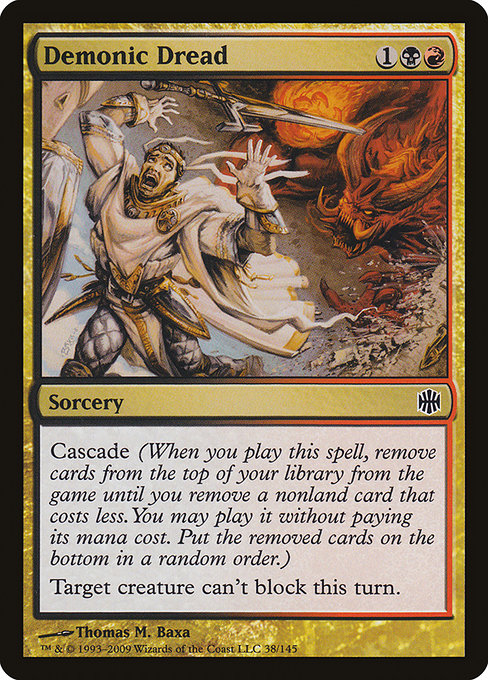
Demonic Dread
Sorcery
common
Cascade (When you cast this spell, exile cards from the top of your library until you exile a nonland card that costs less. You may cast it without paying its mana cost. Put the exiled cards on the bottom in a random order.) Target creature can't block this turn.
 Card Kingdom
 Cardmarket
Semantic Tags
A keyword ability that may let a player cast a random extra spell for no cost. See rule 702.85, “Cascade.”
A keyword ability that may let a player cast a random extra spell for no cost. See rule 702.85, “Cascade.”
A keyword ability found on creature cards that allows them to be cast for an alternative cost. See rule 702.109, “Dash.”
Exile-based card advantage — exile cards from the top of your library and cast them temporarily. Red's primary draw mechanic.
Exile-based card advantage — exile cards from the top of your library and cast them temporarily. Red's primary draw mechanic.
A keyword ability that creates copies of a spell. See rule 702.40, “Storm.”
Cares about or manipulates the top card(s) of your library. Includes scry, surveil, and top-deck payoffs.
Cares about or manipulates the top of library — Sensei's Top, miracles, Future Sight.
Format Legality
Price history
Loading price history…
Printings (1)
| Set | Rarity | TCGplayer | Card Kingdom | Cardmarket |
|---|---|---|---|---|
| Alara Reborn#38 | common | · | · | · |
Related Concepts
Related Rules
Cascade
Subtypes of each card type except creature and plane are always single words and are listed after a long dash. Each word after the dash is a separate subtype. Subtypes of creature cards are one or two words and are listed after a long dash. Each word or two-word phrase, as listed in rule 205.3m, is a separate subtype. Objects other than planes may have multiple subtypes. Subtypes of planes are also listed after a long dash, but may be multiple words; all words after the dash are, collectively, a single subtype.
One card (Apocalypse Chime) refers to permanents with a name originally printed in the Homelands™ expansion. Those names are Abbey Gargoyles; Abbey Matron; Aether Storm; Aliban’s Tower; Ambush; Ambush Party; Anaba Ancestor; Anaba Bodyguard; Anaba Shaman; Anaba Spirit Crafter; An-Havva Constable; An-Havva Inn; An-Havva Township; An-Zerrin Ruins; Apocalypse Chime; Autumn Willow; Aysen Abbey; Aysen Bureaucrats; Aysen Crusader; Aysen Highway; Baki’s Curse; Baron Sengir; Beast Walkers; Black Carriage; Broken Visage; Carapace; Castle Sengir; Cemetery Gate; Chain Stasis; Chandler; Clockwork Gnomes; Clockwork Steed; Clockwork Swarm; Coral Reef; Dark Maze; Daughter of Autumn; Death Speakers; Didgeridoo; Drudge Spell; Dry Spell; Dwarven Pony; Dwarven Sea Clan; Dwarven Trader; Ebony Rhino; Eron the Relentless; Evaporate; Faerie Noble; Feast of the Unicorn; Feroz’s Ban; Folk of An-Havva; Forget; Funeral March; Ghost Hounds; Giant Albatross; Giant Oyster; Grandmother Sengir; Greater Werewolf; Hazduhr the Abbot; Headstone; Heart Wolf; Hungry Mist; Ihsan’s Shade; Irini Sengir; Ironclaw Curse; Jinx; Joven; Joven’s Ferrets; Joven’s Tools; Koskun Falls; Koskun Keep; Labyrinth Minotaur; Leaping Lizard; Leeches; Mammoth Harness; Marjhan; Memory Lapse; Merchant Scroll; Mesa Falcon; Mystic Decree; Narwhal; Orcish Mine; Primal Order; Prophecy; Rashka the Slayer; Reef Pirates; Renewal; Retribution; Reveka, Wizard Savant; Root Spider; Roots; Roterothopter; Rysorian Badger; Samite Alchemist; Sea Sprite; Sea Troll; Sengir Autocrat; Sengir Bats; Serra Aviary; Serra Bestiary; Serra Inquisitors; Serra Paladin; Serrated Arrows; Shrink; Soraya the Falconer; Spectral Bears; Timmerian Fiends; Torture; Trade Caravan; Truce; Veldrane of Sengir; Wall of Kelp; Willow Faerie; Willow Priestess; Winter Sky; and Wizards’ School.
Artifact subtypes are always a single word and are listed after a long dash: “Artifact — Equipment.” Artifact subtypes are also called artifact types. Artifacts may have multiple subtypes. See rule 205.3g for the complete list of artifact types.
Creature subtypes are usually a single word long and are listed after a long dash: “Creature — Human Soldier,” “Artifact Creature — Golem,” and so on. Creature subtypes are also called creature types. Creatures may have multiple subtypes. See rule 205.3m for the complete list of creature types.
Storm is a triggered ability that functions on the stack. “Storm” means “When you cast this spell, copy it for each other spell that was cast before it this turn. If the spell has any targets, you may choose new targets for any of the copies.”
Enchantment subtypes are always a single word and are listed after a long dash: “Enchantment — Shrine.” Each word after the dash is a separate subtype. Enchantment subtypes are also called enchantment types. Enchantments may have multiple subtypes. See rule 205.3h for the complete list of enchantment types.
Instant subtypes are always a single word and are listed after a long dash: “Instant — Arcane.” Each word after the dash is a separate subtype. The set of instant subtypes is the same as the set of sorcery subtypes; these subtypes are called spell types. Instants may have multiple subtypes. See rule 205.3k for the complete list of spell types.
Rulings
The mana value of a split card is determined by the combined mana cost of its two halves. If cascade allows you to cast a split card, you may cast either half but not both halves.
When the cascade ability resolves, you must exile cards. The only optional part of the ability is whether or not you cast the last card exiled.
Cascade triggers when you cast the spell, meaning that it resolves before that spell. If you end up casting the exiled card, it will go on the stack above the spell with cascade.
Due to a 2021 rules change to cascade, not only do you stop exiling cards if you exile a nonland card with lesser mana value than the spell with cascade, but the resulting spell you cast must also have lesser mana value. Previously, in cases where a card's mana value differed from the resulting spell, such as with some modal double-faced cards or cards with an Adventure, you could cast a spell with a higher mana value than the exiled card.
If you cast a card "without paying its mana cost," you can't choose to cast it for any alternative costs. You can, however, pay additional costs. If the card has any mandatory additional costs, you must pay those to cast the card.
If the card has {X} in its mana cost, you must choose 0 as the value of X when casting it without paying its mana cost.
You exile the cards face up. All players will be able to see them.
If a spell with cascade is countered, the cascade ability will still resolve normally.
A spell's mana value is determined only by its mana cost. Ignore any alternative costs, additional costs, cost increases, or cost reductions.