Search
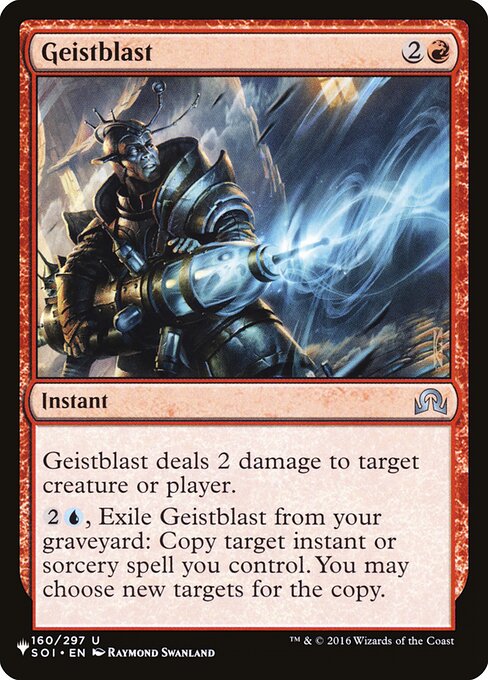
Geistblast
Instant
uncommon
Geistblast deals 2 damage to any target. , Exile this card from your graveyard: Copy target instant or sorcery spell you control. You may choose new targets for the copy.
 Card Kingdom
 Cardmarket
Semantic Tags
A spell that deals direct damage to creatures or players.
Exiles cards from graveyards or prevents graveyard interaction. Shuts down recursion, flashback, and graveyard-matters strategies.
Cares about cards in the graveyard, puts cards into the graveyard, or benefits from things dying.
A permanent with a repeatable activated ability that converts excess mana into value.
Specifically removes planeswalkers.
Answers an opponent's threat by destroying, exiling, bouncing, or otherwise removing a permanent or spell.
Format Legality
Price history
Loading price history…
Printings (2)
| Set | Rarity | TCGplayer | Card Kingdom | Cardmarket |
|---|---|---|---|---|
| The List#SOI-160 | uncommon | · | · | · |
| Shadows over Innistrad#160 | uncommon | · | · | · |
Rulings
If the spell has damage divided as it was cast (also like Avacyn's Judgment), the division can't be changed (although the targets receiving that damage still can).
Geistblast's ability can copy any instant or sorcery spell, not just one with targets.
The copy will have the same targets as the spell it's copying unless you choose new ones. You may change any number of the targets, including all of them or none of them. If, for one of the targets, you can't choose a new legal target, then it remains unchanged (even if the current target is illegal).
If the spell being copied is modal (that is, it says "Choose one —" or the like), the copy will have the same mode. You can't choose a different one.
When Geistblast's ability resolves, it creates a copy of the instant or sorcery spell. The copy is created on the stack, so it's not "cast." Abilities that trigger when a player casts a spell won't trigger. The copy will then resolve like a normal spell, before the original spell resolves but after players get a chance to cast spells and activate abilities.
If the spell being copied has an X whose value was determined as it was cast (like Avacyn's Judgment's madness cost has), the copy will have the same value of X.
If an alternative cost was paid for the spell, such as its madness cost or surge cost, the same alternative cost is considered to have been paid for the copy.