Search
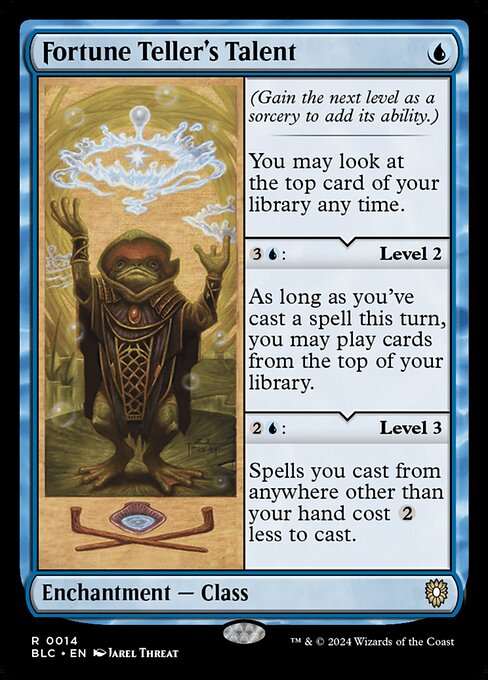
Fortune Teller's Talent
Enchantment — Class
rare
(Gain the next level as a sorcery to add its ability.) You may look at the top card of your library any time. : Level 2 As long as you've cast a spell this turn, you may play cards from the top of your library. : Level 3 Spells you cast from anywhere other than your hand cost less to cast.
 Card Kingdom
 Cardmarket
Semantic Tags
A permanent or effect that makes spells or abilities cheaper to cast or activate.
A permanent with a repeatable activated ability that converts excess mana into value.
A card or token on the battlefield. See rule 110, “Permanents.”
Storm count strategies — casting many spells in a single turn for storm triggers.
Cares about or manipulates the top card(s) of your library. Includes scry, surveil, and top-deck payoffs.
Cares about or manipulates the top of library — Sensei's Top, miracles, Future Sight.
Cares about or manipulates the top of library — Sensei's Top, miracles, Future Sight.
Format Legality
Price history
Loading price history…
Printings (1)
| Set | Rarity | TCGplayer | Card Kingdom | Cardmarket |
|---|---|---|---|---|
| Bloomburrow Commander#14 | rare | · | · | · |
Related Rules
If an ability would produce one or more mana of an undefined type, it produces no mana instead.
Some abilities produce mana based on the type of mana another permanent or permanents “could produce.” The type of mana a permanent could produce at any time includes any type of mana that an ability of that permanent would produce if the ability were to resolve at that time, taking into account any applicable replacement effects in any possible order. Ignore whether any costs of the ability could or could not be paid. If that permanent wouldn’t produce any mana under these conditions, or no type of mana can be defined this way, there’s no type of mana it could produce.
To “tap [a permanent] for mana” is to activate a mana ability of that permanent that includes the {T} symbol in its activation cost. See rule 605, “Mana Abilities.”
An ability that triggers whenever a permanent “is tapped for mana” or is tapped for mana of a specified type triggers whenever such a mana ability resolves and produces mana or the specified type of mana.
A replacement effect that applies if a permanent “is tapped for mana” or tapped for mana of a specific type and/or amount modifies the mana production event while such an ability is resolving and producing mana or the specified type and/or amount of mana.
If an object’s enters-the-battlefield triggered ability or replacement effect refers to X, and the spell that became that object as it resolved had a value of X chosen for any of its costs, the value of X for that ability is the same as the value of X for that spell, although the value of X for that permanent is 0. This is an exception to rule 107.3i.
The tap symbol is {T}. The tap symbol in an activation cost means “Tap this permanent.” A permanent that’s already tapped can’t be tapped again to pay the cost. A creature’s activated ability with the tap symbol in its activation cost can’t be activated unless the creature has been under its controller’s control continuously since their most recent turn began. See rule 302.6.
The untap symbol is {Q}. The untap symbol in an activation cost means “Untap this permanent.” A permanent that’s already untapped can’t be untapped again to pay the cost. A creature’s activated ability with the untap symbol in its activation cost can’t be activated unless the creature has been under its controller’s control continuously since their most recent turn began. See rule 302.6.
Rulings
You can look at the top card of your library whenever you want (with one restriction; see below), even if you don't have priority. This action doesn't use the stack. Knowing what that card is becomes part of the information you have access to, just like you can look at the cards in your hand.
You can't activate the first level ability of a Class unless that Class is level 1. Similarly, you can't activate the second level ability of a Class unless that Class is level 2.
If the top card of your library changes while you're casting a spell, playing a land, or activating an ability, you can't look at the new top card until you finish doing so. This means that if you cast a spell from the top of your library, you can't look at the next one until you're done paying for that spell.
There's no restriction on how many Class permanents you can control, whether they're the same or different classes. Each Class permanent tracks its own level separately.
Gaining a level won't remove abilities that a Class had at a previous level.
Each Class has five abilities. The three in the major sections of its text box are class abilities. Class abilities can be static, activated, or triggered abilities. The other two are level abilities, one activated ability to advance the Class to level 2 and another to advance the Class to level 3.
The cost reduction applies only to generic mana in the total cost of spells you cast from anywhere other than your hand.
Each Class starts with only the first of its three class abilities. As the first level ability resolves, the Class becomes level 2 and gains the second class ability. As the second level ability resolves, the Class becomes level 3 and gains the third class ability.
You must pay all costs and follow all timing rules for lands played and spells cast from the top of your library this way.
Gaining a level is a normal activated ability. It uses the stack and can be responded to.
To determine the total cost of a spell, start with the mana cost or alternative cost you're paying (such as a flashback cost), add any cost increases (such as kicker costs), then apply any cost reductions (such as that of this ability). The mana value of the spell is determined by only its mana cost, no matter what the total cost to cast that spell was.