Search
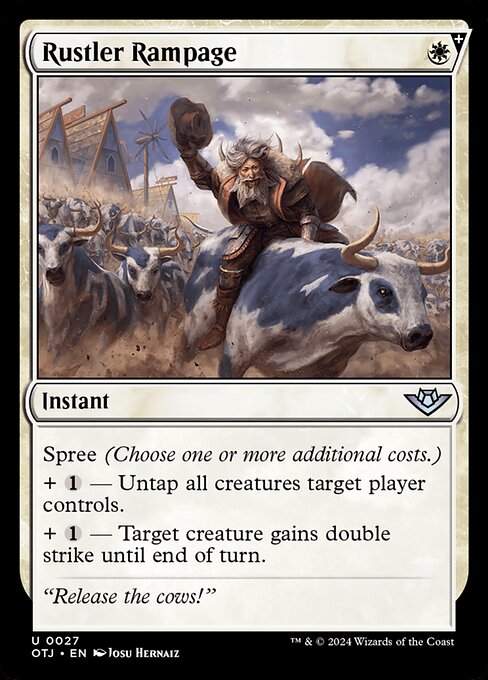
Rustler Rampage
Instant
uncommon
Spree (Choose one or more additional costs.) + — Untap all creatures target player controls. + — Target creature gains double strike until end of turn.
 Card Kingdom
 Cardmarket
Semantic Tags
Attacks quickly and deals damage efficiently. Includes haste, double strike, first strike, prowess, and cards that grant these.
A keyword ability found on creature cards that allows them to be cast for an alternative cost. See rule 702.109, “Dash.”
An effect that untaps permanents, enabling reuse of tap abilities or mana.
Format Legality
Price history
Loading price history…
Printings (1)
| Set | Rarity | TCGplayer | Card Kingdom | Cardmarket |
|---|---|---|---|---|
| Outlaws of Thunder Junction#27 | uncommon | · | · | · |
Related Concepts
Related Rules
Subtypes of each card type except creature and plane are always single words and are listed after a long dash. Each word after the dash is a separate subtype. Subtypes of creature cards are one or two words and are listed after a long dash. Each word or two-word phrase, as listed in rule 205.3m, is a separate subtype. Objects other than planes may have multiple subtypes. Subtypes of planes are also listed after a long dash, but may be multiple words; all words after the dash are, collectively, a single subtype.
Artifact subtypes are always a single word and are listed after a long dash: “Artifact — Equipment.” Artifact subtypes are also called artifact types. Artifacts may have multiple subtypes. See rule 205.3g for the complete list of artifact types.
Creature subtypes are usually a single word long and are listed after a long dash: “Creature — Human Soldier,” “Artifact Creature — Golem,” and so on. Creature subtypes are also called creature types. Creatures may have multiple subtypes. See rule 205.3m for the complete list of creature types.
Enchantment subtypes are always a single word and are listed after a long dash: “Enchantment — Shrine.” Each word after the dash is a separate subtype. Enchantment subtypes are also called enchantment types. Enchantments may have multiple subtypes. See rule 205.3h for the complete list of enchantment types.
Instant subtypes are always a single word and are listed after a long dash: “Instant — Arcane.” Each word after the dash is a separate subtype. The set of instant subtypes is the same as the set of sorcery subtypes; these subtypes are called spell types. Instants may have multiple subtypes. See rule 205.3k for the complete list of spell types.
Land subtypes are always a single word and are listed after a long dash. Land subtypes are also called land types. Lands may have multiple subtypes. See rule 205.3i for the complete list of land types.
Planeswalker subtypes are always a single word and are listed after a long dash: “Planeswalker — Jace.” Each word after the dash is a separate subtype. Planeswalker subtypes are also called planeswalker types. Planeswalkers may have multiple subtypes. See rule 205.3j for the complete list of planeswalker types.
Sorcery subtypes are always a single word and are listed after a long dash: “Sorcery — Arcane.” Each word after the dash is a separate subtype. The set of sorcery subtypes is the same as the set of instant subtypes; these subtypes are called spell types. Sorceries may have multiple subtypes. See rule 205.3k for the complete list of spell types.
Rulings
You must choose at least one of the listed modes and pay its associated additional cost in order to cast a spell with spree.
No player can cast spells or activate abilities in between the modes of a resolving spell. Any abilities that trigger won’t be put onto the stack until the spell is done resolving.
You choose the modes as you cast the spell with spree. Once modes are chosen, they can’t be changed.
If a spell with spree is copied, the effect that creates the copy may allow you to choose new targets. You cannot choose new modes.
Each additional cost and associated mode in the text box is also preceded with a + indicator. These symbols also have no rules meaning and serve only to remind players that the listed costs are additional costs.
If all targets for the chosen modes become illegal before a spell with spree resolves, the spell won’t resolve and none of its effects will happen. If at least one target is still legal, the spell will resolve but will have no effect on any illegal targets.
No matter which modes you choose, you always follow the instructions in the order they are written.
The mana value of a spell with spree is determined only by its mana cost (in the upper right corner of the card). It doesn’t matter which modes you choose or which additional costs you pay, including any additional costs imposed by other effects.
Spells with spree have a + (plus sign) indicator in the upper right corner of the card frame. This has no rules meaning and serves only to remind players that at least one additional cost is required to cast the spell.
If a mode requires a target, you can select that mode only if there’s a legal target available. Ignore the targeting requirements for modes you don’t choose.
You can’t choose the same mode more than once.
If an effect allows you to cast a spell with spree “without paying its mana cost,” you must still choose at least one mode and pay the associated additional costs.