Search
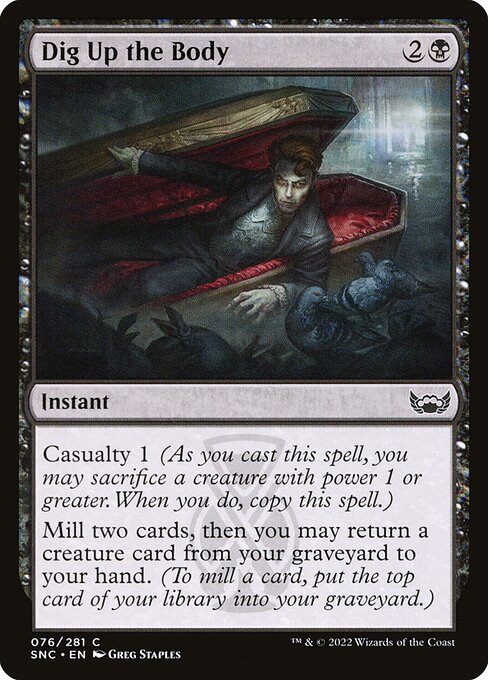
Dig Up the Body
Instant
common
Casualty 1 (As you cast this spell, you may sacrifice a creature with power 1 or greater. When you do, copy this spell.) Mill two cards, then you may return a creature card from your graveyard to your hand. (To mill a card, put the top card of your library into your graveyard.)
 Card Kingdom
 Cardmarket
Semantic Tags
Cares about cards in the graveyard, puts cards into the graveyard, or benefits from things dying.
Returns cards from the graveyard to your hand, the battlefield, or the top of your library.
To mill a number of cards, a player puts that many cards from the top of their library into their graveyard. See rule 701.17.
Cares about power of creatures — Fling effects, power-based draw, Xenagos strategies.
Broadly benefits from sacrificing permanents — overlaps aristocrats but includes non-creature sacrifice.
Lets you sacrifice your own creatures or permanents for value. Key enabler for aristocrats strategies.
An effect that puts cards from your own library into your graveyard for value.
Cares about or manipulates the top card(s) of your library. Includes scry, surveil, and top-deck payoffs.
Format Legality
Price history
Loading price history…
Printings (1)
| Set | Rarity | TCGplayer | Card Kingdom | Cardmarket |
|---|---|---|---|---|
| Streets of New Capenna#76 | common | · | · | · |
Related Concepts
Related Rules
While applying a replacement effect that modifies how a permanent enters the battlefield, another replacement effect may cause a player to mill cards or exile cards from the top of a library. In that case, any card that is entering the battlefield from that library won’t be included in that effect, even though those cards are in the library as the effect is applied.
Mill
For a player to mill a number of cards, that player puts that many cards from the top of their library into their graveyard.
A player can’t mill a number of cards greater than the number of cards in their library. If given the choice to do so, they can’t choose to take that action. If instructed to do so, they mill as many as possible. Similarly, the player can’t pay a cost that includes milling a number of cards greater than the number of cards in their library.
Dredge is a static ability that functions only while the card with dredge is in a player’s graveyard. “Dredge N” means “As long as you have at least N cards in your library, if you would draw a card, you may instead mill N cards and return this card from your graveyard to your hand.”
A player with fewer cards in their library than the number required by a dredge ability can’t mill any of them this way.
Casualty
Casualty is a keyword that represents two abilities. The first is a static ability that functions while the spell with casualty is on the stack. The second is a triggered ability that functions while the spell with casualty is on the stack. Casualty N means “As an additional cost to cast this spell, you may sacrifice a creature with power N or greater,” and “When you cast this spell, if a casualty cost was paid for it, copy it. If the spell has any targets, you may choose new targets for the copy.” Paying a spell’s casualty cost follows the rules for paying additional costs in rules 601.2b and 601.2f–h.
Rulings
If you pay the casualty cost of a spell, the copy will resolve before the original spell.
You may sacrifice only one creature to pay a spell's casualty cost, and you copy the spell only once.
The copy of the spell is created on the stack, so it's not “cast.” Abilities that trigger when a player casts a spell won't trigger.
You may return any creature card from your graveyard to your hand, not just those you milled while resolving Dig Up the Body.
Casualty N means “As an additional cost to cast this spell, you may sacrifice a creature with power N or greater.” and “When you cast this spell, if a casualty cost was paid for it, copy it. If the spell has any targets, you may choose new targets for the copy.”