Search
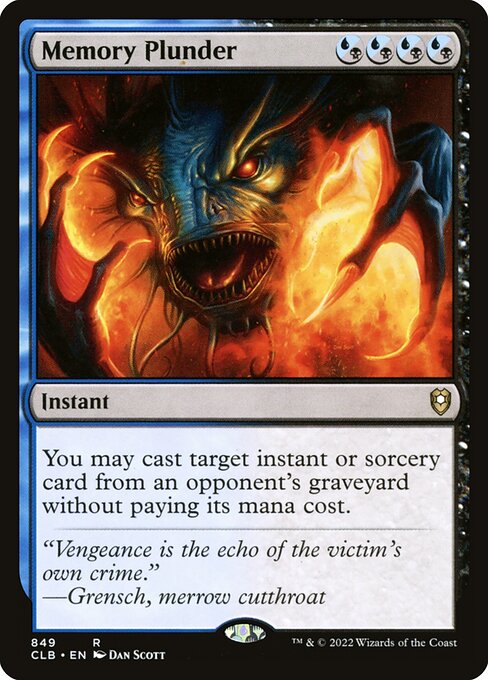
Memory Plunder
Instant
rare
You may cast target instant or sorcery card from an opponent's graveyard without paying its mana cost.
 Card Kingdom
 Cardmarket
Semantic Tags
A keyword ability that reduces how much mana you need to spend to cast a spell. See rule 702.41, “Affinity.”
A keyword ability that may let a player cast a random extra spell for no cost. See rule 702.85, “Cascade.”
An instant-speed spell that modifies combat — pump, protection, or removal during combat.
A keyword ability that lets you tap creatures rather than pay mana to cast a spell. See rule 702.51, “Convoke.”
A keyword ability found on creature cards that allows them to be cast for an alternative cost. See rule 702.109, “Dash.”
A keyword ability that lets you exile cards from your graveyard rather than pay generic mana to cast a spell. See rule 702.66, “Delve.”
A keyword ability that lets a player cast a spell for less by sacrificing a creature. See rule 702.119, “Emerge.”
A keyword ability that lets a player play a card any time they could cast an instant. See rule 702.8, “Flash.”
A keyword ability that lets a player cast a card from their graveyard. See rule 702.34, “Flashback.”
Format Legality
Price history
Loading price history…
Printings (3)
| Set | Rarity | TCGplayer | Card Kingdom | Cardmarket |
|---|---|---|---|---|
| Commander Legends: Battle for Baldur's Gate#849 | rare | · | · | · |
| Commander 2017#178 | rare | · | · | · |
| Shadowmoor#169 | rare | · | · | · |
Related Rules
Cascade
Subtypes of each card type except creature and plane are always single words and are listed after a long dash. Each word after the dash is a separate subtype. Subtypes of creature cards are one or two words and are listed after a long dash. Each word or two-word phrase, as listed in rule 205.3m, is a separate subtype. Objects other than planes may have multiple subtypes. Subtypes of planes are also listed after a long dash, but may be multiple words; all words after the dash are, collectively, a single subtype.
Artifact subtypes are always a single word and are listed after a long dash: “Artifact — Equipment.” Artifact subtypes are also called artifact types. Artifacts may have multiple subtypes. See rule 205.3g for the complete list of artifact types.
Creature subtypes are usually a single word long and are listed after a long dash: “Creature — Human Soldier,” “Artifact Creature — Golem,” and so on. Creature subtypes are also called creature types. Creatures may have multiple subtypes. See rule 205.3m for the complete list of creature types.
Enchantment subtypes are always a single word and are listed after a long dash: “Enchantment — Shrine.” Each word after the dash is a separate subtype. Enchantment subtypes are also called enchantment types. Enchantments may have multiple subtypes. See rule 205.3h for the complete list of enchantment types.
Instant subtypes are always a single word and are listed after a long dash: “Instant — Arcane.” Each word after the dash is a separate subtype. The set of instant subtypes is the same as the set of sorcery subtypes; these subtypes are called spell types. Instants may have multiple subtypes. See rule 205.3k for the complete list of spell types.
Land subtypes are always a single word and are listed after a long dash. Land subtypes are also called land types. Lands may have multiple subtypes. See rule 205.3i for the complete list of land types.
Planeswalker subtypes are always a single word and are listed after a long dash: “Planeswalker — Jace.” Each word after the dash is a separate subtype. Planeswalker subtypes are also called planeswalker types. Planeswalkers may have multiple subtypes. See rule 205.3j for the complete list of planeswalker types.
Rulings
If you want to cast the card, you cast it as part of the resolution of Memory Plunder. Timing restrictions based on the card's type are ignored if it's a sorcery. Other casting restrictions are not (such as “Cast [this card] only during combat”).
If you cast a card “without paying its mana cost,” you can't pay any alternative costs. On the other hand, if the card has additional costs (such as conspire), you may pay those.
If you are unable to cast the card (there are no legal targets for the spell, for example), nothing happens when Memory Plunder resolves, and the card remains in its owner's graveyard.