Search
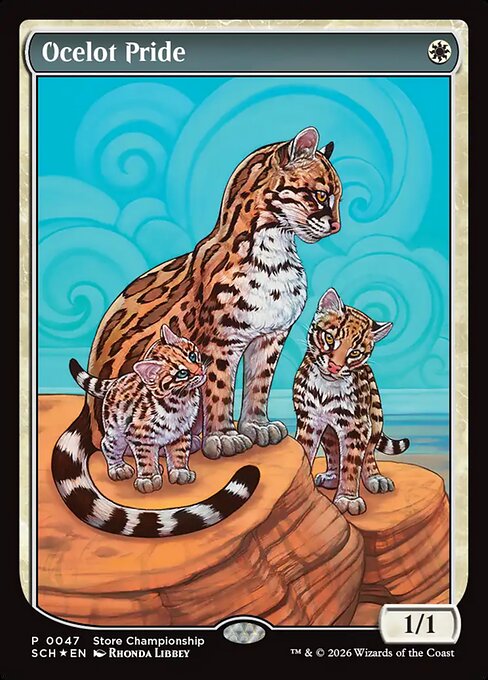
Ocelot Pride
Creature — Cat
mythic
First strike, lifelink Ascend (If you control ten or more permanents, you get the city's blessing for the rest of the game.) At the beginning of your end step, if you gained life this turn, create a 1/1 white Cat creature token. Then if you have the city's blessing, for each token you control that entered this turn, create a token that's a copy of it.
1/1
 Card Kingdom
 Cardmarket
Semantic Tags
Attacks quickly and deals damage efficiently. Includes haste, double strike, first strike, prowess, and cards that grant these.
Creates copies of creatures, permanents, or spells.
A keyword ability that lets a creature deal its combat damage before other creatures. See rule 702.7, “First Strike.”
Has first strike or double strike — trades favorably in combat.
Gains you life. Relevant for lifegain-matters strategies and general survivability.
Triggers or payoffs when you gain life — not just life gain itself, but caring about it.
A keyword ability that causes a player to gain life. See rule 702.15, “Lifelink.”
A card or token on the battlefield. See rule 110, “Permanents.”
Creates creature tokens, Treasure tokens, Food tokens, Clue tokens, or other token types.
Cares about tokens being on the battlefield — payoffs for having or creating tokens. Distinct from token_generation (which creates them).
Format Legality
Price history
Loading price history…
Printings (6)
| Set | Rarity | TCGplayer | Card Kingdom | Cardmarket |
|---|---|---|---|---|
| Store Championships#47 | rare | · | · | · |
| Modern Horizons 3 Promos#38p | mythic | · | · | · |
| Modern Horizons 3 Promos#38s | mythic | · | · | · |
| Modern Horizons 3#322 | mythic | · | · | · |
| Modern Horizons 3#394 | mythic | · | · | · |
| Modern Horizons 3#38 | mythic | · | · | · |
Related Concepts
Related Rules
If an ability would produce one or more mana of an undefined type, it produces no mana instead.
Some abilities produce mana based on the type of mana another permanent or permanents “could produce.” The type of mana a permanent could produce at any time includes any type of mana that an ability of that permanent would produce if the ability were to resolve at that time, taking into account any applicable replacement effects in any possible order. Ignore whether any costs of the ability could or could not be paid. If that permanent wouldn’t produce any mana under these conditions, or no type of mana can be defined this way, there’s no type of mana it could produce.
To “tap [a permanent] for mana” is to activate a mana ability of that permanent that includes the {T} symbol in its activation cost. See rule 605, “Mana Abilities.”
An ability that triggers whenever a permanent “is tapped for mana” or is tapped for mana of a specified type triggers whenever such a mana ability resolves and produces mana or the specified type of mana.
A replacement effect that applies if a permanent “is tapped for mana” or tapped for mana of a specific type and/or amount modifies the mana production event while such an ability is resolving and producing mana or the specified type and/or amount of mana.
If an object’s enters-the-battlefield triggered ability or replacement effect refers to X, and the spell that became that object as it resolved had a value of X chosen for any of its costs, the value of X for that ability is the same as the value of X for that spell, although the value of X for that permanent is 0. This is an exception to rule 107.3i.
The tap symbol is {T}. The tap symbol in an activation cost means “Tap this permanent.” A permanent that’s already tapped can’t be tapped again to pay the cost. A creature’s activated ability with the tap symbol in its activation cost can’t be activated unless the creature has been under its controller’s control continuously since their most recent turn began. See rule 302.6.
The untap symbol is {Q}. The untap symbol in an activation cost means “Untap this permanent.” A permanent that’s already untapped can’t be untapped again to pay the cost. A creature’s activated ability with the untap symbol in its activation cost can’t be activated unless the creature has been under its controller’s control continuously since their most recent turn began. See rule 302.6.
Rulings
If you control ten permanents but don't control a permanent or resolving spell with ascend, you don't get the city's blessing. For example, if you control ten permanents, lose control of two, then cast Ocelot Pride, you won't have the city's blessing.
Ocelot Pride doesn't need to have been on the battlefield when you gained life. For example, if a creature with lifelink deals combat damage on your turn and you cast Ocelot Pride during your second main phase, its last ability will trigger at the beginning of your end step.
Any enters-the-battlefield abilities of tokens you create will trigger when they enter the battlefield. Any "As [this permanent] enters the battlefield" or "[This permanent] enters the battlefield with" abilities of the tokens will also work.
A permanent is any object on the battlefield, including tokens and lands. Spells and emblems aren't permanents.
Each of the token copies you create copies the original characteristics of the token it's copying as stated by the effect that created that token. The newly created token doesn't copy whether the original token is tapped or untapped, whether it has any counters on it, whether it has any Auras and/or Equipment attached to it, or any non-copy effects that changed its power, toughness, types, color, and so on.
Ocelot Pride's last ability doesn't target any of the tokens.
If the creature token created by Ocelot Pride's last ability is your tenth permanent, you'll get the city's blessing before the ability would check to see if you have the city's blessing.
If the original token is copying something else, the token copy you create will use the copiable values of the original token. In most cases, it will be a copy of whatever the original token is copying. If it's copying a permanent or card with {X} in its mana cost, X is 0.
If your tenth permanent enters the battlefield and then a permanent leaves the battlefield immediately afterwards (most likely due to the "legend rule" or due to being a creature with 0 toughness), you get the city's blessing before it leaves the battlefield.
Once you have the city's blessing, you have it for the rest of the game, even if you lose control of some or all your permanents. The city's blessing isn't a permanent itself and can't be removed by any effect.
Ascend on a permanent isn't a triggered ability and doesn't use the stack. Players can respond to a spell that will give you your tenth permanent, but they can't respond to you getting the city's blessing once you control that tenth permanent. This means that if your tenth permanent is a land you play, players can't respond before you get the city's blessing.