Search
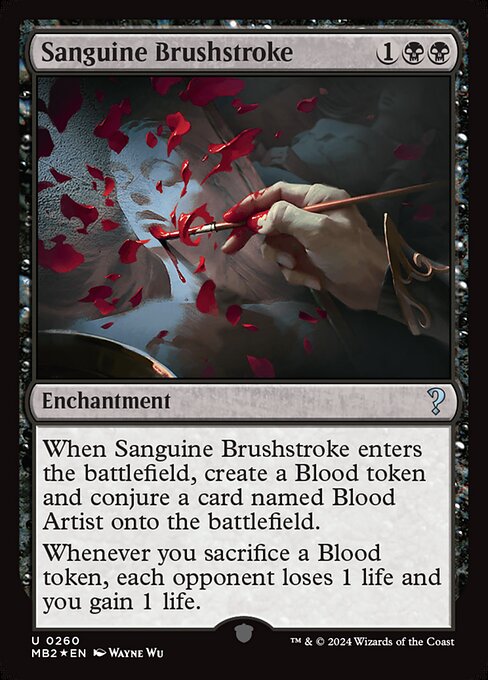
Sanguine Brushstroke
Enchantment
uncommon
When Sanguine Brushstroke enters the battlefield, create a Blood token and conjure a card named Blood Artist onto the battlefield. Whenever you sacrifice a Blood token, each opponent loses 1 life and you gain 1 life.
 Card Kingdom
 Cardmarket
Semantic Tags
Benefits from creatures dying — drain effects, death triggers, and sacrifice-for-value payoffs.
Benefits from creatures or permanents dying — death triggers, blood artist effects.
Triggers when a creature or permanent enters the battlefield. Prime blink targets.
Cards that directly win the game or threaten to end it quickly. Includes 'you win the game' effects and massive threats.
Gains you life. Relevant for lifegain-matters strategies and general survivability.
A card or token on the battlefield. See rule 110, “Permanents.”
Broadly benefits from sacrificing permanents — overlaps aristocrats but includes non-creature sacrifice.
Creates creature tokens, Treasure tokens, Food tokens, Clue tokens, or other token types.
Format Legality
Price history
Loading price history…
Printings (2)
| Set | Rarity | TCGplayer | Card Kingdom | Cardmarket |
|---|---|---|---|---|
| Mystery Booster 2#260 | uncommon | · | · | · |
| Alchemy: Innistrad#32 | rare | · | · | · |
Related Rules
If an ability would produce one or more mana of an undefined type, it produces no mana instead.
Some abilities produce mana based on the type of mana another permanent or permanents “could produce.” The type of mana a permanent could produce at any time includes any type of mana that an ability of that permanent would produce if the ability were to resolve at that time, taking into account any applicable replacement effects in any possible order. Ignore whether any costs of the ability could or could not be paid. If that permanent wouldn’t produce any mana under these conditions, or no type of mana can be defined this way, there’s no type of mana it could produce.
To “tap [a permanent] for mana” is to activate a mana ability of that permanent that includes the {T} symbol in its activation cost. See rule 605, “Mana Abilities.”
An ability that triggers whenever a permanent “is tapped for mana” or is tapped for mana of a specified type triggers whenever such a mana ability resolves and produces mana or the specified type of mana.
A replacement effect that applies if a permanent “is tapped for mana” or tapped for mana of a specific type and/or amount modifies the mana production event while such an ability is resolving and producing mana or the specified type and/or amount of mana.
If an object’s enters-the-battlefield triggered ability or replacement effect refers to X, and the spell that became that object as it resolved had a value of X chosen for any of its costs, the value of X for that ability is the same as the value of X for that spell, although the value of X for that permanent is 0. This is an exception to rule 107.3i.
The tap symbol is {T}. The tap symbol in an activation cost means “Tap this permanent.” A permanent that’s already tapped can’t be tapped again to pay the cost. A creature’s activated ability with the tap symbol in its activation cost can’t be activated unless the creature has been under its controller’s control continuously since their most recent turn began. See rule 302.6.
The untap symbol is {Q}. The untap symbol in an activation cost means “Untap this permanent.” A permanent that’s already untapped can’t be untapped again to pay the cost. A creature’s activated ability with the untap symbol in its activation cost can’t be activated unless the creature has been under its controller’s control continuously since their most recent turn began. See rule 302.6.
Rulings
Conjured cards are not tokens. Treat conjured cards just as you would treat regular cards. They can move between zones just like any other card and continue to exist for the duration of the game. At the end of the game, make sure to remove all conjured cards from your deck.
You can represent conjured cards using objects from outside the game so long as the game state remains clear and understandable to all players. You might need to get creative. For example, while a conjured card is in a public zone, you can represent it by writing on a piece of paper or using some kind of token. But if a conjured card is put into a hidden zone, you must add an object to that zone which, while face down, is indistinguishable from other cards in your deck.
To conjure a card in a game of tabletop Magic, use the Gatherer card database at Gatherer.Wizards.com to find the official text for the card you’re conjuring. Then put the appropriate conjured card into the appropriate zone.
A conjured card’s owner is the player who was instructed to conjure it.
You do not need to own an actual copy of a card in order to conjure it, and a conjured card does not need to obey format legality or deckbuilding restrictions. For example, in a game of Mystery Booster 2 Limited, Toralf’s Disciple can conjure Lightning Bolts into your deck, even though the card Lightning Bolt isn’t found in Mystery Booster 2 and isn’t normally legal in the Limited format.
Sanguine Brushstroke’s last ability triggers whenever you sacrifice a Blood token, not just when you activate a Blood token’s activated ability.