Search
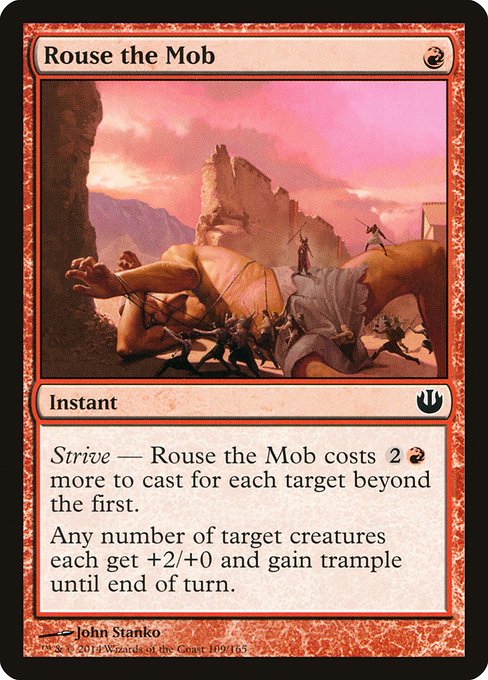
Rouse the Mob
Instant
common
Strive — This spell costs more to cast for each target beyond the first. Any number of target creatures each get +2/+0 and gain trample until end of turn.
 Card Kingdom
 Cardmarket
Semantic Tags
A keyword ability found on creature cards that allows them to be cast for an alternative cost. See rule 702.109, “Dash.”
A keyword ability that allows a spell to affect either a single target or many objects. See rule 702.96, “Overload.”
A spell or ability that gives a temporary power/toughness boost.
Slows opponents down by taxing actions or restricting what they can do.
Storm count strategies — casting many spells in a single turn for storm triggers.
Format Legality
Price history
Loading price history…
Printings (1)
| Set | Rarity | TCGplayer | Card Kingdom | Cardmarket |
|---|---|---|---|---|
| Journey into Nyx#109 | common | · | · | · |
Related Rules
Subtypes of each card type except creature and plane are always single words and are listed after a long dash. Each word after the dash is a separate subtype. Subtypes of creature cards are one or two words and are listed after a long dash. Each word or two-word phrase, as listed in rule 205.3m, is a separate subtype. Objects other than planes may have multiple subtypes. Subtypes of planes are also listed after a long dash, but may be multiple words; all words after the dash are, collectively, a single subtype.
Artifact subtypes are always a single word and are listed after a long dash: “Artifact — Equipment.” Artifact subtypes are also called artifact types. Artifacts may have multiple subtypes. See rule 205.3g for the complete list of artifact types.
Creature subtypes are usually a single word long and are listed after a long dash: “Creature — Human Soldier,” “Artifact Creature — Golem,” and so on. Creature subtypes are also called creature types. Creatures may have multiple subtypes. See rule 205.3m for the complete list of creature types.
Enchantment subtypes are always a single word and are listed after a long dash: “Enchantment — Shrine.” Each word after the dash is a separate subtype. Enchantment subtypes are also called enchantment types. Enchantments may have multiple subtypes. See rule 205.3h for the complete list of enchantment types.
Instant subtypes are always a single word and are listed after a long dash: “Instant — Arcane.” Each word after the dash is a separate subtype. The set of instant subtypes is the same as the set of sorcery subtypes; these subtypes are called spell types. Instants may have multiple subtypes. See rule 205.3k for the complete list of spell types.
Land subtypes are always a single word and are listed after a long dash. Land subtypes are also called land types. Lands may have multiple subtypes. See rule 205.3i for the complete list of land types.
Planeswalker subtypes are always a single word and are listed after a long dash: “Planeswalker — Jace.” Each word after the dash is a separate subtype. Planeswalker subtypes are also called planeswalker types. Planeswalkers may have multiple subtypes. See rule 205.3j for the complete list of planeswalker types.
Sorcery subtypes are always a single word and are listed after a long dash: “Sorcery — Arcane.” Each word after the dash is a separate subtype. The set of sorcery subtypes is the same as the set of instant subtypes; these subtypes are called spell types. Sorceries may have multiple subtypes. See rule 205.3k for the complete list of spell types.
Rulings
If a spell or ability allows you to cast a strive spell without paying its mana cost, you must pay the additional costs for any targets beyond the first.
You choose how many targets each spell with a strive ability has and what those targets are as you cast it. It's legal to cast such a spell with no targets, although this is rarely a good idea. You can't choose the same target more than once for a single strive spell.
The mana cost and mana value of strive spells don't change no matter how many targets they have. Strive abilities affect only what you pay.
If all of the spell's targets are illegal when the spell tries to resolve, it won't resolve and none of its effects will happen. If one or more of its targets are legal when it tries to resolve, the spell will resolve and affect only those legal targets. It will have no effect on any illegal targets.
If such a spell is copied, and the effect that copies the spell allows a player to choose new targets for the copy, the number of targets can't be changed. The player may change any number of the targets, including all of them or none of them. If, for one of the targets, the player can't choose a new legal target, then it remains unchanged (even if the current target is illegal).