Search
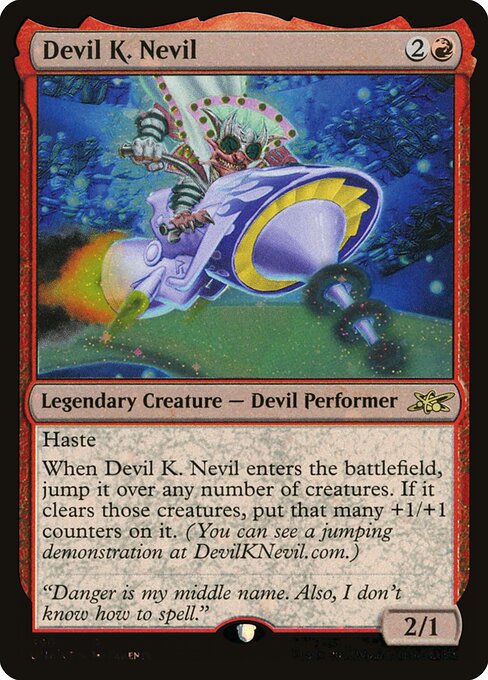
Devil K. Nevil
Legendary Creature — Devil Performer
rare
Haste When Devil K. Nevil enters, jump it over any number of creatures. If it clears those creatures, put that many +1/+1 counters on it. (You can see a jumping demonstration at DevilKNevil.com.)
2/1
 Card Kingdom
 Cardmarket
Semantic Tags
Attacks quickly and deals damage efficiently. Includes haste, double strike, first strike, prowess, and cards that grant these.
Cares about +1/+1 counters — places, moves, doubles, or benefits from counters on creatures.
A keyword ability that lets a creature ignore the “summoning sickness” rule. See rule 702.10, “Haste,” and rule 302.6.
Creatures that tap to produce mana. Llanowar Elves, Birds of Paradise, Elvish Mystic.
A card or token on the battlefield. See rule 110, “Permanents.”
Format Legality
Price history
Loading price history…
Printings (4)
| Set | Rarity | TCGplayer | Card Kingdom | Cardmarket |
|---|---|---|---|---|
| Unfinity#390 | rare | · | · | · |
| Unfinity#249 | rare | · | · | · |
| Unfinity#500 | rare | · | · | · |
| Unfinity#104 | rare | · | · | · |
Related Concepts
Related Rules
If an ability would produce one or more mana of an undefined type, it produces no mana instead.
Some abilities produce mana based on the type of mana another permanent or permanents “could produce.” The type of mana a permanent could produce at any time includes any type of mana that an ability of that permanent would produce if the ability were to resolve at that time, taking into account any applicable replacement effects in any possible order. Ignore whether any costs of the ability could or could not be paid. If that permanent wouldn’t produce any mana under these conditions, or no type of mana can be defined this way, there’s no type of mana it could produce.
To “tap [a permanent] for mana” is to activate a mana ability of that permanent that includes the {T} symbol in its activation cost. See rule 605, “Mana Abilities.”
An ability that triggers whenever a permanent “is tapped for mana” or is tapped for mana of a specified type triggers whenever such a mana ability resolves and produces mana or the specified type of mana.
A replacement effect that applies if a permanent “is tapped for mana” or tapped for mana of a specific type and/or amount modifies the mana production event while such an ability is resolving and producing mana or the specified type and/or amount of mana.
If an object’s enters-the-battlefield triggered ability or replacement effect refers to X, and the spell that became that object as it resolved had a value of X chosen for any of its costs, the value of X for that ability is the same as the value of X for that spell, although the value of X for that permanent is 0. This is an exception to rule 107.3i.
The tap symbol is {T}. The tap symbol in an activation cost means “Tap this permanent.” A permanent that’s already tapped can’t be tapped again to pay the cost. A creature’s activated ability with the tap symbol in its activation cost can’t be activated unless the creature has been under its controller’s control continuously since their most recent turn began. See rule 302.6.
The untap symbol is {Q}. The untap symbol in an activation cost means “Untap this permanent.” A permanent that’s already untapped can’t be untapped again to pay the cost. A creature’s activated ability with the untap symbol in its activation cost can’t be activated unless the creature has been under its controller’s control continuously since their most recent turn began. See rule 302.6.
Rulings
For any card involved in the jump, the card sleeve it’s in is considered part of the card.
For anything involved in the jump that’s a token, including Devil K. Nevil itself, use a Magic card-sized card as a substitute. Magic cards are the most Magic card-sized thing we can think of.
You may use any creatures on the battlefield except Devil K. Nevil itself for the jump, including your opponent’s creatures. You are limited to the number of other creatures on the battlefield for the jump attempt.
The jump is considered attempted if your hand makes contact with Devil K. Nevil and it moves. You can’t use anything other than your hand to flick Devil K. Nevil. If you’re wearing gloves (which are basically card sleeves for hands), those count as part of your hand.
In case the video doesn’t clarify what jumping Devil K. Nevil over any number of creatures means, perhaps a lengthy text explanation will help. First, place Devil K. Nevil at the edge of the table such that about half the card vertically is sticking over the edge of the table. Then take any number of creatures on the battlefield and place them side-by-side on the table in front of Devil K. Nevil. Those creature cards should be horizontal to Devil K. Nevil’s vertical from your perspective (unless they’re not cards—see below). Ideally, the first creature card should be as close to Devil K. Nevil as it can be without touching it, but if you’d like to make the jump more difficult, we’re not going to stop you. To execute the jump, flick Devil K. Nevil from underneath to cause it to fly up into the air and forward, majestically flying over the line of creatures. You can’t just flick him horizontally. Devil craves hang time. If Devil comes to rest completely past the creatures without touching any of them, it has cleared those creatures and will earn those +1/+1 counters. If it touches any of the creatures during the jump, that’s okay, as long as Devil comes to rest past the creatures, not touching any of them. All of Devil K. Nevil must be past the farthest creature for the jump to be successful. If Devil veers off to the side and doesn’t get farther than the last creature, the jump is unsuccessful, even if it comes to rest not touching any of the creatures. An unsuccessful jump has no consequences other than shame. Shame and no +1/+1 counters.
You may choose to jump over no creatures—and thus not attempt a jump—if you want. If there are no other creatures on the battlefield as the enters-the-battlefield ability resolves, Devil K. Nevil is a stunt devil without a stunt and there won’t be a jump.
If Devil K. Nevil is in a card sleeve, you may take it out of the sleeve if you’d like (assuming you own the card; ask permission if you don’t). However, no other modifications are allowed to the card. You can’t put anything into the sleeve to make it heavier, for example. You also can’t bend, fold, or do anything else to the card that would make it unplayable in your deck.