Search
Processor Assault
Sorcery
uncommon
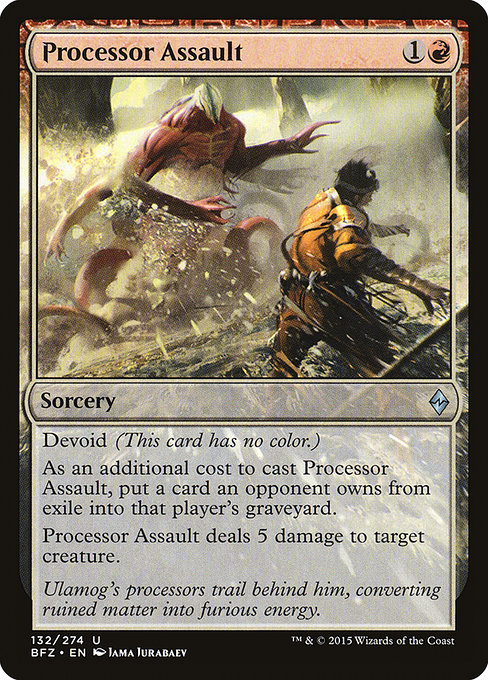
Devoid (This card has no color.) As an additional cost to cast this spell, put a card an opponent owns from exile into that player's graveyard. Processor Assault deals 5 damage to target creature.
 Card Kingdom
 Cardmarket
Semantic Tags
A spell that deals direct damage to creatures or players.
Specifically removes creatures — destroy, exile, damage, or -X/-X.
Exiles cards from graveyards or prevents graveyard interaction. Shuts down recursion, flashback, and graveyard-matters strategies.
Answers an opponent's threat by destroying, exiling, bouncing, or otherwise removing a permanent or spell.
Format Legality
Price history
Loading price history…
Printings (1)
| Set | Rarity | TCGplayer | Card Kingdom | Cardmarket |
|---|---|---|---|---|
| Battle for Zendikar#132 | uncommon | · | · | · |
Related Concepts
Related Rules
Rulings
Devoid works in all zones, not just on the battlefield.
If a replacement effect will cause cards that would be put into a graveyard from anywhere to be exiled instead (such as the one created by Anafenza, the Foremost), you can still put an exiled card into its opponent’s graveyard. The card becomes a new object and remains in exile. In this situation, you can’t use a single exiled card if required to put more than one exiled card into the graveyard. Conversely, you could use the same card in this situation if two separate spells or abilities each required you to put a single exiled card into its owner’s graveyard.
Cards with devoid use frames that are variations of the transparent frame traditionally used for Eldrazi. The top part of the card features some color over a background based on the texture of the hedrons that once imprisoned the Eldrazi. This coloration is intended to aid deckbuilding and game play.
You must put exactly one card an opponent owns from exile into that player’s graveyard to cast Processor Assault. You can’t cast it without doing so, and you can’t put multiple exiled cards into their owners’ graveyards this way.
If a spell or ability requires that you put more than one exiled card into the graveyard, you may choose cards owned by different opponents. Each card chosen will be put into its owner’s graveyard.
You can’t look at face-down cards in exile unless an effect allows you to.
Players can respond to Processor Assault only after it’s been cast and all of its costs have been paid. No one can try to remove the card from exile to stop you from casting the spell.
A card with devoid is just colorless. It’s not colorless and the colors of mana in its mana cost.
Other cards and abilities can give a card with devoid color. If that happens, it’s just the new color, not that color and colorless.
Face-down cards in exile are grouped using two criteria: what caused them to be exiled face down and when they were exiled face down. If you want to put a face-down card in exile into its owner’s graveyard, you must first choose one of these groups and then choose a card from within that group at random. For example, say an artifact causes your opponent to exile their hand of three cards face down. Then on a later turn, that artifact causes your opponent to exile another two cards face down. If you use Wasteland Strangler to put one of those cards into their graveyard, you would pick the first or second pile and put a card chosen at random from that pile into the graveyard.
If a card loses devoid, it will still be colorless. This is because effects that change an object’s color (like the one created by devoid) are considered before the object loses devoid.