Search
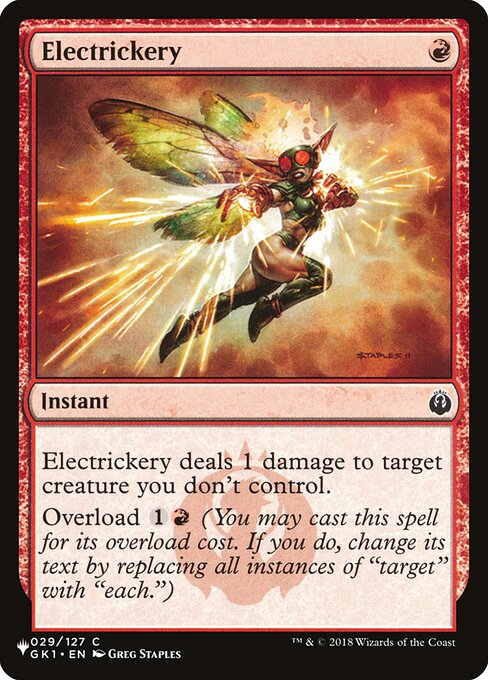
Electrickery
Instant
common
Electrickery deals 1 damage to target creature you don't control. Overload (You may cast this spell for its overload cost. If you do, change "target" in its text to "each.")
 Card Kingdom
 Cardmarket
Semantic Tags
A spell that deals direct damage to creatures or players.
Specifically removes creatures — destroy, exile, damage, or -X/-X.
A keyword ability that allows a spell to affect either a single target or many objects. See rule 702.96, “Overload.”
A keyword ability that allows a spell to affect either a single target or many objects. See rule 702.96, “Overload.”
Answers an opponent's threat by destroying, exiling, bouncing, or otherwise removing a permanent or spell.
Format Legality
Price history
Loading price history…
Printings (3)
| Set | Rarity | TCGplayer | Card Kingdom | Cardmarket |
|---|---|---|---|---|
| The List#GK1-29 | common | · | · | · |
| GRN Guild Kit#29 | common | · | · | · |
| Return to Ravnica#93 | common | · | · | · |
Related Concepts
Related Rules
Overload
Overload is a keyword that represents two static abilities that function while the spell with overload is on the stack. Overload [cost] means “You may choose to pay [cost] rather than pay this spell’s mana cost” and “If you chose to pay this spell’s overload cost, change its text by replacing all instances of the word ‘target’ with the word ‘each.’” Casting a spell using its overload ability follows the rules for paying alternative costs in rules 601.2b and 601.2f–h.
If a player chooses to pay the overload cost of a spell, that spell won’t require any targets. It may affect objects that couldn’t be chosen as legal targets if the spell were cast without its overload cost being paid.
Overload’s second ability creates a text-changing effect. See rule 612, “Text-Changing Effects.”
Rulings
If you are instructed to cast a spell with overload "without paying its mana cost," you can't choose to pay its overload cost instead.
Because a spell with overload doesn't target when its overload cost is paid, it may affect permanents with hexproof or with protection from the appropriate color.
To determine the total cost of a spell, start with the mana cost or alternative cost you're paying (such as an overload cost), add any cost increases, then apply any cost reductions. The mana value of the spell remains unchanged, no matter what the total cost to cast it was.
Note that if the spell with overload is dealing damage, protection from that spell's color will still prevent that damage.
If you don't pay the overload cost of a spell with overload, that spell will have a single target. If you pay the overload cost, the spell won't have any targets.